Book-building Process
Book Building Process
What is Book Building?
Book Building is a process used in the Initial Public Offering (IPO) of shares where investors bid for shares within a price band instead of being offered a fixed price. It helps companies discover the best price for their shares based on market demand.
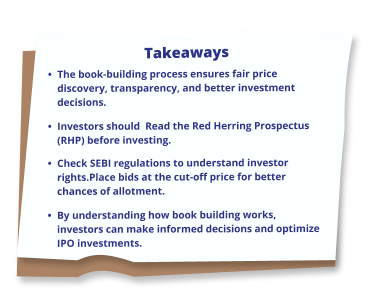
This process ensures transparency, fair price discovery, and efficient allocation of shares.
How Does the Book Building Process Work?

The book-building process involves the following key steps:
Step 1: Price Band and Red Herring Prospectus (RHP)
The company and its Book Running Lead Manager (BRLM) set a price band (e.g., ₹120-₹144 per share
A Draft Red Herring Prospectus (DRHP) is filed with SEBI, containing all issue details except the final price.
The Red Herring Prospectus (RHP) is issued before the IPO starts.
Step 2: Bidding by Investors
Investors place bids within the price band, specifying:
- Price per share
- Number of shares they wish to buy
Institutional investors, retail investors, and high-net-worth individuals (HNIs) also participate.
Retail investors can bid at the "cut-off price", meaning they will get shares at the final discovered price.

Step 3: Price Discovery and Cut-off Price Determination
Once the bidding period ends, the company and BRLM analyse the demand.
The final price, called the Cut-off Price, is determined based on the highest demand level.
All investors who bid at or above the cut-off price are allotted shares.
Step 4: Share Allotment and Refund
Investors who bid below the cut-off price do not receive shares
If an issue is oversubscribed, investors may receive fewer shares than applied for
Refunds are processed for excess bid amounts
Example of Book Building Process
Let’s assume a XYZ company offers 5,000 shares through book building with a price band of ₹120-₹144.
The cut-off price is set at ₹135, as this is the lowest price at which all shares are fully subscribed.
Investors who bid ₹135 and above receive shares.
| Price | Shares Demanded | Total Demand |
|---|---|---|
| 120 | 500 | 6500 |
| 130 | 1000 | 6000 |
| 135 | 2500 | 5000(Cut-Off) |
| 140 | 1500 | 2500 |
| 144 | 1000 | 1000 |
Regulatory Requirements for Book Building
SEBI Guidelines for Companies
The issue must be fully underwritten, ensuring all shares are sold.
The price band cap cannot exceed 20% of the floor price.
The company can revise the price band during the IPO with a mandatory 3-day extension.
Stock Exchange Regulations
The IPO must be listed on a recognized stock exchange (NSE/BSE) within 3 days after closure.
The book-building process must be transparent, with real-time online bidding records available
Anchor investors must hold shares for a lock-in period (50% for 30 days, 50% for 90 days).
Benefits of Book Building for Investors
| Benefit | Description |
|---|---|
| Market-Driven Pricing | Ensures fair price discovery based on demand. |
| Higher Transparency | Investors can see real-time bidding data. |
| Flexibility in Bidding | Retail investors can bid at the cut-off price. |
| Efficient Capital Raising | Companies get fair value for their shares, avoiding under-pricing. |