Where this fits: Part 2 decided what you need. This chapter explains the machinery you are about to use.
By the end of this chapter you will be able to
- Learn what the securities market does for the economy and for you
- Distinguish the primary market from the secondary market
- Name the main products traded and say which are suitable for a beginner
The problem the market solves
A company in Coimbatore wants to build a new factory. It needs ₹500 crore. It does not have ₹500 crore.
Meanwhile, several million households across India each have a surplus of a few thousand rupees a month that is sitting idle.
The securities market exists to connect those two facts. It is a mechanism for moving savings from people who have them to enterprises that can use them — and for giving the savers a share of the resulting returns.
Everything else in this book is a detail of how that connection is made safely.
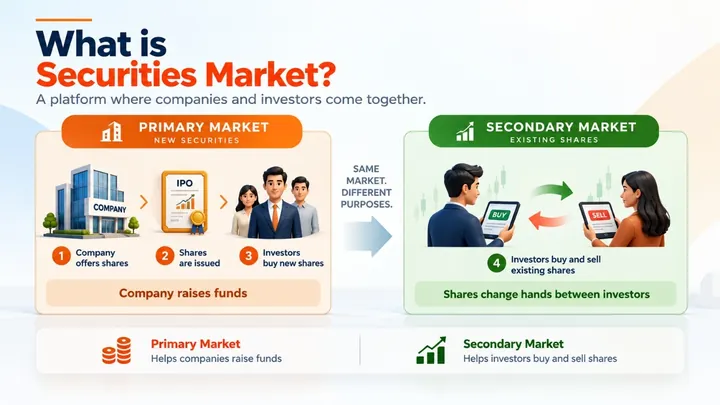
What is securities market
A security is a tradable financial instrument representing either ownership or a debt.
- If you buy an equity share, you own a small piece of the company. You share in its profits and its losses.
- If you buy a bond or debenture, you have lent money to the issuer. You are owed interest and repayment, whether or not the issuer does well.
That single distinction — owner or lender — explains most of the differences in risk and return between products. An owner can gain without limit and can lose everything. A lender’s upside is capped at the agreed interest, and their downside is limited to the borrower defaulting.
What the market does for the economy
Understanding this makes you a better investor, because it tells you what you are actually participating in.
It mobilises household savings: Small amounts from millions of households aggregate into capital large enough to build infrastructure and industry.
It enables capital formation: Companies raise long-term money for new projects, expansion and modernisation without depending entirely on bank loans.
It provides price discovery: Continuous public trading produces a visible, constantly updated price for each security, reflecting the collective judgement of all participants about its worth.
It provides liquidity: Because there is an organised market, an investor who needs money can sell without finding a private buyer. Without this, almost nobody would be willing to make a long-term investment in the first place.
It funds the government: Central and state governments raise long-term money by issuing Government Securities and Treasury Bills, funding public infrastructure without printing money.
The two segments
The securities market has two parts. They are separate but inseparable — neither works without the other.
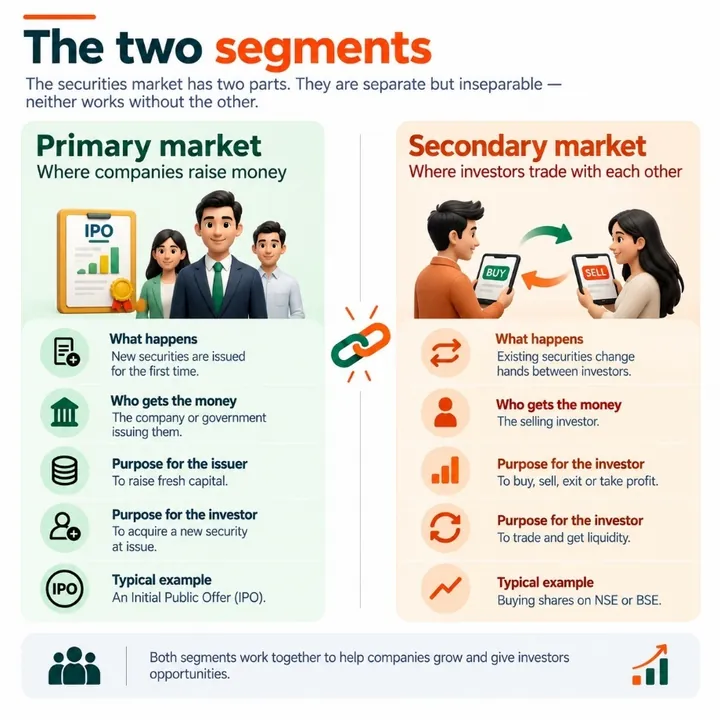
The relationship between the two is worth grasping. Nobody would subscribe to an IPO if there were no way to sell afterwards. The secondary market’s liquidity is what makes the primary market’s fundraising possible. When you buy a share on the exchange, no money reaches the company — but the existence of that market is precisely what allowed the company to raise money in the first place.
The step-by-step route in
For orientation, here is the entire practical sequence. Part 4 does each step properly.
- Have a bank account in your own name, linked to your mobile number
- Complete your KYC — a one-time identity verification
- Open the accounts you need — for mutual funds you may need nothing more; for shares you need a trading account and a demat account with a SEBI-registered intermediary
- Start with something simple and diversified — a diversified equity mutual fund or a broad index fund, rather than an individual stock tip
- Invest regularly rather than in one go
- Monitor and review, without reacting to every movement
Recap in one minute
- The securities market connects households with surplus savings to enterprises and governments that need capital.
- A share makes you an owner; a bond makes you a lender. That distinction drives risk and return.
- The primary market issues new securities and raises money for the issuer; the secondary market trades existing ones between investors.
- The main products are mutual funds, shares, bonds, ETFs, derivatives and commodities.
- Derivatives are high-risk and unsuitable for most individual investors. Beginners are better served by diversified holdings than by concentrated or leveraged positions, whichever route they use to hold them.
Check your understanding
When you buy shares of a listed company on NSE, does the company receive your money? Explain.
Show answer to question 1
No. The money goes to the investor selling you the shares. The company received money only when the shares were first issued in the primary market.Give one reason a company might prefer to raise money by issuing shares rather than taking a bank loan.
Show answer to question 2
Equity capital does not have to be repaid and carries no fixed interest obligation, so it does not create pressure on cash flow during difficult periods.Which product gives a small investor diversification most easily, and why?
Show answer to question 3
A mutual fund — it pools money from many investors, so a small amount buys a share of a portfolio holding dozens of securities.
Your action step
Visit the SEBI investor website (investor.sebi.gov.in) and spend fifteen minutes reading the section on securities market basics. Note down two things you did not know. You will use this site again.