Where this fits: Part 1 gave you money to invest. Before choosing where to put it, you need to know what it is for.
By the end of this chapter you will be able to
- Convert a vague financial wish into a SMART goal
- Classify any goal as short, medium or long term and explain why that classification decides the product
- Estimate what a goal will cost in future rupees
Investing without a goal is just gambling with extra steps
“I want to be financially secure” is not a goal. It is a mood. You cannot invest for it, because you cannot say how much is needed, by when, or how much risk is appropriate.
A goal has three parts: an amount, a date, and a purpose. Once those exist, every other decision — which product, how much monthly, how much risk — follows almost mechanically. Without them, you are choosing products by what sounds attractive, which is how people end up with a fifteen-year lock-in for a three-year need.
The SMART framework
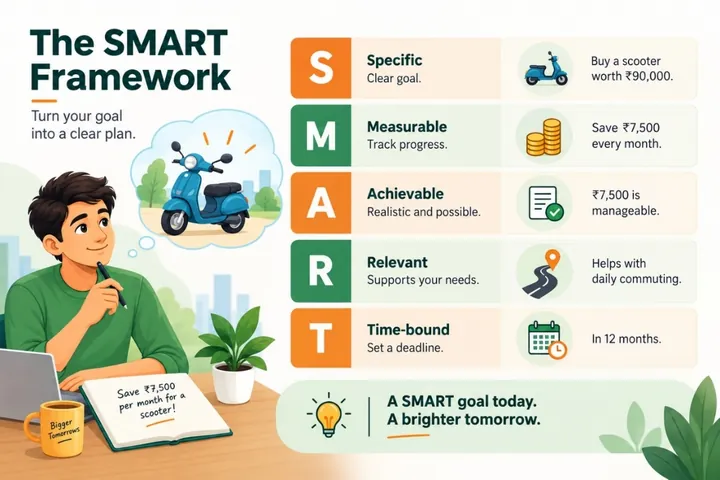
A well-formed goal is Specific, Measurable, Achievable, Relevant and Time-bound.
Take this statement:
“I will save ₹7,500 per month from my salary for the next 12 months to buy a scooter worth ₹90,000, which I need for daily commuting.”
| Letter | Element | How this goal satisfies it |
|---|---|---|
| S | Specific | A scooter costing ₹90,000 — not “a vehicle” |
| M | Measurable | ₹7,500 every month; progress is checkable each month |
| A | Achievable | Verified against actual income and expenses; ₹7,500 is genuinely available |
| R | Relevant | Needed for commuting; saves travel time and cost |
| T | Time-bound | Twelve months, with a specific end date |
Compare it with “I want to buy a scooter soon.” The second version cannot be planned, cannot be funded, and cannot be failed — which means it also cannot be achieved.
The A deserves special attention. A goal that requires ₹40,000 a month from a household with a ₹6,000 surplus is not ambitious, it is fictional, and it will be abandoned within three months, taking the person’s confidence with it. If a goal is not achievable, one of three things must change: the amount, the date, or the monthly contribution. Change one deliberately rather than letting the goal quietly collapse.
Classify every goal by time horizon
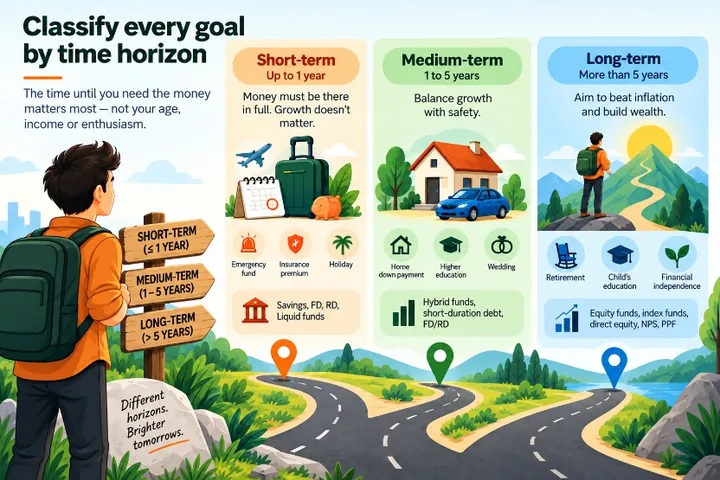
The time until you need the money is the single most important input in choosing where to keep it. Not your age. Not your income. Not your enthusiasm. The horizon.
Short-term goals — up to about 1 year
What matters: the money must be there, in full, on the date you need it. Growth is irrelevant.
Examples: an emergency fund, an annual insurance premium, a family function, a short holiday, a household appliance, next year’s school fees.
Suitable places: savings account, short-tenure fixed deposit, recurring deposit, liquid or overnight mutual funds.
Never use: equity of any kind. A market that falls 20% in the eleventh month does not care that your fee payment is due in the twelfth.
Medium-term goals — about 1 to 5 years
What matters: a balance. You want more than a savings account gives, but you cannot afford a large fall close to the date.
Examples: a home down payment, a vehicle, a postgraduate course, a wedding, a major home renovation.
Suitable places: hybrid or balanced mutual funds, short-duration debt funds, recurring deposits, fixed deposits matched to the date.
Long-term goals — more than 5 to 7 years
What matters: beating inflation over a long period. Short-term falls can be absorbed because you have time to recover from them.
Examples: retirement, a child’s higher education fifteen years away, a child’s marriage, financial independence.
Suitable places: equity mutual funds, index funds, direct equity, the National Pension System, the Public Provident Fund, and gold ETFs as a small diversifying holding — used in a mix appropriate to the goal, not any single one automatically.
Watch Out — the mismatch that causes most retail losses
Two errors, both extremely common, both caused by ignoring the horizon:
Short money in long assets. Putting next year’s fees into an equity fund because “equity gives better returns.” It does, over long periods. Over one year it may give you −18%.
Long money in short assets. Keeping a retirement fund twenty-five years away in a fixed deposit because “it’s safe.” Over twenty-five years, guaranteed low returns against 6% inflation is not safety — it is a slow, certain loss.
Match the asset to the horizon. That one discipline prevents more damage than any amount of scheme selection skill.
Costing a goal in future rupees
Inflation means your goals move. Here is how to handle that in practice.
Step 1. Find today’s cost of the goal.
Step 2. Estimate the inflation rate for that specific category.
Step 3. Compute the future cost.
Step 4. Work backwards to the monthly investment required.
Worked Example — Deepa’s daughter’s education
Deepa’s daughter is 3. The degree Deepa has in mind costs ₹8,00,000 today. She will need it in fifteen years. Education costs have been rising at around 8% a year.
Future cost: ₹8,00,000 × (1.08)¹⁵ ≈ ₹25,38,000 (approx.)
That is the real target, not ₹8 lakh. Saving to the wrong target is the most expensive planning error one can make.
What must she invest?
At an assumed 11% return a year over fifteen years, a monthly investment of roughly ₹5582 would be needed. If she waits five years and starts when her daughter is 8, with ten years left, the required monthly amount rises to roughly ₹11,696 — double, for the same goal, because she gave away the five most valuable years. (All figures illustrative. Returns are not guaranteed and actual outcomes will differ.)
Write down every goal
Most households have between four and eight goals running at once. Write them all in one table, because seeing them together is what forces honest prioritisation.
| Goal | Amount today | Years away | Inflation assumed | Future amount | Horizon class | Monthly needed |
|---|---|---|---|---|---|---|
| Emergency fund | ₹1,80,000 | 0 | — | ₹1,80,000 | Short | — |
| Car | ₹7,00,000 | 4 | 6% | ₹8,84,000 | Medium | — |
| Daughter’s degree | ₹8,00,000 | 15 | 8% | ₹25,38,000 | Long | — |
| Retirement | ₹60,00,000 | 27 | 6% | ₹2,89,00,000 | Long | — |
When the monthly amounts add up to more than your surplus — and they usually will at first — you must choose. Fund the emergency fund and retirement first, delay or shrink the discretionary goals, and revisit annually as your income grows. That conversation is uncomfortable, and it is far better to have it now than to discover the shortfall in year fourteen.
The savings-first principle, applied to goals
You have already met Income − Savings = Expenses. At the goal stage it becomes concrete: each goal gets its own automatic monthly transfer, ideally into its own separate investment, so you can see progress goal by goal.
Keeping goals separate matters more than it sounds. A single pot labelled “investments” will be raided for the nearest want. A folio labelled “Anaya’s education” is psychologically much harder to break into, and that friction is doing real work.
Reviewing goals
Goals are not set once. Review them annually, and whenever something significant changes — a marriage, a birth, a job change, a large raise, a serious illness.
At each review ask three questions:
- Is the goal still relevant? People change. A goal you no longer want should be retired, not endured.
- Has the cost changed? Actual inflation may have run faster or slower than you assumed.
- Am I on track? If not, adjust the amount, the date, or the monthly contribution — deliberately.
Recap in one minute
- A goal needs an amount, a date and a purpose. Anything less cannot be planned for.
- SMART: Specific, Measurable, Achievable, Relevant, Time-bound. The “achievable” test is the one people skip.
- The time horizon — not your age or income — decides which products are suitable.
- Cost every long-term goal in future rupees using that category’s inflation rate.
- Give each goal its own automatic monthly transfer and its own investment, and review annually.
Check your understanding
Rewrite this as a SMART goal: “I want to save for my son’s wedding.”
Show answer to question 1
For example: “I will invest ₹15,000 per month for the next 6 years to accumulate
₹13,00,000 for my son’s wedding in 2032.” Specific amount, specific monthly contribution, specific date.Rohit needs ₹3,00,000 in eighteen months for a house deposit. Name one suitable place of investment and one clearly unsuitable place, and say why.
Show answer to question 2
Suitable: a short-tenure fixed deposit or liquid fund. Unsuitable: an equity fund — an 18month horizon cannot absorb a market fall, and the money must be there in full on the date.A goal costs ₹5,00,000 today and is twelve years away. If its costs inflate at 6% a year, roughly what will it cost then? (Use the Rule of 72.)
Show answer to question 3
At 6%, costs double in about 12 years (72 ÷ 6). So roughly ₹10,00,000.
Your action step
Draw the goal table above on one sheet. Fill in every goal your household has, including the ones you have been avoiding. Compute the future amount for each long-term goal. Keep this sheet — you will use it again.