Where this fits: The last chapter gave you goals and horizons. This chapter explains the price you pay for growth.
By the end of this chapter you will be able to
- Name the main types of investment risk and say which ones diversification can remove
- Explain the risk-return relationship and why “high return, no risk” is always a lie
- Distinguish the two ways an investment can pay you
What risk actually means
In everyday speech, risk means the chance of something bad. In investing it has a more precise meaning:
Risk is the possibility that your actual return will differ from your expected return — including the possibility of losing part or all of your capital.
Note the word differ. Risk is two-sided. The same volatility that can leave you 20% down can leave you 30% up. Investors who want the second without the first are asking for something that has never existed.
The Three pillars

Every investment can be judged on three characteristics. The uncomfortable truth is that no investment scores highly on all three, and understanding the trade-offs between them is most of what investment skill consists of -
| Pillar | What it means | Example |
|---|---|---|
| Safety | Protection of the capital you put in | Government securities carry very low credit risk, though their market value still moves with interest rates |
| Liquidity | How quickly and cheaply you can turn it back into cash | A savings account is instantly liquid; real estate can take months and costs a great deal to sell |
| Return | Income and growth from the investment | Equity may deliver high long-term returns, with correspondingly high short-term variability |
A savings account gives you safety and liquidity, and almost no return. Real estate may give return, with poor liquidity. Equity may give return and reasonable liquidity, with no safety in the short run.
You choose your position among these three based on the goal and its horizon — which is exactly why goals came first.
The risk-return relationship
The core principle is unglamorous and absolute:
- Higher potential return generally requires accepting higher risk
- Lower risk generally means accepting lower return
There is no product that escapes this. If someone offers you equity-like returns with fixed deposit safety, one of three things is true: they have misunderstood the product, they are misrepresenting it, or it is a fraud. The third case is more common than most people expect.
Four principles follow from this.
There is no such thing as a risk-free investment: Even a government bond, which has effectively no credit risk, has interest rate risk — its market price falls when rates rise. Even cash in a locker has inflation risk. You do not get to avoid risk; you only get to choose which risk you take.
Risk and return are a trade-off, not a menu: You cannot select high return and decline high risk. Chasing the first means accepting a wider range of outcomes, including bad ones.
Risk cannot be eliminated, but it can be managed: Diversification, asset allocation, matching horizon to product, and staying invested through cycles all reduce the impact of risk without pretending to abolish it.
Suspicion should rise with promised returns: When someone promises a return well above what regulated markets typically produce, the correct response is not excitement but investigation.
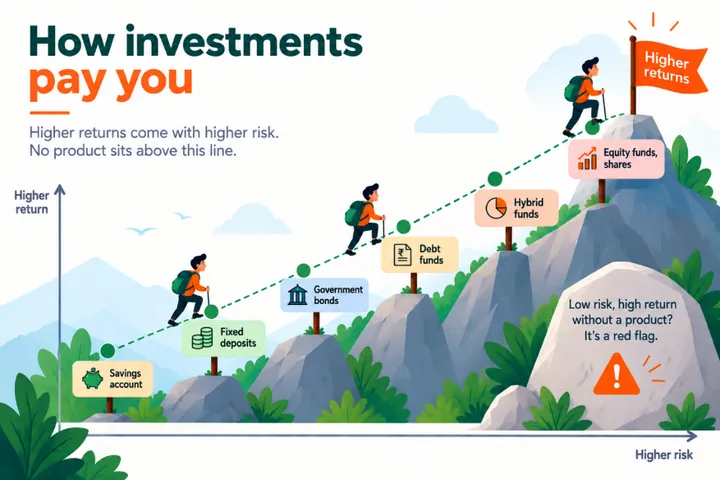
Figure 7 No product sits above this line. Anything advertised as high return with low risk is sitting in the empty space above it — which is the single most reliable sign of a fraud.
The main types of risk
| Risk | What it is |
|---|---|
| Market risk (systematic risk) | The risk from factors affecting the whole market or economy — recessions, wars, policy shocks, pandemics. It affects nearly all securities together. |
| Unsystematic risk | Risk specific to one company or industry — a factory fire, a fraud, a regulatory ban on a product, a failed drug trial. |
| Inflation risk | Also called purchasing power risk. The risk that your returns will not keep pace with rising prices, so you gain rupees and lose value. |
| Interest rate risk | The risk that changes in market interest rates alter the value of fixed-income securities. When interest rates rise, existing bond prices fall. |
| Liquidity risk | The risk that you cannot buy or sell quickly at a fair price, so you are forced either to wait or to accept a worse price. |
| Business risk | The risk that a specific company’s operations deteriorate or cease due to operational, market or financial problems. |
| Credit or default risk | The risk that a borrower — a company issuing a bond, for instance — fails to pay interest or repay principal. |
| Volatility risk | The risk arising from price fluctuation itself. Prices that swing widely may force you to sell at a bad moment or panic you into doing so. |
| Currency risk | The risk of loss from exchange rate movements when you hold investments denominated in a foreign currency. |
| Concentration risk | The risk from holding too much of one thing — one stock, one sector, one asset class, or your employer’s shares alongside your salary. |
The one distinction that matters most
The most useful way to group these is by whether diversification helps reduce risk.
Systematic risk affects the whole market. Market risk, inflation risk, interest rate risk and currency risk are largely systematic.
You cannot diversify it away — owning fifty different stocks does not protect you from a market-wide crash, because they all fall together. You manage systematic risk through asset allocation (mixing equity with debt and gold) and through time horizon (staying invested long enough to recover).
Unsystematic risk affects one company or one sector. Business risk, credit risk and concentration risk are largely unsystematic. This risk can be very substantially reduced by diversification — if one company in a portfolio of fifty collapses, you will not lose 100%.
Some risks straddle both. Volatility can arise from market-wide events or company-specific ones. Liquidity can dry up in a single security or across an entire market in a crisis.
Watch Out — the risk you cannot see is usually concentration
An employee holding a large block of their own employer’s shares has stacked their salary, their job security and their investments on a single company. If the company fails, all three go at once. The same applies to a household whose wealth is entirely in one city’s property market, or one sector’s stocks. Concentration risk is comfortable — you feel you understand what you own — and that comfort is exactly what makes it dangerous.
Measuring risk: two numbers worth knowing
You do not need to compute these, but you will see them and should know what they mean.
Standard deviation measures how widely returns have varied around their average. A fund with a standard deviation of 18% has historically moved much more, in both directions, than one with 6%. It is the most common numerical proxy for volatility.
Risk-adjusted return asks how much return you earned per unit of risk taken.
A common form is:
Risk-adjusted return = Return − Risk-free rate
Standard deviation
Two funds may both have returned 14%. If one did it with half the volatility, it delivered a better outcome for the same result — because the calmer path is far easier to stay invested in, and staying invested is what actually produces returns.
How investments pay you
An investment returns money to you in exactly two ways, and it is worth being clear about which one you are relying on.
| Type | What it is | Examples |
|---|---|---|
| Current income | Money received at intervals while you continue to hold the investment | Interest from fixed deposits and bonds; dividends from shares; distributions from mutual funds |
| Capital appreciation | The gain when the value of the investment rises and you sell it | Buying a share at ₹50 and selling at ₹65 |
Worked Example — capital appreciation
An investor buys 100 shares of XYZ Ltd at ₹50 each, paying ₹5,000 in total.
The price rises to ₹65. The investor sells all 100 shares and receives ₹6,500.
Gain = ₹6,500 − ₹5,000 = ₹1,500, or ₹15 per share. This is capital appreciation, also called a capital gain.
Note two things this example leaves out, which the real world does not: brokerage, statutory charges and taxes reduce the gain, and the price could equally have fallen to ₹40 per share.
Different goals want different mixes. A retired person living off a portfolio wants current income. A thirty-year-old building a corpus wants capital appreciation and should generally reinvest any income received. This distinction returns later, when we compare Growth plans with IDCW plans in mutual funds.
Real return, one more time
It is worth repeating the real return formula here, because it is the point at which risk and inflation meet. The shortcut version is:
Real return = Nominal return − Inflation rate
The exact formula — [(1 + Nominal return) ÷ (1 + Inflation rate)] − 1, set out in Chapter 3 — always gives a slightly lower figure than the subtraction. Use it whenever the result is going to be compounded over many years; for the judgement being made here, the shortcut is enough.
A “safe” investment returning 5.5% against 6% inflation has a negative real return. It has not protected your money; it has lost it slowly with a guarantee attached. When people say that avoiding risk is itself risky, this is the arithmetic they mean.
Recap in one minute
- Risk is the possibility that actual returns differ from expected returns, in both directions.
- Safety, liquidity and return: you can have two, never all three at their best.
- Higher potential return requires accepting higher risk. Any offer that denies this should be investigated, not accepted.
- Systematic risk affects everything and cannot be diversified away; unsystematic risk is company-specific and largely can be.
- Investments pay you through current income or capital appreciation. Know which one you are depending on.
Check your understanding
A friend describes a scheme offering “3% per month, fully guaranteed, no risk.” Using this chapter, give two reasons to be sceptical.
Show answer to question 1
First, no regulated investment produces 36% a year with certainty — the risk-return relationship makes it impossible. Second, guaranteed returns in the securities market do not exist, and anyone offering them is either misrepresenting or defrauding.Which of these can diversification reduce: a factory fire at one company, a nationwide recession, a fraud at one company, a rise in interest rates?
Show answer to question 2
Diversification reduces the factory fire and the company fraud (unsystematic, company specific). It does not reduce the recession or the interest rate rise (systematic, market wide).An FD returns 6.5%. Inflation is 5.8%. What is the real return, and what does it tell you?
Show answer to question 3
0.7%. It tells you the investment is barely maintaining purchasing power — the nominal return looks respectable but the real gain is minimal.
Your action step
List everything you currently own that has any financial value — deposits, insurance policies with a savings element, gold, any shares or funds, provident fund, and any property other than the home you live in. Next to each, write which of the three pillars it serves best and which risk it is most exposed to. Most people find their list is heavily concentrated in one pillar. You will use this list in the next chapter.