Where this fits: The last chapter showed that some risk can be reduced without giving up return. This chapter is how.
By the end of this chapter you will be able to
- Name the major asset classes and what each is good at
- Explain the difference between diversification and asset allocation
- Build an outline allocation for your own goals and life stage
Asset classes
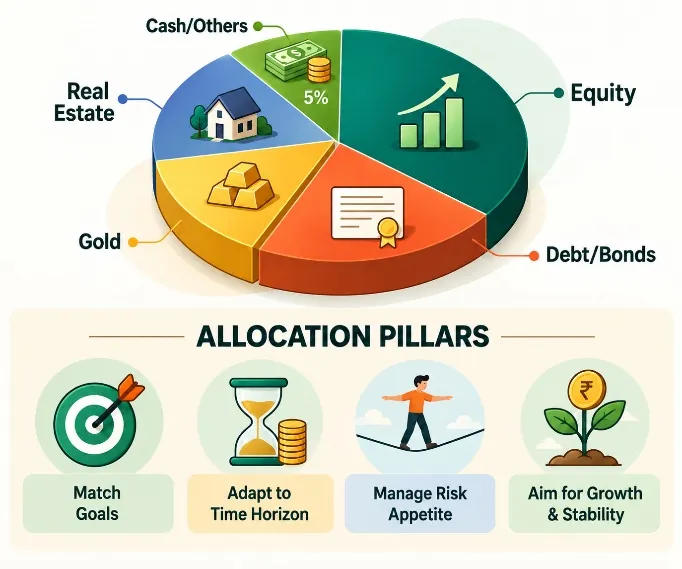
An asset class is a category of investments that share similar characteristics, risk-return behaviour and response to economic conditions.
| Asset class | What it is good at | What it is bad at | Main risks |
|---|---|---|---|
| Equity (shares, equity funds) | Long-term growth well above inflation | Short-term stability | Market, business, volatility |
| Debt (bonds, deposits, debt funds) | Predictable income, capital stability | Beating inflation over long periods | Interest rate, credit, inflation |
| Gold | Holding value in crises and inflationary periods | Producing any income | Price volatility, storage, no yield |
| Real estate (other than your own home) | Long-term appreciation and rental income | Liquidity, divisibility | Liquidity, concentration, regulatory |
| Cash and equivalents | Immediate availability and certainty | Growth of any kind | Inflation |
Gold appears in the table as the commodity most Indian households already own. It belongs to a wider class — energy, base metals and agricultural goods — which trades as derivatives on SEBI-regulated commodity exchanges. That market is described in Part 5.
The single most important property of asset classes is this: they do not all move together. When equity markets fall sharply, government bonds often hold their value or rise. Gold has frequently risen during periods of financial stress and currency weakness. That imperfect correlation is the entire engineering principle behind everything in this chapter.
Diversification
Diversification means spreading your money so that no single asset, company, sector or event can seriously damage your overall position.
It operates at several levels, and most people stop at the first one:
- Across asset classes — equity and debt and gold, not only one
- Across securities within a class — many companies, not one
- Across sectors — banking, information technology, pharmaceuticals, energy, consumer goods, not one sector
- Across market capitalisations — large, mid and small companies
- Across issuers within debt — government and multiple corporate issuers
- Across time — investing regularly rather than all at once
What diversification does: it reduces unsystematic risk substantially, so that one company’s failure is an inconvenience rather than a catastrophe.
What diversification does not do: it does not protect you from a market-wide fall, and it does not maximise returns. A diversified portfolio will always contain something that is underperforming — that is not a flaw in the portfolio, it is the portfolio working correctly. The person holding only the single best-performing asset of the last three years is not skilled; they are exposed, and they will find out when that asset turns.
Watch Out — more funds is not more diversification
Owning nine equity mutual funds is not nine times the diversification of owning one. If they are all large-cap funds, they hold substantially the same thirty companies, and you have paid nine expense ratios for one portfolio, made rebalancing harder, and created a paperwork burden. Diversification is about owning different things, not many things. For most households, three to five well-chosen funds across asset classes is ample.
Asset allocation
Asset allocation is deciding what proportion of your money goes into each asset class. It is the most consequential decision you will make, and it deserves more thought than scheme selection — which is where most people spend their attention instead.
The reason is straightforward. Whether you hold 70% equity or 30% equity will swing your outcome far more, over a decade, than whether you picked the second-best or the fifth-best large-cap fund.
Allocation is driven by three things:
Your goal’s time horizon: The short, medium and long classification, applied directly.
Your risk capacity: How much loss you can afford — a function of income stability, dependants, existing wealth, insurance and how far away the goal is. This is objective.
Your risk tolerance: How much loss you can sleep through. This is psychological, and it is the constraint that actually binds. A portfolio that is theoretically optimal but that you abandon in the first bad year is worse than a conservative one you stick with.
Allocation by goal horizon
| Horizon | Priority | Indicative approach |
|---|---|---|
| 0–1 year | Capital safety and liquidity | Cash, savings account, liquid funds, short FDs |
| Horizon | Priority | Indicative approach |
| 1–5 years | Balance of growth and protection | Hybrid funds, short-duration debt funds, RDs, FDs |
| 5–7+ years | Inflation-beating growth | A diversified mix with meaningful equity exposure and a small gold allocation, tapering the equity as the goal approaches |
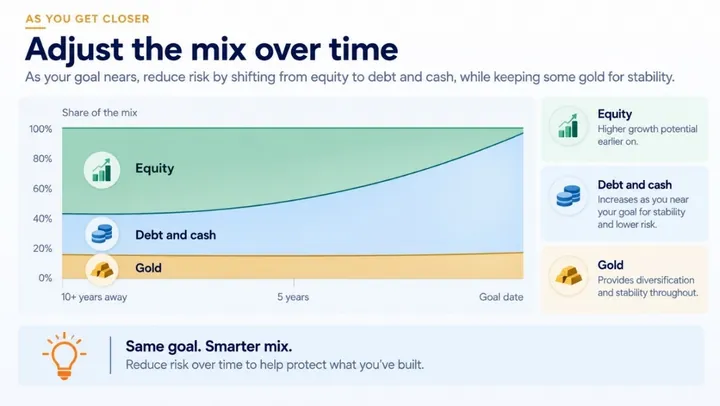
Note that “long horizon” does not mean “all equity, automatically.” It means equity exposure appropriate to the goal, the person and their capacity — and it means reducing that exposure as the date approaches. The mechanism for that taper is covered later.
Figure 8 A long horizon does not mean all equity forever. It means equity exposure suited to the horizon, tapering as the goal date approaches, with a small gold allocation held throughout. Shape is indicative, not a prescription.
Where gold fits
Gold appears in every allocation table in this chapter, and as the band running along the foot of the figure above. It is worth saying plainly why, because it is the asset most often either ignored altogether or bought far too much of.
Gold is held for diversification, not for growth: Over long periods equity has produced better real returns, and gold produces no income at all — no interest, no dividend, no rent. What it does is behave differently from equity. It has frequently risen during periods of financial stress, sharp currency weakness and high inflation, which tend to be the same periods in which equity is falling. A holding that rises while the rest of the portfolio falls makes the fall shallower, and a shallower fall is one you are more likely to sit through.
That argument supports a small allocation, not a large one:
- A working range is 5–10% of the portfolio: for most investors, which is the range used in the tables in this chapter. Below about 5% it is too small to change the outcome; much above 10% and you are making a large bet on an asset that produces nothing.
- Hold it steadily rather than tactically: Gold is useful because it was already there when the crisis arrived, not because it was bought during one. By the time the case for gold is obvious, the price already reflects it.
- Jewellery is not an investment holding: Making charges, purity uncertainty and the difficulty of selling at a fair price all work against you. For an allocation, gold ETFs or gold mutual funds are cleaner: transparently priced, sold in a day, with nothing to store or insure.
One difference from equity is worth noting. Gold’s share does not usually need to taper as the goal date approaches, because it is already acting as a stabiliser rather than a growth asset. That is why it appears in the figure above as a constant band rather than a shrinking one, and why a small gold holding appears at every life stage in the tables that follow, usually shown bundled together with cash.
Age-based rules of thumb
Two shortcuts are widely quoted. Treat them as conversation-starters, not prescriptions. Neither is prescribed or endorsed by any regulator.
The Rule of 100: Equity allocation ≈ 100 − your age. A 30-year-old holds about 70% equity, a 55-year-old about 45%.
Bogle’s rule of thumb: Hold a debt percentage roughly equal to your age. A 40-year-old holds about 40% debt and 60% equity.
Their virtue is that they capture something real — risk capacity generally falls as the horizon to retirement shortens. Their flaw is that they ignore everything else: a 55-year-old with a pension, no dependants and a paid-off house has far greater risk capacity than a 35-year-old supporting three people on an insecure income. Use the rule as a starting point and then adjust for your actual situation.
Life-stage allocation
A more realistic framing looks at what is happening in your life rather than just your age.
| Life stage | Characteristics | Indicative mix | Focus |
|---|---|---|---|
| Accumulation — 20s and 30s | Long horizon, few dependants, capacity to absorb volatility, income likely to rise | 70–80% equity, 15–20% debt, 5– 10% gold/cash | Building the habit and the corpus; diversified equity funds, index funds, NPS, PPF |
| Transition — 40s | Peak earnings, peak responsibilities — children’s education, home loan, ageing parents | 50–60% equity, 30–40% debt, 10% gold/cash | Protecting what has accumulated while still growing; hybrid funds, corporate bonds |
| Pre-retirement and retirement — 50s and 60s+ | Short horizon, capital preservation, need for regular income | 15–30% equity, 50–60% debt, 10– 30% gold, cash and liquid | Income and safety; GSecs, SCSS, deposits, systematic withdrawal plans, annuities |
(Indicative only. Your own circumstances should override any table.)
Even in retirement, some equity exposure is usually appropriate. A 65-year-old may have a twenty-five year horizon, and a portfolio with no growth assets at all will be steadily eroded by inflation over that period. The mistake at both ends of life is to think in terms of “safe” and “risky” rather than in terms of horizon.
Risk-profile allocation
| Profile | Description | Indicative mix |
|---|---|---|
| Conservative | Capital safety is the priority; large falls are unacceptable | 70–75% debt and cash, 20–25% equity, 5% gold |
| Moderate | Wants growth but with meaningful stability | 50% equity, 40% debt, 10% gold or cash |
| Aggressive | Seeks maximum long-term growth, accepts large short-term falls | 70–80% equity, 20–30% debt and gold |
Strategic and tactical allocation
Strategic allocation sets a long-term target mix — say 60% equity, 30% debt, 10% gold — and returns to it periodically regardless of market conditions. It is deliberately unexciting, and for most individual investors it is the right approach.
Tactical allocation temporarily shifts the mix to take advantage of what the investor or fund manager believes are market opportunities. It requires skill, discipline, and a willingness to be wrong publicly. Most individual investors who attempt it are in fact reacting to recent news, which is usually the worst available signal.
Rebalancing
Left alone, your allocation drifts. If equity rises 30% and debt rises 6%, a portfolio that started at 60:40 will end the year at roughly 65:35 — more aggressive than you chose, at precisely the moment when equity has become more expensive.
Rebalancing means selling some of what has grown and buying more of what has not, to return to your target percentages.
Rebalancing feels wrong every single time. You are selling your winners and buying your laggards. That discomfort is a feature, not a bug: it is a mechanical rule that forces you to sell high and buy low, at times when your instincts would do the opposite.
How often: annually is sufficient for most people. Some investors use a threshold instead — rebalance only when an asset class drifts more than five percentage points from target. Either works. Rebalancing monthly does not improve outcomes and generates costs and tax.
Also rebalance after major life events — marriage, a child, a job change, an inheritance, a serious illness — because your risk capacity has changed, not just your percentages.
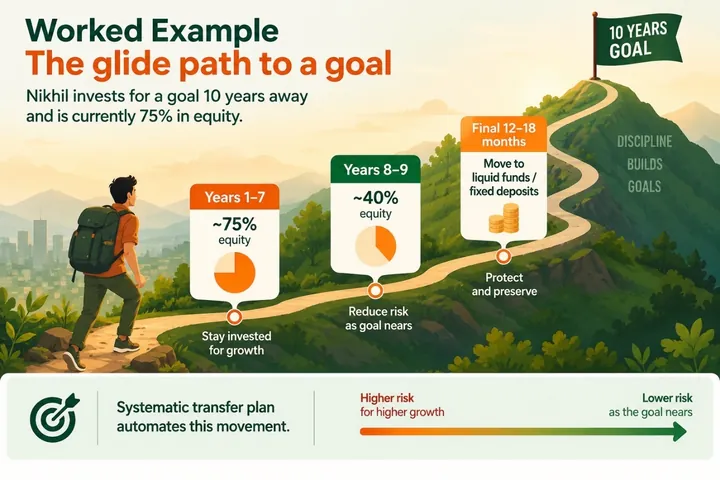
By the target date, essentially none of the money is exposed to market movement. He has captured most of the growth of the long period and removed the risk of a 25% fall arriving in the final year — which is the single event most capable of destroying a decade of good work. The Systematic Transfer Plan, explained later, automates exactly this movement.
Recap in one minute
- Asset classes behave differently in the same conditions; that is what makes mixing them useful. Equity, debt, gold and cash are the four most households need.
- Diversification reduces company-specific risk. It does not protect against market-wide falls and does not maximise return.
- Asset allocation — the split between classes — matters more than which scheme you pick.
- Allocation is driven by horizon, risk capacity and risk tolerance. Age-based rules are starting points, not answers.
- Rebalance about once a year, and glide out of growth assets as a goal approaches.
Check your understanding
Explain the difference between diversification and asset allocation in one sentence each.
Show answer to question 1
Diversification is spreading money so no single holding can seriously damage you. Asset allocation is deciding the proportion in each asset class.A portfolio targeted at 60% equity has drifted to 70% after a strong year. What does rebalancing require, and why does it feel wrong?
Show answer to question 2
Rebalancing requires selling equity and buying debt to return to 60%. It feels wrong because you are selling what has done well and buying what has not — which is exactly why it works as a discipline.Why is holding eight large-cap equity funds not the same as being diversified?
Show answer to question 3
Because eight large-cap funds hold substantially the same companies. You have paid eight expense ratios for approximately one portfolio. Diversification means owning different things, not many things.
Your action step
Take the list of everything you own from the last chapter. Group each item into equity, debt, gold, real estate or cash — counting only property you do not live in — and calculate what percentage of your total each class represents. Compare that with the life-stage table. Almost everyone finds a surprise. Write down the one change that would move you closest to where you should be.