Where this fits: A share has to be created before it can be traded. This chapter covers the moment of creation — when a company sells shares to the public for the first time and the money actually reaches the business.
By the end of this chapter you will be able to
- Explain what an IPO is and what the different types of issue mean
- Apply for an IPO through ASBA and UPI, and understand what is happening to your money
- Judge an IPO on something other than expectations of listing-day gains
What the primary market does
The primary market is where securities are issued for the first time. A company sells new shares, and the money goes to the company — to fund expansion, repay debt, or provide an exit to existing shareholders.
This is the point at which savings genuinely become capital. When you buy on the secondary market, you are buying from another investor. When you subscribe to a fresh issue, you are financing the business.
Types of issue
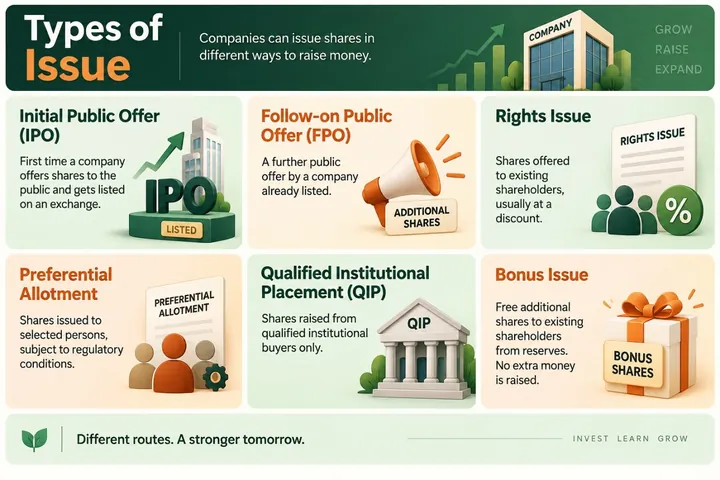
Fresh issue and offer for sale
Within an IPO or FPO, the shares being sold can come from two places, and the distinction matters a great deal.
Fresh issue: New shares are created and sold. The money goes to the company and can be used for expansion, new plants, repaying debt or working capital. The company grows.
Offer for Sale (OFS): Existing shareholders — promoters, early investors, private equity funds — sell their existing shares. The money goes to those selling shareholders, not to the company. The company receives nothing and its business is unchanged.
Most issues are a mix. Read the issue document to see the split.
Watch Out — read who is selling and why
An IPO that is entirely an Offer for Sale is not raising money for growth. It is an exit for existing owners.
That is perfectly legitimate — early investors are entitled to sell, and it is how venture capital works. But it should shape how you read the issue. People who know the business best have decided that this price is a good one at which to sell. You are on the other side of that trade. It is worth asking why they are selling now, at this valuation.
The Draft Red Herring Prospectus
Before a public issue, the company files a Draft Red Herring Prospectus (DRHP) with SEBI. It is a detailed disclosure document containing:
- What the company does and how it makes money
- Audited financial statements for prior years
- Details of promoters, management and shareholding
- Risk factors — a mandatory, detailed listing
- The objects of the issue — precisely what the money will be used for
- Pending litigation and regulatory actions
- Industry background and competition
SEBI reviews it and issues observations. The company then files the final prospectus with the price band.
Two things to understand about SEBI’s role, because they are widely misunderstood:
SEBI does not approve the company as an investment: It checks that the required disclosures have been made. A company can make full and accurate disclosures and still be a poor investment.
SEBI does not vet or approve the price: Since 1992, issuers price their own shares. The market decides whether the price is justified — and it is entirely possible for an issue to be priced at a level from which it falls and does not recover.
The DRHP is long. If you read only two sections, read Risk Factors and Objects of the Issue. Both are freely available on SEBI’s website and the merchant banker’s website.
How to apply
ASBA — Application Supported by Blocked Amount
ASBA is the mechanism that made IPO applications safe. Instead of sending money to the company and waiting weeks for a refund if you receive no allotment, the application amount is blocked in your own bank account.
- The money never leaves your account during the application period
- It continues to earn whatever interest your account pays
- If you are allotted shares, only the allotted amount is debited
- If you receive no allotment, or a partial one, the block is simply released — no refund process, no waiting, no cheque
ASBA is mandatory for public issue applications. Before it existed, refund delays were among the largest categories of investor complaint.
UPI in ASBA
Retail investors may apply using UPI integrated with ASBA, up to the prescribed limit. The process:
- Choose the issue on your broker’s app, the exchange platform, or your bank’s net banking
- Enter your bid — quantity in lots, and price (or select “cut-off,” meaning you accept whatever final price is determined within the band)
- Enter your UPI ID: Use only a UPI ID linked to a bank account in your own name
- Approve the mandate: in your UPI app. This is the block instruction — read it carefully and check the amount before approving
- The amount is blocked: in your account until allotment
- Allotment is finalised: If oversubscribed, retail allotment is typically by lottery for one lot each
- Debit or release: Allotted amount debited; the rest released
- Shares credit to your demat account, and listing follows — under the current framework, generally within T+3 working days of issue closure
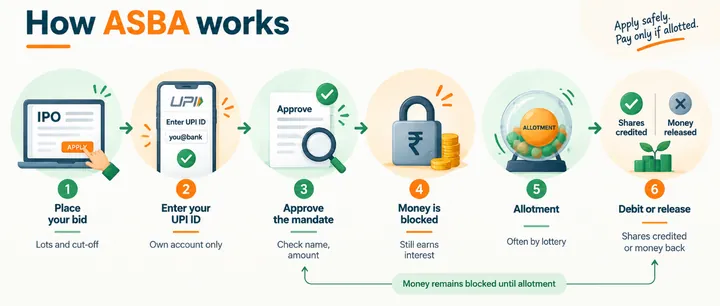
Figure 13 Under ASBA the money never leaves your account during the application, and keeps earning interest. Read the mandate before approving it: check the issue name and the exact amount.
Watch Out — the UPI mandate scam
Fraudsters send UPI collect requests dressed up as IPO applications, or ask you to “approve a mandate to confirm your allotment.” The rules are absolute:
- A genuine IPO mandate is a block, not a payment - Read the request. If it says “pay,” it is not an IPO mandate.
- Approve a mandate only in your own UPI app, immediately after you yourself placed a bid. Never one that arrives unprompted.
- Nobody ever needs your UPI PIN to give you money. Entering a PIN authorises money to leave your account. There is no exception to this, ever.
Judging an IPO
Most retail interest in IPOs is about listing-day gains — buying at the issue price and selling immediately at a premium. Sometimes that works. It is not investing, and it is not reliable.
If you are considering an IPO as an investment, look at:
The business — What does it sell, to whom, and why will it keep working?
The financials — Revenue and profit trajectory over several years, debt levels, cash flow. Be alert to a company whose profits appeared only in the year before listing.
The valuation — Compare its pricing to already-listed peers on the usual measures. An issue priced far above comparable listed companies requires justification.
The objects of the issue — Expansion is a better use than repaying promoter loans.
The offer-for-sale proportion — As discussed above.
The risk factors — Read them. They are written by the company’s own lawyers and are usually more candid than anything in the marketing.
Grey market chatter: ignore it entirely — The “grey market premium” is an unofficial, unregulated indication with no legal standing, no reliable source, and every incentive for manipulation by those who profit from generating interest.
SME IPOs
Small and medium enterprises can list on dedicated SME platforms of the exchanges, with lighter eligibility requirements than the main board.
Features:
- Smaller issue sizes
- Much larger minimum application size — The minimum application amount for an SME IPO in India is not less than ₹2,00,000 for individual retail investors, deliberately set to restrict participation to investors who can bear the risk
- Trading in fixed lot sizes rather than single shares
- Migration to the main board is possible after meeting prescribed criteria Risks, stated plainly:
- Low liquidity - There may be very few buyers when you want to sell.
- Concentration - Many SMEs depend on a small number of customers, a single product, or one promoter.
- Limited public information - Less analyst coverage and less scrutiny.
- Higher volatility, with prices capable of moving sharply on small volumes.
- Susceptibility to manipulation - Low float and low liquidity are precisely the conditions in which price manipulation is easiest.
SEBI has progressively tightened the SME framework — strengthening eligibility criteria, tightening disclosure and monitoring of issue proceeds, applying restrictions on promoter shareholding release, and increasing surveillance of price movements after listing — in response to observed instances of inflated valuations and manipulation.
The plain guidance for a reader of this book: SME IPOs are not a beginner’s product. The higher minimum application is itself a signal about who the segment is designed for.
Follow-on Public Offer
An FPO is a public issue by a company that is already listed.
Why a company does it: To raise further capital for expansion, to reduce debt, to meet minimum public shareholding requirements, or to allow existing shareholders to sell.
How it differs from an IPO: There is a crucial advantage — the company already has a market price and a public track record. You are not guessing at a valuation with no reference point; you can compare the offer price with the prevailing market price and with the company’s actual performance since listing.
FPOs are commonly priced at a small discount to the market price to attract subscription. Note that a fresh issue in an FPO increases the number of shares outstanding, which dilutes existing shareholders’ proportional ownership unless they subscribe.
The application process — ASBA, UPI, bidding within a price band — is the same as for an IPO.
Recap in one minute
- The primary market issues new securities; money from a fresh issue goes to the company, money from an offer for sale goes to selling shareholders.
- The DRHP is the real source of information. Read Risk Factors and Objects of the Issue at minimum.
- SEBI checks disclosure. It does not approve the company or vet the price.
- ASBA blocks money in your own account; UPI mandates for IPOs are blocks, never payments, and never require your PIN to receive money.
- SME IPOs carry low liquidity, high volatility and manipulation risk, and are not a beginner’s product.
Check your understanding
In an IPO that is 100% offer for sale, who receives your money, and what should that tell you?
Show answer to question 1
The selling shareholders, not the company. It should tell you that the people who know the business best consider this price attractive to sell at — and you are on the other side of that trade.Why does ASBA protect an investor better than the old system of sending a cheque with the application?
Show answer to question 2
Because the money stays blocked in your own bank account and is debited only if shares are allotted. There is no refund process, no delay, and the money continues to earn interest meanwhile.A message says “approve this UPI mandate to receive your IPO allotment.” What is wrong with it?
Show answer to question 3
A UPI mandate is a block, not a payment, and it is only ever generated after you place a bid. Nobody needs a mandate approval or your PIN to send you shares or money. It is a fraud attempt.
Your action step
Find the DRHP of any recent IPO on SEBI’s website. Read the Risk Factors section only. Note how many risks are disclosed and whether any would have changed your view. This is the section almost nobody reads and the one written to be read.