Where this fits: Once a company’s shares are listed, they change hands between investors and the company is no longer involved. This chapter is about doing that yourself — and about being honest regarding whether you should.
By the end of this chapter you will be able to
- Explain what happens between placing an order and owning a share
- Read an index and say what it does and does not tell you
- State the difference between investing and trading, and which one you are doing
A one-line reminder
An equity share makes you a part-owner: last in the queue, unlimited upside, no promise of price or dividend. That was established earlier. This chapter is about the machinery of buying and selling one.
How the secondary market works
The secondary market is where shares already in existence change hands between investors. The company receives nothing; it is simply a marketplace of buyers and sellers.
Here is what actually happens when you buy.
- You place an order through your broker’s app or website, specifying the security, the quantity and the price condition.
- The broker routes it to the exchange - NSE or BSE.
- The exchange matches it with a corresponding sell order, using price-time priority — best price first, and among equal prices, whoever was there first.
- A trade is executed. You do not know who the seller is, and you do not need to.
- The clearing corporation guarantees settlement, becoming buyer to the seller and seller to the buyer.
- Settlement occurs on a T+1 basis — generally one working day after the trade date. Your money is debited and the shares are credited to your demat account.
- You receive a contract note from your broker within the prescribed time, itemising everything.
The whole sequence takes seconds for the trade and a day for the settlement, and involves no trust in any counterparty. That is the achievement of the depositories and the clearing corporation.
Order types
| Order type | What it does | When to use it |
|---|---|---|
| Market order | Executes immediately at the best available price | When execution matters more than price. Risky in illiquid or volatile stocks |
| Limit order | Executes only at your specified price or better | Almost always preferable. You control the price you pay |
| Stop-loss order | Triggers a sell if the price falls to a set level | Limiting downside on a position, mainly used by traders |
For most investors, a limit order is the sensible default. A market order in a thinly traded stock can execute at a price materially worse than the one you saw on screen.
Settlement and the UPI block mandate
Under T+1 settlement, trades settle one working day after execution. Pay-in and pay-out of funds and securities are handled through the clearing corporation, which ensures both legs complete together.
For secondary market transactions, eligible investors may use a UPI block mandate. Instead of transferring money to the broker in advance, the required amount is blocked in your own bank account and debited only when the trade actually executes. Your money stays in your account, earning interest, until it is genuinely needed — and it is not sitting with an intermediary. This is a meaningful investor protection and worth asking your broker about.
Market indices
An index measures the performance of a defined group of securities, giving a single number that represents how a market or segment is doing.
What an index is for
A market barometer: “The Nifty fell 1.2% today” is a compact summary of thousands of individual movements.
A benchmark: Fund performance is judged against a relevant index. If a large-cap fund returned 11% and its benchmark returned 14%, the manager underperformed regardless of the positive number.
An investable product: Index funds and ETFs replicate an index, giving broad diversification at very low cost.
How indices are built
A committee selects constituents based on rules — typically market capitalisation, liquidity, listing history and sector representation.
Most modern indices use free-float market capitalisation weighting: each company’s weight reflects the market value of only those shares actually available for public trading, excluding promoter and strategic holdings. The rationale is that an index should represent what investors can actually buy.
Constituents are reviewed periodically. Companies that no longer meet the criteria are removed and replaced.
The main Indian indices
| Index | What it tracks | |
|---|---|---|
| Nifty 50 | 50 large companies across sectors, on NSE | |
| Sensex | 30 large, well-established companies on BSE | |
| Nifty Next 50 | The 50 companies immediately after the Nifty 50 | |
| Nifty Midcap 150 / Smallcap 250 | Mid and small capitalisation segments | |
| Nifty Bank, Nifty IT, and other sectoral indices | Individual sectors | |
| MCX iCOMDEX and similar | Commodity market benchmarks | |
| Watch Out — an index is not the whole market “The market is at an all-time high” almost always refers to a large-cap index. It is entirely possible for the Nifty to be at a record while mid-caps are 20% below their peak, or for the index to rise because three heavyweight companies did well while the majority fell. An index is a weighted average of a selected group. It is useful and it is not the same as “shares in general.” |
Investing and trading are different activities
These words are used interchangeably in conversation. They describe fundamentally different activities, with different skills, time commitments, tax treatments and outcomes.
| Parameter | Investing | Trading |
|---|---|---|
| Objective | Build wealth over years by participating in a business’s growth | Profit from short-term price movements |
| Holding period | Years to decades | Minutes to weeks |
| Basis of decision | The company’s business, financials, management, valuation | Price patterns, volumes, momentum, news flow |
| Frequency | Rare | Constant |
| Costs | Low, because activity is low | High, because every transaction incurs brokerage, statutory charges and taxes |
| Time required | A few hours a year | Continuous attention during market hours |
| Tax treatment | Capital gains, more favourable for long holdings | Short-term capital gains, or business income for frequent activity |
| Main risk | Choosing a poor business | Leverage, overtrading, and being wrong quickly and repeatedly |
Intraday trading and leverage
Intraday trading means buying and selling the same security within a single trading session, squaring off before the market closes. It is usually done with leverage — the broker funds part of the position, so a small price move produces a large percentage gain or loss on your own capital.
Three facts a beginner should have before going anywhere near this:
Leverage magnifies losses exactly as it magnifies gains — With 5x leverage, a 2% adverse move wipes out 10% of your capital. A 20% adverse move wipes it out entirely.
Costs are proportionally enormous — A trader making twenty round trips a month pays brokerage, STT, stamp duty, exchange charges and GST forty times. That drag must be overcome before any profit begins.
The published evidence is discouraging — SEBI has published studies on individual traders in the equity derivatives segment, repeatedly finding that a large majority lose money, with substantial average losses.
None of this means trading is prohibited or illegitimate. It means it is a professional activity with poor odds for amateurs, and that money allocated to it should be money you can afford to lose entirely — not your goal-based investments.
Buying and selling shares: the practical steps
- Open a trading and demat account with a SEBI-registered broker
- Fund your trading account, or use the UPI block mandate
- Research the company — its business, financials, management and valuation, using the annual report and exchange filings, not social media
- Place the order, preferably a limit order
- Receive the contract note and verify every detail against what you intended
- Confirm the demat credit on T+1
- Monitor periodically — not hourly
Key risks in equity investing
- Market risk — the whole market can fall, and yours falls with it
- Business risk — the specific company may deteriorate or fail
- Concentration risk — too few holdings, or too much in one sector
- Liquidity risk — thinly traded shares can be hard to exit at a fair price
- Behavioural risk — panic selling, overtrading, chasing tips. Statistically the largest of all, which is why this book devotes three chapters to it
- Fraud risk — manipulated stocks, fake tips, pump-and-dump schemes
Good practice
- Invest only surplus money. Never borrowed money, never the emergency fund.
- Diversify. A single stock should not be a large share of your portfolio, however confident you feel.
- Research before you buy, not after. If you cannot explain in two sentences what the company does and why you are buying it, do not buy it.
- Ignore tips. From friends, from television, from Telegram groups, from anyone.
- Use limit orders.
- Check your contract note every time.
- Do not average down mechanically. Buying more of a falling stock because it is “cheaper now” is only sensible if the business is sound and your original reasoning still holds. Often it is simply refusing to admit a mistake.
- Keep records. You will need them for tax.
- Review on a schedule, not on a price move. Checking a holding because the market fell is how a plan turns into a reaction. Set a fixed date — once a quarter is enough for a long-term holding — and look at whether your reason for owning it still holds, not at what the price did last week. Daily checking does not make you better informed; it makes you more likely to act.
Recap in one minute
- A share makes you an owner, last in the queue for claims and first to absorb losses.
- Orders route through your broker to the exchange, are guaranteed by the clearing corporation, and settle on T+1.
- Use limit orders by default; consider the UPI block mandate so your money stays in your account.
- An index is a weighted average of selected companies, useful as a barometer and a benchmark — not the whole market.
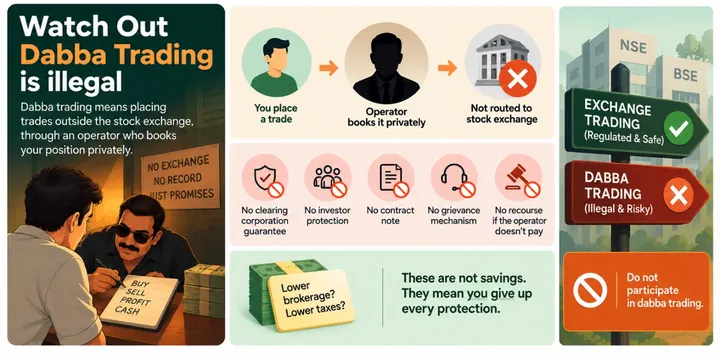
- Investing and trading are different activities. Trading is high-cost, high-risk, and statistically unrewarding for individuals. Dabba trading is illegal.
Check your understanding
Explain what a clearing corporation does in a share transaction and why you never need to know who sold you the shares.
Show answer to question 1
It guarantees settlement through novation, becoming buyer to every seller and seller to every buyer. Because it stands between the two parties, the identity and creditworthiness of your counterparty are irrelevant to you.What is the difference between a market order and a limit order, and which is generally safer?
Show answer to question 2
A market order executes immediately at the best available price; a limit order executes only at your specified price or better. The limit order is generally safer, because a market order in a thinly traded stock can execute far from the price you saw.Give three reasons why frequent intraday trading is harder to profit from than long-term investing.
Show answer to question 3
Costs are incurred on every transaction and multiply with frequency; leverage magnifies losses as well as gains; and short-term price movements are far less predictable than long-term business performance.
Your action step
Pick one listed company whose products you use. Find its latest annual report on its website or the exchange site. Read only the chairman’s statement and the section on risks. Then write two sentences describing what the company does and how it makes money. If you cannot, you have learned something important about how much research a single stock requires.