Where this fits: The last chapter covered market-based debt. This chapter covers the government-backed savings and pension schemes that form the safe core of many Indian households’ portfolios.
By the end of this chapter you will be able to
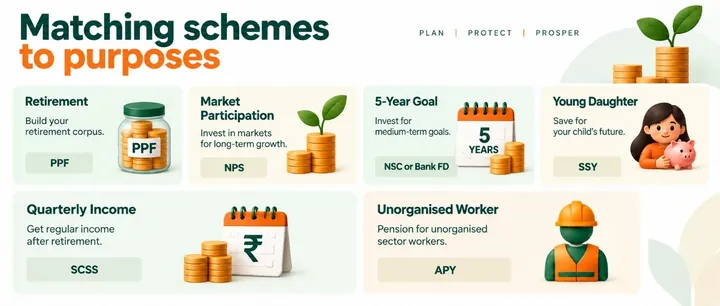
- Match the main small savings schemes to the goals they suit
- Explain what makes PPF distinctive for long-term goals
- Identify which schemes apply to your household situation
Why these schemes matter
Government-backed small savings schemes occupy a specific and useful place: sovereign backing, predictable returns, and in several cases favourable tax treatment. They are not glamorous and they will not make anyone wealthy on their own. As the stable foundation of a portfolio — the debt allocation in your plan, held in a form that is safe and largely unaffected by market movement — they are hard to beat.
Interest rates on most small savings schemes are notified by the government and reviewed periodically. Every rate mentioned in this chapter should be verified against the current notification before you act.
Public Provident Fund
The PPF is a long-term, government-backed savings scheme, and for many households the single most useful product in this chapter.
| Feature | Detail |
|---|---|
| Tenure | 15 years, extendable in blocks of 5 years |
| Who can open | Resident individuals; an account may also be opened on behalf of a minor |
| Deposit limits | A prescribed minimum and maximum per financial year |
| Interest | Notified by the government and reviewed periodically; compounded annually |
| Tax treatment | Historically Exempt-Exempt-Exempt (EEE) — contribution eligible for deduction, interest exempt, maturity exempt, subject to the applicable tax framework |
| Liquidity | Partial withdrawal permitted from a specified year; loan facility available in earlier years |
| Protection | The balance is generally protected from attachment under court decree, subject to law |
Why it is distinctive: Very few instruments anywhere combine sovereign backing, tax-free compounding and a fifteen-year horizon. That combination makes PPF unusually well-suited to your very long-term goals — particularly retirement — as the debt component that never needs to be watched.
The catch: The lock-in is genuine. Money you may need in five years should not be here. And the returns, while attractive on a tax-adjusted basis, are unlikely to match equity over very long periods. PPF is the stable part of the portfolio, not the whole of it.
Worked Example — PPF as a quiet accumulator
Meenakshi deposits ₹1,50,000 into her PPF account at the start of each financial year for 15 years, at an assumed 7.1% a year.
Total deposited: ₹22,50,000 Approximate maturity value: ₹40,68,000
The gain of roughly ₹18 lakh accrued without a single decision after the initial one, without market anxiety, and — under the historic EEE treatment — without tax on the interest or maturity.
(Illustrative, at an assumed constant rate. Actual rates are notified periodically and vary.)
National Savings Certificate
NSC is a fixed-tenure savings certificate available at post offices.
- Fixed maturity, commonly five years
- Interest accrues annually and is paid at maturity
- Investment historically eligible for deduction under the applicable framework
- Accrued interest is generally treated as reinvested during the term, with its own tax treatment
- Can be pledged as security for a loan
Suitable for a defined medium-term goal where certainty matters more than growth.
Senior Citizens Savings Scheme
SCSS is designed for retirees who need regular, safe income.
- Available to individuals above a prescribed age, with relaxations for certain early retirees and defence personnel
- Five-year tenure, extendable by a further prescribed period
- Interest paid quarterly, which is its main attraction — a predictable income stream rather than accumulation
- A maximum investment limit applies per individual
- Sovereign backing
For a retiree building an income floor, SCSS combined with a portion in G-Secs and a modest equity allocation for inflation protection is a sound and widely used structure.
Sukanya Samriddhi Yojana
SSY is a savings scheme for a girl child, introduced under the Beti Bachao Beti Padhao initiative.
| Feature | Detail |
|---|---|
| Purpose | Building a corpus for a girl child’s education and marriage |
| Who can open | A parent or legal guardian, in the name of a girl child below a prescribed age |
| Number of accounts | Generally one per girl child, with limits per family and specified relaxations for multiple births |
| Deposits | Prescribed minimum and maximum per financial year; deposits required for a specified initial period |
| Interest | Notified by government, reviewed periodically; typically among the higher small savings rates |
| Tenure | Matures after a prescribed period from opening |
| Partial withdrawal | Permitted for higher education after the girl reaches a specified age, subject to limits |
| Premature closure | Permitted only in specified circumstances |
Why it works well: It combines a high notified rate, sovereign backing, favourable tax treatment under the applicable framework, and a long horizon that matches the goal precisely. For a household with a young daughter, it is one of the most straightforward long-term decisions available.
One caution: Because the tenure is long and withdrawal restricted, SSY should be part of the plan for that goal, not the entirety of it — particularly if education costs may arise earlier than the scheme permits access.
National Pension System
The NPS, regulated by PFRDA, is a market-linked retirement savings system.
- Contributions are invested across equity, corporate debt and government securities, in a mix you choose or in an auto-choice that shifts towards debt as you age
- Two account types: Tier I, the retirement account with withdrawal restrictions; Tier II, a voluntary account with more flexibility
- Very low fund management charges compared with most managed products
- At retirement, a portion may be withdrawn as a lump sum and the balance used to purchase an annuity, subject to the prescribed rules
- Specific tax provisions apply to contributions and withdrawals; verify against the current framework
NPS sits between the schemes in this chapter and the market products: it is government regulated and low-cost, but its returns are market-linked and not assured.
Insurance and pension welfare schemes
These provide basic protection at very low cost and are worth knowing about, particularly for households that have no other cover.
Pradhan Mantri Jeevan Jyoti Bima Yojana (PMJJBY) — a term life cover offering a lump sum to the nominee on death, available to eligible bank account holders within a specified age range, at a low annual premium auto-debited from the account.
Pradhan Mantri Suraksha Bima Yojana (PMSBY) — an accident insurance cover for death or specified disability, at a very low annual premium.
Atal Pension Yojana (APY) — a guaranteed minimum pension from age 60, with contribution amounts depending on the pension level chosen and the age at joining, aimed primarily at workers in the unorganised sector.
Premiums, cover amounts and eligibility conditions for all three are revised from time to time. Check the current position at your bank or the official scheme website.
Watch Out — a scheme being government-backed does not make it right for you Sovereign backing removes credit risk. It does not remove two other problems:
Lock-in. PPF for fifteen years and SSY until the child reaches a specified age are genuine commitments. Money that might be needed sooner does not belong there, regardless of how attractive the rate is.
Inflation. A scheme paying 7.1% against 6% inflation delivers a real return of about 1.1%. Over thirty years, that is meaningful accumulation — but it is not the same as growth, and a retirement portfolio consisting only of small savings schemes will very likely fall short. The allocation logic still applies.
Recap in one minute
- Small savings schemes offer sovereign backing and predictable returns; rates are notified periodically and must be verified before acting.
- PPF combines a 15-year horizon, tax-favoured compounding and government backing — well matched to very long-term goals.
- SCSS pays quarterly and suits retirees needing an income floor; SSY suits a long-horizon goal for a girl child.
- NPS is government-regulated and very low-cost, but market-linked, not assured.
- Government backing removes credit risk. It does not remove lock-in or inflation risk.
Check your understanding
Why is PPF well suited to retirement but poorly suited to a goal four years away?
Show answer to question 1
Because PPF has a 15-year lock-in with only limited partial withdrawal. That suits a retirement horizon and makes it unsuitable for money needed in four years.What is the main practical difference between SCSS and NSC for a retired person?
Show answer to question 2
SCSS pays interest quarterly, providing regular income. NSC accrues interest and pays at maturity, providing accumulation rather than income.A household holds its entire long-term savings in PPF and NSC. Which risk are they most exposed to?
Show answer to question 3
Inflation risk. Both provide safety and predictable returns but limited real growth. Over decades, a portfolio with no growth assets is very likely to fall short.
Your action step
Check which of the schemes in this chapter you or your household are already eligible for and not using. If you have a PPF account, check whether you have deposited this financial year — many people open one and forget it. If your household has no life or accident cover, look up PMJJBY and PMSBY at your bank today.