Where this fits: The chapters so far have covered ownership — funds and shares. This chapter covers the lending side of your portfolio, the part that provides stability.
By the end of this chapter you will be able to
- Explain how a bond works and why its price moves opposite to interest rates
- Read a credit rating and say what it does and does not tell you
- Access government securities and other avenues directly as a retail investor
A one-line reminder
A bond is a loan: you are a lender, paid before owners, with your return capped at the agreed coupon. That was established earlier. What was left unexplained is the part that surprises people — why the market price of a bond you already hold moves at all. That is where this chapter starts.
Why bond prices move
This is the single most misunderstood mechanic in retail investing, and it is worth working through slowly.
Worked Example — why a bond falls when rates rise
You buy a bond for ₹1,000 paying a 6% coupon — ₹60 a year — maturing in ten years.
A year later, interest rates in the economy have risen. New bonds of similar quality and maturity are being issued paying 8%, or ₹80 a year.
Now consider someone choosing between your bond and a new one. Why would they pay ₹1,000 for ₹60 a year when they can pay ₹1,000 for ₹80 a year?
They would not. To sell your bond, you must drop the price to a level where ₹60 a year represents a competitive yield. Your bond’s market price falls.
If rates had fallen to 4% instead, your bond paying ₹60 would be more attractive than new ones paying ₹40, and its price would rise.
Bond prices and interest rates move in opposite directions. Always.
Two consequences follow:
If you hold to maturity, price movements do not matter. You receive your coupons and your principal as agreed. The market price in year three is irrelevant if you are holding until year ten.
If you hold a debt mutual fund, they matter a great deal. A debt fund is valued daily at market prices, so its NAV falls when rates rise. This is why a debt fund can show a negative month with no default having occurred. It is normal. It is not a failure of the fund.
Duration measures a bond’s sensitivity to rate changes. Longer maturity means greater sensitivity. A liquid fund holding 30-day paper barely moves; a long-duration gilt fund can move substantially.
Credit ratings
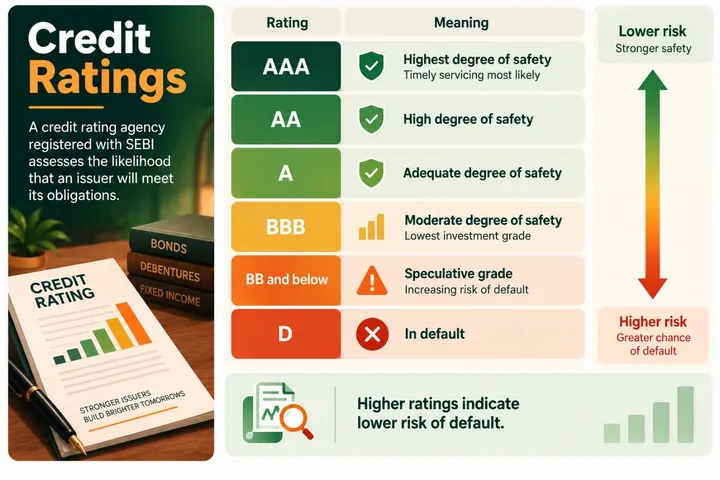
A credit rating agency, registered with SEBI, assesses the likelihood that an issuer will meet its obligations, and expresses it as a symbol.
| Broad band | Meaning |
|---|---|
| AAA | Highest degree of safety regarding timely servicing |
| AA | High degree of safety |
| A | Adequate degree of safety |
| BBB | Moderate degree of safety — the lowest investment grade |
| BB and below | Speculative grade; increasing risk of default |
| D | In default |
Three things a rating does not do:
It is not a guarantee. It is an opinion about relative credit risk. Highly-rated issuers have defaulted, in India and everywhere else.
It says nothing about price movement. A AAA bond still falls in price when interest rates rise. The rating addresses default risk, not market risk.
It is not permanent. Ratings are reviewed and can be downgraded, sometimes rapidly and sometimes in steps that surprise the market.
The yield tells you what the market really thinks. If a bond is offering a return far above government securities of similar maturity, the market is pricing in risk regardless of the printed rating. An unusually high yield is a warning, not an opportunity.
Government Securities
Government Securities (G-Secs) are debt instruments issued by the Government of India. Because the sovereign issues the currency in which they are denominated, they are treated as carrying effectively no credit risk in rupee terms.
- Treasury Bills (T-Bills) — short-term, up to one year, issued at a discount and redeemed at face value
- Dated Government Securities — longer-term, paying periodic coupons, with maturities out to several decades
- State Development Loans (SDLs) — issued by state governments
They still carry interest rate risk. A twenty-year G-Sec can fall meaningfully in price when rates rise. “No credit risk” is not “no risk.”
RBI Retail Direct
RBI Retail Direct is an online platform allowing individual investors to open a Retail Direct Gilt account with the RBI and buy G-Secs, T-Bills and SDLs directly — in primary auctions and in the secondary market — without an intermediary.
For an investor wanting genuinely risk-free rupee income over a long period, particularly a retiree seeking a predictable stream, this is a facility worth knowing about. Interest on G-Secs is not subject to tax deducted at source; you declare it in your return.
Online Bond Platforms
Online Bond Platform Providers (OBPPs) are SEBI-regulated platforms through which retail investors can buy and sell listed debt securities — corporate bonds, G-Secs and other instruments — often in small denominations that were previously inaccessible to individuals.
Before using one, verify its SEBI registration. And apply the same scrutiny to the bonds themselves as to anything else: check the issuer, the rating, the yield relative to government securities of the same maturity, and the liquidity.
Other avenues - REITs and InvITs
Real Estate Investment Trusts (REITs) own and operate income-producing real estate — typically commercial office and retail property. Infrastructure Investment Trusts (InvITs) own operating infrastructure assets such as roads, transmission lines or pipelines.
Both are listed and traded on exchanges, and both are required to distribute the large majority of their distributable cash flows to unitholders at prescribed intervals.
What they solve: Real estate has historically been inaccessible to small investors: a commercial property costs crores, cannot be divided, takes months to sell, and requires management. A REIT gives you a fractional, liquid, professionally managed and regulated exposure to the same asset class for a few thousand rupees.
What to watch: The unit price fluctuates with the market. Distributions vary with occupancy, rentals and interest costs, and are not guaranteed. Tax treatment of distributions is specific and depends on their composition — verify the current position.
Gold
Gold has traditionally been held in Indian households as jewellery. As an investment, jewellery is inefficient: making charges, purity uncertainty, storage cost and risk, and a wide gap between buying and selling price.
Financial alternatives include gold ETFs and gold mutual funds, which track the price of gold, are held electronically, and can be bought and sold on an exchange or through a fund house.
Sovereign Gold Bonds (SGBs) were issued by the Government of India, tracking the gold price and additionally paying a fixed rate of interest. The government discontinued fresh issuances; existing bonds continue until maturity and previously issued tranches trade on exchanges, though often thinly. Check the current position before assuming new tranches are available.
Gold’s role in a portfolio is diversification and crisis protection, not income — it produces no cash flow. A modest allocation is common; a large one is a bet on a single, non-productive asset.
Commodities
Gold is one commodity. It is worth knowing that it sits inside a whole asset class, and that this class trades on regulated exchanges in India under the same regulator as your shares.
A commodity is a basic physical good that is interchangeable with any other unit of the same grade — one tonne of a given quality of copper is the same as any other. That uniformity is what allows commodities to be traded on a standardised contract rather than negotiated item by item.
Retail investors almost never buy the physical commodity. What trades on the exchanges is commodity derivatives: futures and options whose value derives from the price of the underlying good. Until 2015 these were supervised by the Forward Markets Commission; that body was merged into SEBI in September 2015, so commodity derivatives now sit under the same regulator, the same broker registration framework and the same investor grievance machinery as the rest of the securities market.
Who the market is actually for
The commodity derivatives market exists primarily for people with a genuine exposure to the price of a physical good, and understanding that is the key to knowing whether you belong in it:
- Hedgers: A farmer who will harvest in three months, a jeweller holding stock, an oil importer, a spinning mill buying cotton. They use futures to fix a price in advance and remove the uncertainty from their business. This is the economic purpose of the market.
- Traders and speculators: They take the other side of those hedges and provide the liquidity that makes hedging possible. They carry the price risk the hedger wanted to shed.
- Price discovery for everyone else: A published, continuous, national price for chana or copper is useful even to people who never trade — it tells a farmer what the crop is worth before the trader arrives at the gate.
The exchanges and what they offer
Commodity derivatives in India trade on SEBI-recognised exchanges. Since 2018 a single exchange has been permitted to run equity, derivative and commodity segments together, so the equity exchanges now list commodity contracts as well:
| Exchange | Main focus | Products offered |
|---|---|---|
| MCX (Multi Commodity Exchange of India) | India’s largest commodity derivatives exchange; nonagricultural commodities | Futures and options in bullion (gold, silver), base metals (copper, aluminium, zinc, lead, nickel), energy (crude oil, natural gas) and selected agricultural commodities; plus index futures on its BULLDEX, METLDEX and ENRGDEX indices |
| NCDEX (National Commodity & Derivatives Exchange) | Agricultural and soft commodities | Futures and options in cereals, pulses, oilseeds and their derivatives, spices, fibres such as cotton and guar; plus futures on its agricultural indices |
| NSE and BSE — commodity derivatives segments | Bullion, energy and metals alongside their equity business | Commodity futures and options listed within the same trading membership as equities |
Contracts differ in whether they settle in cash or by physical delivery. A cash-settled contract ends in a money difference; a deliverable one can end with an obligation to give or take actual goods at an accredited warehouse. Read the contract specification before you trade anything — it states the lot size, the tick, the quality, the delivery centres and the settlement method, and those details are the contract.
How a retail investor can take commodity exposure
- Without derivatives, which is what most people should do. Gold and silver ETFs and the corresponding fund-of-fund schemes give you price exposure inside an ordinary mutual fund or demat account, with no margin, no expiry and no delivery obligation. Electronic Gold Receipts, traded on the stock exchanges, are another route to holding gold in dematerialised form.
- Through commodity derivatives. This requires a broker who is a member of the relevant commodity exchange, and activation of the commodity segment on your existing trading account. Your KYC carries across; the segment does not activate itself.
Watch Out — commodity derivatives are not a beginner’s product
Commodity futures are leveraged. You post a margin that is a fraction of the contract value, which means a small adverse price move can wipe out the margin and require you to bring more money the same day. Contracts also expire, and a deliverable contract held to expiry can leave you with a settlement obligation you never intended.
Commodities also produce no income. A share can pay a dividend and a bond pays a coupon; a tonne of zinc does nothing but sit there and change price. That makes the entire return dependent on selling to someone else at a higher price.
For an investor building long-term wealth, the sensible place for commodity exposure is a modest allocation to gold through a fund, as described above — not a leveraged position in crude oil. The warning given earlier about equity derivatives applies here with equal force.
Corporate fixed deposits
Company deposits typically pay more than bank deposits. They are not covered by the ₹5 lakh DICGC deposit insurance that protects bank deposits, and they carry the credit risk of the issuing company. The extra return is compensation for that risk — which is exactly what it is. Check the rating, the issuer’s financial position, and how much of your portfolio a single issuer represents.
Building the debt part of your portfolio
| Purpose | Suitable instruments | |
|---|---|---|
| Emergency fund | Savings account, sweep FD, liquid fund | |
| Money needed within a year | Liquid or ultra-short duration fund, short FD | |
| One to three years | Short duration debt funds, FDs matched to the date | |
| Stable long-term income | G-Secs via RBI Retail Direct, high-quality corporate bonds, PPF | |
| Retirement income | SCSS, G-Secs, SWP from debt or hybrid funds, annuities | |
| Watch Out — chasing yield is how conservative investors lose money An investor who would never buy a volatile small-cap share will sometimes put a large sum into a deposit or bond paying 3% more than a bank, because it is called a “deposit” and feels safe. Extra yield is never free. It is payment for credit risk, liquidity risk, or both. When a highly-rated issuer offers 7% and another offers 13%, the market is telling you something specific about the second, and the rating agency may be behind the market. If you would not accept a total loss of that amount, do not reach for the extra yield. |
Recap in one minute
- A bond makes you a lender: capped upside, priority over shareholders, and default as the main risk.
- Bond prices move opposite to interest rates. Hold to maturity and it does not matter; hold a debt fund and it shows up in the NAV.
- Credit ratings are opinions about default risk, not guarantees, and not comments on price movement.
- G-Secs carry no credit risk but full interest rate risk, and are accessible directly through RBI Retail Direct.
- Unusually high yield is a warning about risk, not a reward for cleverness.
Check your understanding
Interest rates rise by 1%. What happens to the price of a bond you already hold, and why?
Show answer to question 1
The price falls, because newly issued bonds now pay a higher coupon, so your lowercoupon bond must be priced lower to offer a competitive yield.You hold a bond to maturity. Does the price movement in year three affect what you eventually receive?
Show answer to question 2
No. You receive the agreed coupons and the principal at maturity regardless of interim price movements.Two bonds have the same maturity. One yields 7.2%, the other 12.8%. What is the market telling you?
Show answer to question 3
That the market perceives significantly higher risk in the second — credit risk, liquidity risk, or both. Extra yield is payment for risk, not a reward for finding a bargain.
Your action step
Look up the current yield on a 10-year Government Security. Write it down. That number is your risk-free reference point: any investment offering more is offering it in exchange for some risk, and your job is always to identify which risk.