Where this fits: This is the first step. Everything else in the book rests on it.
By the end of this chapter you will be able to
- State your own monthly income and expenditure as two specific numbers
- Calculate your monthly surplus and name three sensible things to do with it
- Explain why keeping money at home costs you money every year
Money has only three jobs
Every rupee that reaches your hand does exactly one of three things. It gets spent, it gets saved, or it gets invested. That is the whole of personal finance. Everything else in this book is detail hanging off those three words.
Most people manage the first one by instinct and the other two by accident. The purpose of this chapter is to replace the accident with a decision.
Income: what comes in
Income — is all the money you receive in a period — usually a month. It includes:
- Salary or wages
- Profit from a business or profession
- Rent from property you own
- Interest from bank deposits
- Pension
- Money received under government schemes
- Payments for freelance or part-time work
Two things about income matter more than its size.
Regularity — A salaried person receiving ₹30,000 on the first of every month can plan with more confidence than a trader whose income swings between ₹10,000 and ₹80,000. If your income is irregular, plan on your lowest typical month, not your average one.
Number of sources — A household with one earner and one income stream is fragile. If that stream stops, everything stops. Over time, the goal is to add sources — a skill that earns on the side, a spouse’s income, and eventually income from assets you own. Building that second and third stream is one of the reasons this book exists.
Expenditure: what goes out
Expenditure is money spent to meet needs and obligations. Rent, food, school fees, electricity, transport, medicines, EMIs, phone recharges, festival spending, eating out, subscriptions.
Here is the difficulty. Most people can state their income to the rupee and cannot state their expenditure within ₹5,000. Income arrives in one or two large, memorable transactions. Expenditure leaves in a hundred small forgettable ones.
You cannot manage a number you do not know. The next chapter shows you how to find it.
The number that matters: your surplus
Surplus = Income − Expenditure
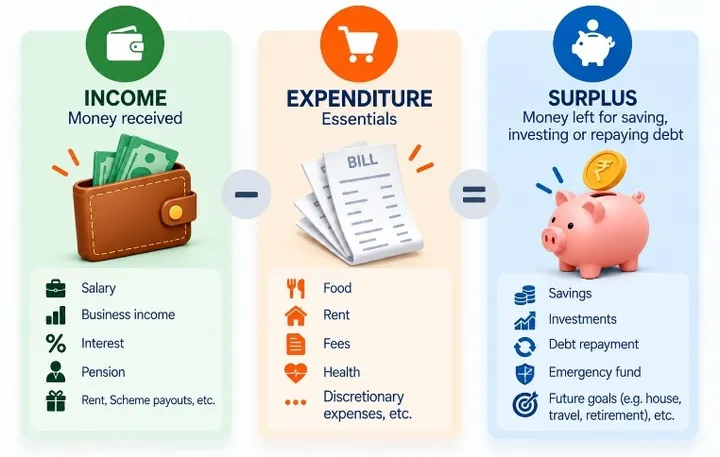
If the answer is positive, you have a surplus. If it is negative, you have a deficit, and you are funding it either by drawing down past savings or by borrowing. A household running a deficit month after month is heading towards a debt trap, and no investment product can rescue it. Fixing the deficit comes first.
If you have a surplus, you have exactly three sensible uses for it, and they should generally be taken in this order:
- Clear high-cost debt: Paying off a credit card charging 36% a year is mathematically identical to earning a guaranteed, tax-free 36% return. No investment will beat that.
- Build an emergency fund: Money set aside in a safe, instantly accessible place for the month everything goes wrong.
- Invest for your goals: Only once the first two are done. Parts 2 to 4 cover this.
Worked Example — Meera’s surplus
Meera is a schoolteacher in Nashik. Her salary is ₹38,000 a month. She also gives private tuition and earns about ₹4,000 more.
- Total income: ₹42,000
- She writes down her expenses for one month and finds they total ₹36,500
- Surplus = ₹42,000 − ₹36,500 = ₹5,500 a month
Meera had always assumed she “saved nothing.” In fact she was generating ₹66,000 a year in surplus — she simply had never seen the number, so it drifted away in unplanned spending. Naming the number is what allowed her to direct it.
Where households commonly keep savings
Before we discuss investing at all, it is worth being honest about where money actually sits in most Indian households.
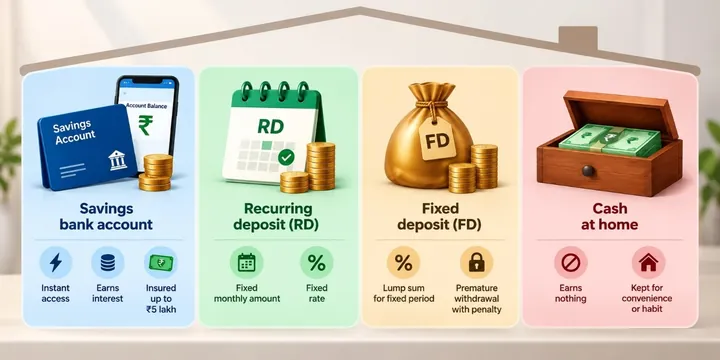
Savings bank account — Money is instantly available, deposits and withdrawals are easy, and it earns a small rate of interest set by the bank. Rates vary by bank and account type and can be changed by the bank.
Deposits with scheduled commercial banks in India are insured by the Deposit Insurance and Credit Guarantee Corporation (DICGC) up to ₹5 lakh per depositor per bank, covering principal and interest together. This is a genuine safety feature and worth knowing about.
Recurring deposit (RD) — A fixed amount is deducted every month for a fixed tenure — typically anywhere from six months to ten years — and earns a fixed rate of interest agreed at the start. An RD suits a person who wants to build a habit of monthly saving with certainty about the maturity amount.
Fixed deposit (FD) — A lump sum is placed for a fixed period at a fixed rate. Premature withdrawal is usually allowed with a penalty on the interest rate.
Cash at home — Earns nothing at all. It is kept for convenience, for privacy, or out of habit. In small amounts this is perfectly reasonable. In large amounts it is one of the most expensive habits in personal finance — expensive in a way that is invisible, which is precisely why it persists.
Watch Out — the invisible cost of cash at home
₹1,00,000 kept in a steel almirah for ten years is still ₹1,00,000 at the end of ten years. But the things you can buy with it will have shrunk substantially, because prices will have risen every one of those ten years. Nothing was stolen. No one cheated you. Yet you are materially poorer. The next chapter gives this effect its name and its arithmetic.
Why saving alone is not enough
Consider a simple question
If prices are rising by about 6% a year and your savings account pays about 3%, is your money keeping up with the cost of living?
It is not. It is falling behind by roughly 3% a year, every year, quietly and without any statement ever showing you a loss. The balance in your passbook goes up. Your ability to buy things goes down.
This is not an argument for abandoning savings accounts — you need one, and this book will later insist that you keep real money in one. It is an argument for understanding that a savings account is a parking place, not a growth place. Knowing the difference between the two is the single most valuable idea in Part 1.
Recap in one minute
- Every rupee is spent, saved or invested. Choose deliberately rather than by default.
- Income is what comes in; regularity and number of sources matter as much as the amount.
- Expenditure is what goes out, and almost nobody knows their own number until they measure it.
- Surplus = Income − Expenditure. This is the number your entire financial future is built from.
- A savings account parks money safely; it does not grow it faster than prices rise.
Check your understanding
Rakesh earns ₹55,000 a month and spends ₹58,000. What is his surplus, and what should his first priority be?
Show answer to question 1
Rakesh has a deficit of ₹3,000 a month, not a surplus. His first priority is to close the gap — reduce expenditure or increase income — before considering any investment. A household funding a deficit through borrowing is heading towards a debt trap.Name two advantages and one disadvantage of keeping money in a savings bank account.
Show answer to question 2
Advantages: instant liquidity, and safety (deposits insured up to ₹5 lakh per depositor per bank by DICGC). Disadvantage: the interest rate is typically below inflation, so purchasing power falls in real terms.Why is a household with two income sources more secure than one with a single larger source?
Show answer to question 3
Because if one source stops, the household still has income. A single larger source is a single point of failure.
Your action step
Take a sheet of paper. Write your total monthly income at the top. For the next seven days, write down every single rupee you spend, including the ₹10 ones. Do not change your behaviour — just record it. You will use this sheet in the next chapter.