Where this fits: You have found your surplus. Now you will take control of it, rather than letting it evaporate.
By the end of this chapter you will be able to
- Sort any expense into needs, wants or desires and explain why it matters
- Apply the 50-30-20 rule to your own income
- Explain the difference between active and passive income, and why it decides when you can stop working
Financial literacy has three parts, and most people have only one
Being good with money is not the same as knowing about money. It has three components, and weakness in any one of them undoes the other two.
Financial knowledge — what you know?
Understanding what inflation does, how compounding works, what a mutual fund is, how a loan is priced. This is the part books teach, and it is the easiest part.
Financial attitude — how you think?
Whether you are willing to delay a pleasure today for a larger one later. Whether you treat saving as a leftover or as an obligation. A person with excellent knowledge and a poor attitude will make impressive-sounding decisions and still end up broke.
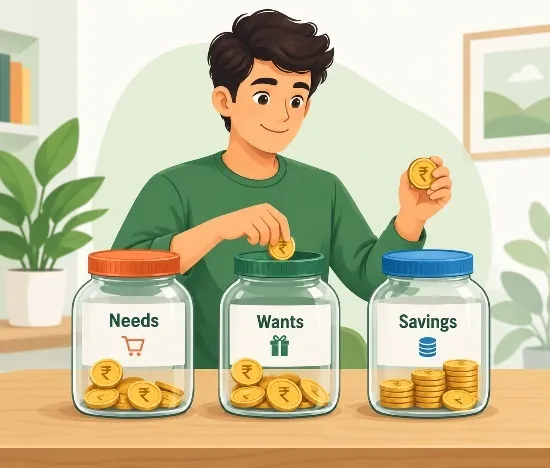
Financial behaviour — what you actually do?
Tracking spending. Paying the credit card in full. Setting up the monthly investment and not cancelling it in a bad month. This is the part that produces results, and it is the hardest.
This book supplies the knowledge. It can nudge the attitude. Only you can supply the behaviour — which is why every chapter ends with an action step.
The 50-30-20 rule
A budget is not a punishment. It is a plan that decides where money goes before it goes there.
The simplest framework that works for most households divides take-home income three ways:
| Share | Purpose | What it covers |
|---|---|---|
| 50% | Needs | Rent, basic groceries, utilities, transport to work, school fees, insurance premiums, minimum loan repayments |
| 30% | Wants | Eating out, entertainment, shopping beyond necessity, travel, hobbies, upgrades |
| 20% | Savings investments | Emergency fund, debt repayment above the minimum, and investing for your goals |
Treat these as targets, not laws. In a high-rent city, needs may genuinely take 60%. In that case the 30% must shrink, not the 20%. The one line that should not be crossed is the savings line, because it is the only one with no immediate consequence for breaking it — and therefore the only one that gets broken.
Worked Example — applying 50-30-20
Sunita’s take-home salary is ₹40,000.
- Needs (50%): ₹20,000 — rent ₹11,000, groceries ₹5,500, electricity and gas ₹1,500, bus pass ₹800, health insurance premium ₹1,200
- Wants (30%): ₹12,000 — eating out, a streaming subscription, clothes, a monthly outing
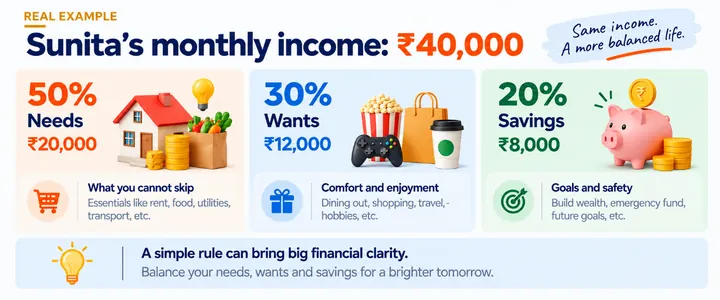
- Savings and investments (20%): ₹8,000
Sunita’s ₹8,000 goes first to building an emergency fund. Once that is complete, the same ₹8,000 becomes her monthly investment. Note that she did not need a raise to start investing. She needed a decision.
Figure 1 The 50-30-20 split, applied to Sunita’s ₹40,000. In a costly city the needs share may stretch to 60% — in which case the wants share shrinks, never the savings share.
Needs, wants and desires
The 50-30-20 rule only works if you can sort expenses honestly. Three categories help.
Needs are what you cannot live safely or decently without. Basic food, shelter, electricity and water, essential clothing, medicine, children’s schooling, travel to work, insurance premiums. Cutting these damages your life or your health.
Wants improve comfort or enjoyment but are not required. Restaurant meals, weekend cinema, branded clothing, a new phone while the old one still works, a subscription you use twice a month.
Desires are aspirational and expensive — a luxury car, designer goods, an overseas holiday. There is nothing wrong with desires. There is a great deal wrong with funding them from borrowings.
The dividing line is not the item. It is the version of the item. A phone is a need. A ₹1,20,000 phone is a desire wearing a need’s clothing. Rice is a need. A restaurant is a want. Being honest about which is which is uncomfortable, and it is exactly where budgets succeed or fail.
The rule to remember: cover needs first, set aside your savings and investments second, and spend on wants and desires only from what remains.
The savings-first equation
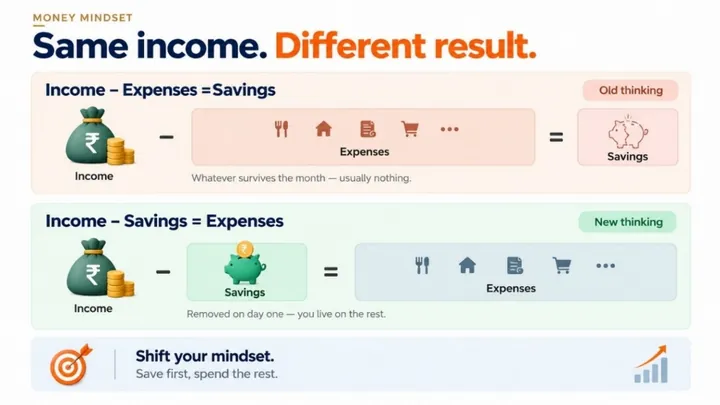
Here is a change to one line of arithmetic that transforms outcomes.
| Mindset | Equation | What it means in practice |
|---|---|---|
| Old thinking | Income − Expenses = Savings | You save whatever survives the month. Usually nothing |
| New thinking | Income − Savings = Expenses | You remove savings on day one and live on the rest. |
Figure 2 The same income, reordered. Moving savings from the end of the month to the start is the whole of the change.
The second equation works because of a quirk of human behaviour: we adjust our spending to fit whatever is available in the account. If ₹8,000 leaves your account automatically on the 2nd of every month, you will manage the rest of the month on what remains, and you will barely notice. If you wait until the 30th to see what is left, something will always have consumed it.
The practical form of this is an automatic transfer or a standing instruction dated within two days of your salary credit. Automation beats willpower, because willpower has bad days.
Active income and passive income
There are two ways money can arrive, and the difference between them decides whether you will ever be able to stop working.
Active income is earned by your time and effort. Salary, wages, professional fees, and business profit depend on your daily presence. Its defining feature: if you stop, it stops. Illness, job loss, a business downturn, or simply age will eventually interrupt it.
Passive income is earned by assets you already own. Interest from deposits and bonds, dividends from shares and mutual funds, rent from property, pension or annuity payments. Its defining feature: it continues when you do not.
Financial independence is not a number in a bank account. It is the point at which your passive income covers your essential expenses. Everything in Parts 2 to 4 of this book is, ultimately, about converting active income into assets that produce passive income.
What investing actually means
Now that the ground is prepared, a precise definition.
Investing is deploying money into assets or instruments with the objective of generating a return over time, in order to meet a financial goal.
Some clarifications that people commonly get wrong:
- Buying a house to live in is a major financial decision, but it is a consumption asset you occupy rather than an investment. A second property, bought to let out or to sell later, is a different matter — that is an investment, and real estate is a legitimate asset class. The distinction is set out below, because it matters more in India than almost anywhere.
- Paying school or college fees is an expense, even though it improves future earning capacity.
- Bank deposits are usually treated as savings products rather than investments, although they do earn interest.
Watch Out — the first house and the second house are not the same thing
Property is the largest asset most Indian households own, and the two cases get muddled constantly.
The house you live in is consumption. It gives you shelter, which is real and valuable, and it removes rent from your monthly budget, which is a genuine financial gain. What it does not give you is income or access. It pays you nothing while you hold it. You cannot sell two bedrooms to fund a medical emergency. And if you sell the whole thing, you have to live somewhere else and pay for that. A rising valuation on the house you occupy does not make you richer in any way you can actually spend.
A second property is an investment. Bought to let out or to sell later, it produces rent or capital appreciation and can be sold without making you homeless. It behaves like an asset because it is one. Income tax law draws the same line: a self-occupied house is treated differently from one that is let out or deemed to be let out.
That does not make it an easy investment. Property is illiquid, cannot be divided, is expensive to buy and sell, concentrates a large sum in one building in one location, and has to be managed and maintained. REITs, covered later in this book, give exposure to income-producing property without most of those problems.
The practical test: If you have to keep living in it, it is not funding your goals. Count your home as your home. Do not count it in the corpus you are building for retirement or your children’s education. Households that do this arrive at retirement asset-rich and cash-poor, holding something they cannot spend and will not sell.
Investing has three characteristics: a time horizon that is usually medium to long, a degree of risk, and the possibility of a return that outpaces inflation. Remove the risk and you generally remove the higher return along with it.
Saving and investing are not the same thing
| Parameter | Saving | Investing |
|---|---|---|
| Purpose | Keeping money safe and available | Growing money over time |
| Priority | Safety and liquidity | Growth and income |
| Time horizon | Immediate to about 1 year | 3, 5, 10 years or more |
| Risk | Low to negligible; bank deposits insured up to ₹5 lakh per depositor per bank | Varies by asset class; higher in equity, lower in debt |
| Typical return | Low and fixed | Market-linked and uncertain, potentially higher |
| Effect of inflation | Often loses to inflation in real terms | Aims to beat inflation over the long term |
| Common avenues | Savings account, FD, RD, post office savings | Equity shares, mutual funds, ETFs, bonds, PPF, gold |
You need both. Saving handles next month. Investing handles the next decade. Using one for the other’s job is the most common structural error in Indian household finance — people keep ten years of money in a savings account and then borrow at 14% for an emergency.
Watch Out — the “I’ll start when I earn more” trap
The most common reason given for not investing is insufficient income. It is almost never true. A person who cannot set aside ₹500 from ₹20,000 will not set aside ₹5,000 from ₹2,00,000, because spending rises to meet income unless a rule stops it. The habit is what is scarce, not the money. Start with an amount so small it is painless, and raise it every time your income rises.
Recap in one minute
- Financial literacy is knowledge plus attitude plus behaviour. Only behaviour produces results.
- 50-30-20 is a starting framework: half to needs, a third to wants, a fifth to savings and investments.
- Sort expenses honestly into needs, wants and desires — the dividing line is usually the version, not the item.
- Flip the equation: Income − Savings = Expenses, and automate the savings transfer.
- Active income stops when you stop; passive income does not. The whole point of investing is to build the second kind.
Check your understanding
Anil takes home ₹60,000 a month. Under 50-30-20, what should each of the three buckets be?
Show answer to question 1
Needs ₹30,000, wants ₹18,000, savings and investments ₹12,000.Classify these: a health insurance premium, a weekend movie, a second car, a phone recharge.
Show answer to question 2
Health insurance premium — need. Weekend movie — want. Second car — desire. Phone recharge — need (though the plan chosen may include want elements).Why does the savings-first equation work better than the old one, even though the arithmetic is identical?
Show answer to question 3
Because we adjust spending to whatever is available. Removing savings first means we live on the remainder without noticing; waiting until month-end means something always consumes it.
Your action step
Using the seven-day spending sheet from the last chapter, extend it to a full month, then sort every line into needs, wants and desires. Total each column. Compare the result with 50-30-20. Then set up one automatic transfer, for any amount you like, dated two days after your salary arrives.