Where this fits: The last two chapters made the case for investing. This chapter is the gate you must pass through first.
By the end of this chapter you will be able to
- Calculate the size of the emergency fund your household needs and say where to keep it
- Distinguish protection from investment, and explain why mixing them is expensive
- Tell good debt from bad debt and recognise the warning signs of a debt trap
Why this chapter exists
There is a strong temptation, having read about compounding, to start investing tomorrow morning. Resist it for one more chapter.
An investment plan built on an unprotected household does not survive contact with reality. The first hospital admission, the first job loss, the first vehicle accident will force you to sell your investments at whatever price the market happens to be offering that week — which, by the nature of these things, is often a bad one. You will have converted a long-term plan into a short-term loss.
Three defences must be in place first. They are not exciting. They are what makes everything after them possible.
Defence 1: The emergency fund
An emergency fund is money set aside specifically for unexpected events, kept somewhere safe and immediately accessible.
What counts as an emergency
- Loss of job or a sharp fall in business income
- A medical event not fully covered by insurance
- Urgent major repair to a home or vehicle
- An unavoidable family obligation
A festival, a wedding you knew about for a year, a phone upgrade and a holiday are not emergencies. They are planned expenses, and they belong in your budget.
How large should it be?
The standard guidance is three to six months of essential living expenses. Note the word essential — you need to cover rent, food, utilities, school fees, EMIs and insurance premiums, not your entire normal spending.
Adjust for your circumstances:
| Your situation | Suggested size |
|---|---|
| Stable salaried job, two earners in household | 6 months |
| Stable salaried job, single earner | 6 months |
| Business income, commission income, or contract work | 6 to 12 months |
| Dependents with ongoing medical needs | Larger, plus separate health cover |
Where should it be kept?
The emergency fund has exactly two requirements: it must be safe, and it must be reachable within a day or two. It does not need to earn a good return, and chasing one defeats the purpose.
Reasonable places: a savings bank account, a sweep-in fixed deposit, a short-tenure fixed deposit, or a liquid mutual fund. Keeping part of it in a bank account and part in a liquid fund is a sensible compromise between instant access and slightly better returns.
Unreasonable places: equity shares, equity mutual funds, real estate, or anything with a lock-in period. These may be excellent long-term investments. They are terrible emergency funds, because emergencies do not check the market level before arriving.
Worked Example — Amit’s fund did its job
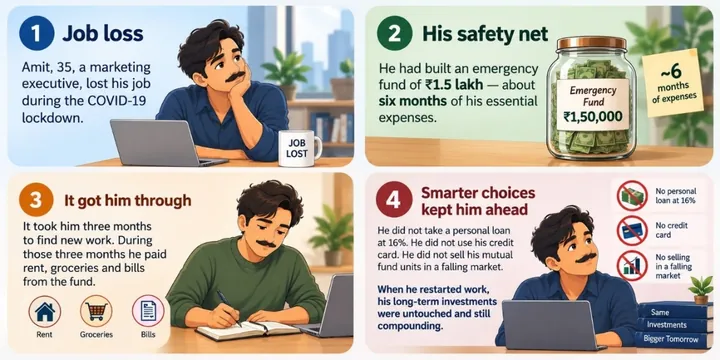
Amit, 35, a marketing executive, lost his job during the COVID-19 lockdown. He had built an emergency fund of ₹1.5 lakh — about six months of his essential expenses.
It took him three months to find new work. During those three months he paid rent, groceries and bills from the fund.
What he did not do is as important as what he did. He did not take a personal loan at 16%. He did not use his credit card. He did not sell his mutual fund units in a falling market. When he restarted work, his long-term investments were untouched and still compounding. The emergency fund did not earn him anything. It saved him a great deal.
Defence 2: Insurance
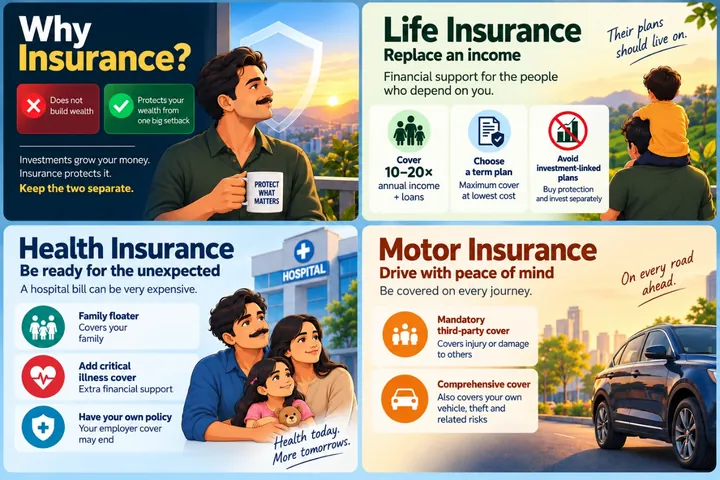
Insurance transfers a risk you cannot afford to carry to an institution that can. It does not build wealth. It stops a single event from destroying the wealth you are building.
The organising principle is simple: investments grow your money; insurance protects it. Keep the two separate.
Life insurance — replacing an income
If people depend on your income, you need life cover. Its purpose is to replace your earnings and clear your debts if you die, so that your family’s plans do not die with you.
- How much: A common rule of thumb is 10 to 20 times your annual income, plus any outstanding loans, minus existing assets earmarked for the family.
- What kind: a term insurance policy is pure protection — the largest cover for the smallest premium. If you survive the term, there is no payout, and that is the point. You are buying protection, not a return.
- The golden rule: do not buy investment-linked insurance products in the belief that you are doing both jobs at once. Bundled products typically give you less cover than a term plan and lower returns than a mutual fund, while making both harder to compare. Buy a term plan for protection and invest separately.
If nobody depends on your income — you are single with no dependants and no loans — you may not need life insurance at all yet. You almost certainly need the next one.
Health insurance — the most commonly skipped essential
A single hospitalisation can consume years of savings. Health cover pays for room charges, surgery, doctors’ fees and medicines.
- A family floater policy covers your whole family under one shared sum insured, usually more cheaply than separate policies.
- A critical illness rider or policy pays a lump sum on diagnosis of specified serious illnesses, which helps with income loss and non-hospital costs.
- If your employer provides cover, it usually ends the day your employment does — which is precisely when you are least able to buy a new policy. A personal policy alongside the employer’s is worth the premium.
Motor insurance
Third-party motor insurance is a statutory requirement in India for any vehicle used on public roads; it covers injury or damage you cause to others. Comprehensive cover adds damage to your own vehicle, theft and related risks.
Three practical rules
Buy early: Premiums for life and health cover rise with age and with the onset of medical conditions. The cheapest policy you will ever be offered is the one available to you today.
Disclose everything honestly: Concealing a medical history, a habit or an existing policy is the single largest cause of claim rejection. A policy that does not pay is worse than no policy, because you paid for a false sense of safety.
Store the documents where your family can find them: Nominees who do not know a policy exists cannot claim it. Consider an e-Insurance Account (eIA), which holds policies in electronic form.
Defence 3: Getting out from under bad debt
Debt is money borrowed to be repaid later, with interest. It is a tool, and like any tool it is useful or dangerous depending on what you do with it.
Good debt and bad debt
The distinction is not about the amount. It is about what the borrowed money buys.
Good debt funds something that creates value, generates income, or appreciates:
- Home loan — acquires an asset that may appreciate and replaces rent. Typically the lowest interest rate available to an individual, with tax benefits on principal and interest under the applicable provisions.
- Education loan — funds earning capacity, with tax benefit available on interest under the applicable provisions.
- Business loan — funds machinery, stock or working capital that generates revenue. Schemes such as MUDRA loans are aimed at small enterprises.
Good debt tends to carry lower rates, longer tenures and some tax relief, and is backed by something that produces value.
Bad debt funds something that is consumed or loses value immediately:
- Credit card revolving balance — the most expensive borrowing most households ever take, commonly in the range of 18% to 48% a year when annualised. Paying only the “minimum amount due” is how a ₹40,000 balance becomes a multi-year problem.
- Personal loans for consumption — unsecured, typically 12% to 20% a year, used for holidays, functions or lifestyle spending.
- EMIs on depreciating goods — gadgets, appliances and clothing that are worth less the moment they leave the shop.
Watch Out — how the minimum payment works
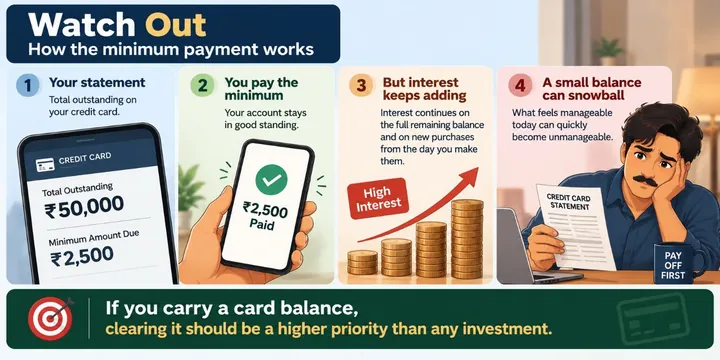
A credit card statement showing ₹50,000 outstanding will offer a “minimum amount due” of perhaps ₹2,500. Paying it keeps your account in good standing, which is why it feels responsible. But interest continues on the full remaining balance, and — critically — on new purchases from the day you make them, with no interest-free period once you are revolving. This is how a manageable balance quietly becomes unmanageable. If you carry a card balance, clearing it is a higher priority than any investment in this book.
Four questions before you borrow
- Is this a need or a want? Bad debt almost always fails this question.
- What is the total interest, in rupees, over the full tenure? Not the monthly EMI — the total. Lenders quote the EMI because it sounds small.
- Can I afford the EMI even in a bad month? As a general guide, total EMIs should stay within a modest share of monthly income, leaving room for savings and essentials.
- What is my repayment plan if my income is interrupted?
Alternatives to borrowing
- Use the emergency fund — that is what it is for
- Delay a non-essential purchase by three months and save towards it instead
- Start a recurring deposit or a monthly savings instruction for a known future expense rather than borrowing after the fact
- Use a no-cost EMI offer only if you are certain of repaying on schedule, and only after checking whether the “no cost” is recovered through a higher price
Red flags
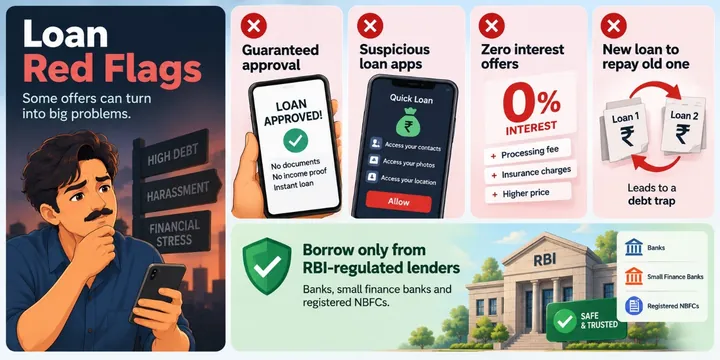
- Any lender offering guaranteed approval without checking your capacity to repay
- Loan apps that are not from a bank or an RBI-registered NBFC, particularly those demanding access to your contacts or photo gallery
- “Zero interest” offers with processing fees, insurance add-ons or inflated prices hidden inside
- Taking a new loan to repay an old one. This is the definition of a debt trap, and it is the point at which the situation stops being a budgeting problem and becomes an emergency.
Borrow only from RBI-regulated entities: scheduled commercial banks, small finance banks and registered NBFCs. Never from unregistered app-based lenders or informal moneylenders.
Your credit score
Borrowing well is not only about how much you owe. It is also about what it costs you to borrow, and that is largely decided by a number most people never look at until a loan is refused.
A credit score is a three-digit summary of how reliably you have repaid what you borrowed. In India it is computed by four credit information companies regulated by the RBI — CIBIL (TransUnion), Experian, Equifax and CRIF High Mark. Each maintains its own record and each produces its own score, so the numbers will not match exactly. Scores generally run from 300 to 900, and higher is better.
Why it matters more than people think
Lenders use it to decide two things, and the second one is the expensive one:
- Whether to lend to you at all
- At what interest rate
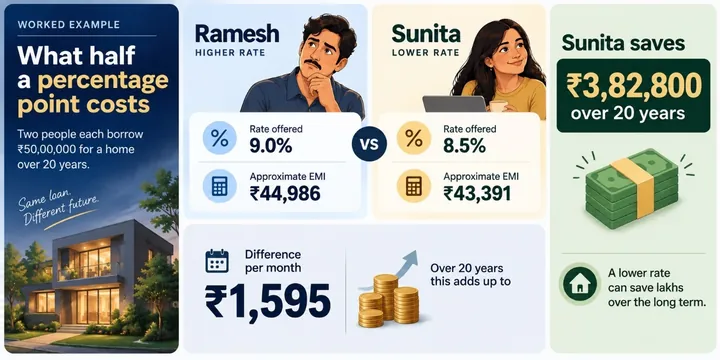
A strong score does not just improve your chances of approval. It moves you into a better rate band, and on a long loan that difference is very large.
Worked Example — what half a percentage point costs
Two people each borrow ₹50,00,000 for a home over twenty years.
Ramesh
Sunita
Rate offered
9.0%
8.5%
Approximate EMI
₹44,986
₹43,391
Difference per month
—
₹1,595
Difference over twenty years
—
about ₹3,82,800
Sunita did nothing clever. She paid her card bills in full and on time for several years. That habit was worth roughly ₹3.8 lakh, and she was never asked to make a single investment decision to earn it.
(Illustrative. Rates and EMIs vary by lender, tenure and loan amount.)
Your score is also consulted in places that are not loans at all: credit card limits and upgrades, some rental agreements, and certain employment checks in financial roles.
What actually moves the number
The exact weightings are proprietary and differ between the four companies, but the drivers are consistent:
| Factor | What it means | Weight |
|---|---|---|
| Repayment history | Paying every instalment and card bill on or before the due date | Largest single factor |
| Credit utilisation | How much of your available card limit you use. Consistently running near the limit reads as stress | High |
| Age of credit | How long you have held credit accounts. Longer records score better | Moderate |
| Mix of credit | A blend of secured loans and unsecured credit reads better than unsecured alone | Moderate |
| Recent enquiries | Each formal application creates a hard enquiry. Many in a short period reads as desperation | Lower, but real |
How to build and keep a good score
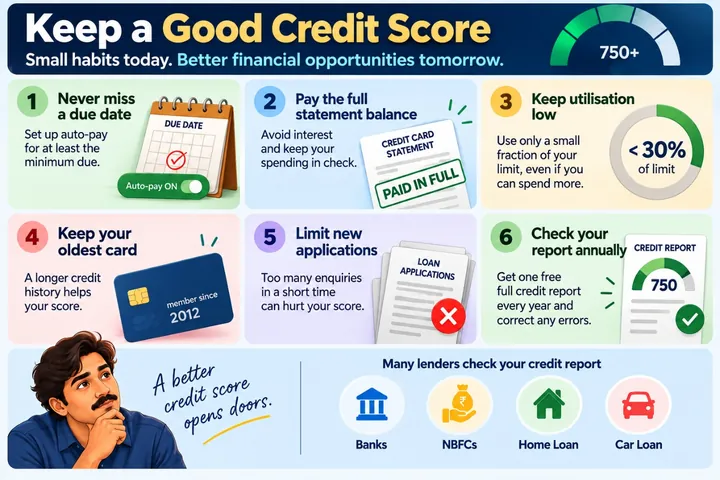
- Never miss a due date: One missed payment can affect the score for years, and it is the single most damaging thing you can do to it. Automate the minimum payment as a safety net, then pay the full amount manually.
- Pay the full statement balance, not the minimum: Paying only the minimum keeps the account current but leaves a revolving balance at credit-card interest rates, which is the most expensive money in the book.
- Keep utilisation low: Using a small fraction of your limit consistently is read far more favourably than using most of it, even if you clear it every month. If you regularly need most of your limit, ask for a higher limit rather than using more of the existing one.
- Do not close your oldest card: Closing it shortens your credit history and reduces your total available limit, which raises your utilisation ratio. An old card with no annual fee is worth keeping alive with a small recurring payment.
- Space out applications: Do not apply to five lenders in a week to compare offers. Use lenders’ indicative rate tools, which do not create a hard enquiry, and make one formal application.
- Check your report at least once a year and correct errors: Under RBI rules each of the four companies must provide one free full credit report a year. Errors are common — a loan you closed still showing as open, or an account that is not yours.
Watch Out — three things people get wrong about credit scores
Checking your own score does not lower it. Your own check is a soft enquiry and has no effect. Only a lender’s check on a formal application is a hard enquiry. Check yours freely.
Standing guarantee for someone else’s loan puts it on your record. If you guarantee or cosign a loan, it appears in your credit report and their default becomes your default. Treat a request to guarantee a loan as seriously as a request for the money itself.
No credit history is not the same as good credit history. Someone who has never borrowed has a thin file and may be refused or offered a poor rate, simply because there is nothing to assess. A single credit card used lightly and cleared in full each month builds a record at no cost.
A good score is not a financial achievement in itself and it will not make you wealthy. It is a costreduction tool. It quietly lowers the price of every rupee you ever borrow, and the money it saves goes straight into the surplus that funds everything else in this book.
The order of operations
Putting the whole of Part 1 together, here is the sequence:
- Measure income and expenditure; find your surplus
- Build a budget and automate the savings transfer
- Clear high-cost debt, starting with the highest rate, and check your credit report
- Build the emergency fund to three to six months of essentials
- Put term life cover and health cover in place
- Only now, begin investing for goals
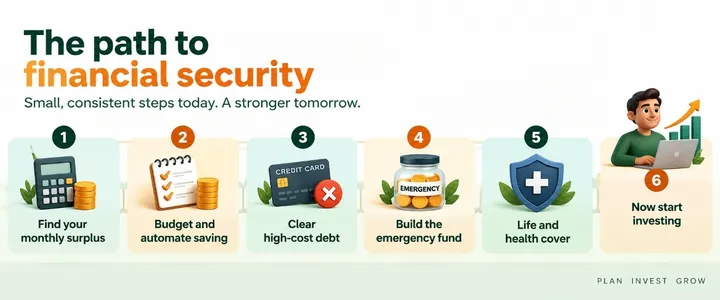
If you are partway down this list, that is completely normal. Work down it. Steps 3, 4 and 5 can proceed in parallel with a small investment if it helps you build the habit — but they should not be postponed indefinitely in favour of it.
Figure 6 The order of operations.
Recap in one minute
- Build three to six months of essential expenses as an emergency fund, kept somewhere safe and instantly accessible.
- Insurance protects wealth; investment builds it. Never buy one product hoping to do both.
- Buy term life cover if anyone depends on your income, and health cover regardless.
- Good debt buys appreciating or income-producing assets; bad debt buys things that are consumed.
- Taking a new loan to repay an old one is a debt trap. Clearing high-cost debt beats any investment return available to you.
- Your credit score decides what borrowing costs you. Pay every bill on time, keep card usage low, and read your free annual credit report.
Check your understanding
Kavita’s essential monthly expenses are ₹32,000 and she runs a small business. What size emergency fund should she target, and where should she keep it?
Show answer to question 1
As a business owner with irregular income, Kavita should target 6 to 12 months of essential expenses — roughly ₹1.9 lakh to ₹3.8 lakh. Keep it in a savings account, sweep FD or liquid fund; never in equity.Why is a term insurance policy usually a better protection choice than a bundled insurance-cum-investment plan?
Show answer to question 2
Because term insurance provides the largest cover for the lowest premium, and keeping insurance and investment separate makes both cheaper and easier to compare. Bundled products typically give less cover than a term plan and lower returns than a mutual fund.A credit card charges 36% a year. A mutual fund has returned 12% a year. Kavita has ₹50,000 spare and a ₹50,000 card balance. What should she do, why, and what will that decision do to her credit score?
Show answer to question 3
Clear the card balance. Eliminating a 36% cost is equivalent to a guaranteed, tax-free 36% return — three times what the fund has delivered, with no risk. It also helps her credit score twice over: the outstanding balance is cleared, and her credit utilisation drops sharply, which is one of the largest inputs to the score after repayment history.
Your action step
Write down three numbers: (a) your total essential monthly expenses, (b) your current emergency fund, (c) your total outstanding high-cost debt. If (b) is less than three times (a), or (c) is greater than zero, you have your project for the next six months. Then do two more things: check whether you have health insurance that is not tied to your employer, and pull your free annual credit report from any one of the four credit information companies. Read it line by line and note anything you do not recognise.