Where this fits: The last chapter showed you the problem. This chapter shows you the only force strong enough to beat it.
By the end of this chapter you will be able to
- Explain the difference between simple and compound interest with numbers
- Use the Rule of 72 to estimate doubling time in your head
- Explain why ten years of delay costs far more than ten years of contributions
Interest on interest
Compounding is what happens when the return you earn is added to your original amount, so that next year’s return is calculated on the larger sum. Your returns start earning returns.
That sentence sounds mild. Its arithmetic is not.
Simple interest versus compound interest
Take ₹1,000 invested at 10% a year.
Under simple interest, you earn ₹100 every year on the original ₹1,000, forever. Under compound interest, you earn 10% on whatever the balance is at the time.
| Year | Simple interest | Compound interest |
|---|---|---|
| 1 | ₹1,100 | ₹1,100 |
| 2 | ₹1,200 | ₹1,210 |
| 3 | ₹1,300 | ₹1,331 |
| 10 | ₹2,000 | ₹2,594 |
| 20 | ₹3,000 | ₹6,727 |
| 40 | ₹5,000 | ₹45,259 |
(Figures approximate, rounded to the nearest rupee.)
Look at the two columns in year 3. The difference is ₹31 — trivial, and this is exactly why people give up on compounding early. Now look at year 40. The difference is ₹40,259, or nine times the entire simple-interest result.
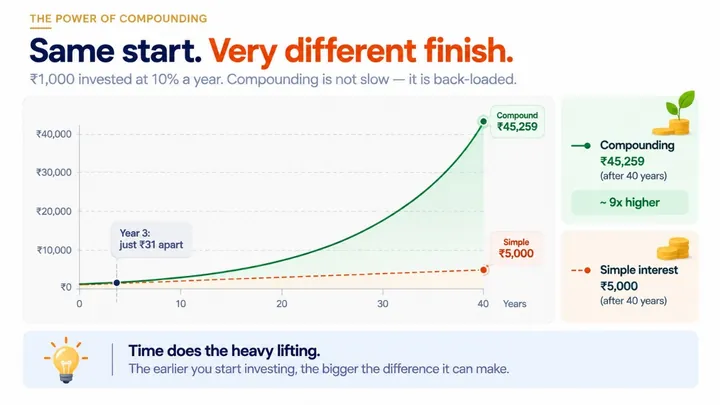
Figure 4 ₹1,000 at 10% a year. Compounding is not slow — it is back-loaded. The two lines are almost touching at year 3 and nine times apart at year 40.
Compounding is not slow. It is back-loaded. Almost nothing happens for a long time, and then a great deal happens. The people who benefit from it are simply the ones who were still there when the interesting part arrived.
Where the money comes from
Here is the same ₹1,000 shown year by year, so you can see the mechanism rather than just the result.
| Year | Opening balance | Rate | Interest earned | Closing balance |
|---|---|---|---|---|
| 1 | ₹1,000 | 10% | ₹100 | ₹1,100 |
| 2 | ₹1,100 | 10% | ₹110 | ₹1,210 |
| 3 | ₹1,210 | 10% | ₹121 | ₹1,331 |
| 10 | ₹2,358 | 10% | ₹236 | ₹2,594 |
| 20 | ₹6,116 | 10% | ₹612 | ₹6,727 |
| 40 | ₹41,145 | 10% | ₹4,114 | ₹45,259 |
In year 1, the investment earns ₹100. In year 40, it earns ₹4,114 — forty-one times as much, from the same original ₹1,000. Nobody added a single rupee. The interest simply kept being left alone.
The time value of money
Compounding is one half of a broader principle called the time value of money: a rupee available today is worth more than a rupee received in the future.
This is true for two separate reasons. First, the future is uncertain, and people naturally prefer certainty. Second, and more importantly, money available today can be put to work immediately.
Future value (FV) is what an amount today will grow to. It answers: if I invest ₹1,000 today, what will it become?
𝐹𝑉 =𝑃𝑉×(1+𝑟)𝑛
Present value (PV) is what a future amount is worth today. It answers: how much must I invest today to reach ₹20,00,000 in twelve years?
𝐹𝑉
𝑃𝑉 =(𝑟)𝑛
Where PV is the amount today, FV is the amount in future, r is the annual rate expressed as a decimal, and n is the number of years.
Working the two questions
Both formulas need three inputs: an amount, a rate and a number of years. Here is each question worked through, using the ₹1,000 at 10% a year from the table above.
- If I invest ₹1,000 today, what will it become?
Take twenty years as the holding period. The amount today is the PV; you are solving for FV.
- Step 1 - Write down the inputs. PV = ₹1,000, r = 0.10, n = 20.
- Step 2 - Work out the growth factor. (1 + 0.10)20 = 1.10 × 1.10 … twenty times = 6.7275.
- Step 3 - Multiply. FV = ₹1,000 × 6.7275 = ₹6,727 (rounded).
That is the same ₹6,727 that appears in the year-20 row of the table above — reached in one calculation instead of twenty. The growth factor is doing all the work: the ₹1,000 has not changed, and no further money was added.
- How much must I invest today to reach ₹20,00,000 in twelve years?
Now the ₹20,00,000 is the FV and you are solving for PV. Assume the same 10% a year.
- Step 1 - Write down the inputs. FV = ₹20,00,000, r = 0.10, n = 12.
- Step 2 - Work out the growth factor. (1 + 0.10)12 = 3.1384.
- Step 3 - Divide instead of multiplying. PV = ₹20,00,000 ÷ 3.1384 = ₹6,37,262 (rounded).
- Step 4 - Check it by running the answer forward. ₹6,37,262 × 3.1384 = ₹20,00,000. A present value calculation that does not reverse cleanly has an error in it.
So ₹6,37,262 set aside today, left alone at 10% a year, becomes ₹20,00,000 in twelve years.
The rate assumption changes the answer more than most people expect. The same goal, the same twelve years, three different assumed returns:
| Assumed return a year | Growth factor over 12 years | Amount needed today |
|---|---|---|
| 8% | 2.5182 | ₹7,94,228 |
| 10% | 3.1384 | ₹6,37,262 |
| Assumed return a year | Growth factor over 12 years | Amount needed today |
| 12% | 3.8960 | ₹5,13,350 |
Assume too high a return and you will set aside too little, and discover the shortfall at the end, when there is no time left to fix it. For a goal that matters, use a rate you would be comfortable defending.
One practical note. Both answers above are lump sums. Most households reach a goal like this through a monthly investment instead: at 10% a year, roughly ₹7,235 a month for twelve years reaches the same ₹20,00,000. The arithmetic for monthly investing is covered in Part 4.
You will not need to calculate these by hand — every bank and mutual fund website has a calculator, and a spreadsheet does it in one formula. What matters is knowing that both directions exist, because financial planning uses both. You use FV to work out what your goal will cost. You use PV to work out what you must set aside for it.
Worked Example — both directions
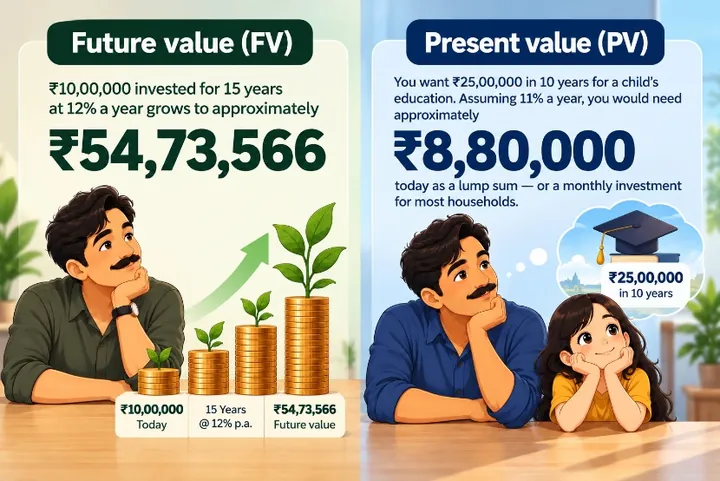
Future value (FV): ₹10,00,000 invested for 15 years at 12% a year grows to approximately ₹54,73,566.
Present value (PV): You want ₹25,00,000 in 10 years for a child’s education. Assuming 11% a year, you would need approximately ₹8,80,000 today as a lump sum — or, more realistically for most households, a monthly investment.
The Rule of 72
You will not always have a calculator. The Rule of 72 is a mental shortcut that is accurate enough for planning conversations.
Years to double ≈ 72 ÷ annual rate of return (%)
| If You Earn | Your money doubles in about |
|---|---|
| 4% | 18 years |
| 6% | 12 years |
| 8% | 9 years |
| 12% | 6 years |
| 15% | 4.8 years |
You can also run it backwards: required rate ≈ 72 ÷ years available. If you need to double your money in nine years, you need about 8% a year.
Worked Example 1 — how long?
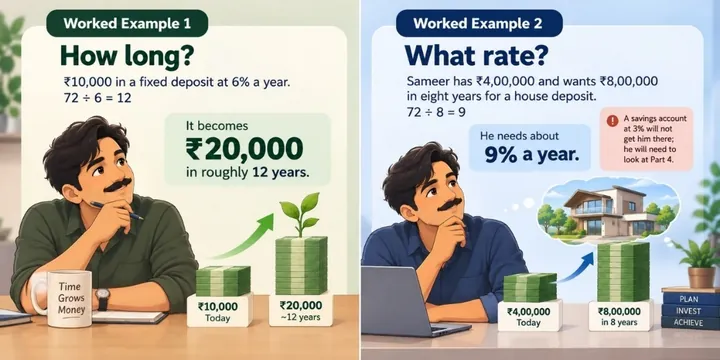
₹10,000 in a fixed deposit at 6% a year. 72 ÷ 6 = 12. It becomes ₹20,000 in roughly 12 years.
Worked Example 2 — what rate?
Sameer has ₹4,00,000 and wants ₹8,00,000 in eight years for a house deposit. 72 ÷ 8 = 9. He needs about 9% a year. A savings account at 3% will not get him there; he will need to look at Part 4.
The Rule of 72 also works in reverse for inflation, which is a sobering exercise. At 6% inflation, prices double in twelve years. Whatever your monthly household budget is today, expect to need double that in twelve years for the same standard of living.
Why starting early beats investing more?
This is the most important table in Part 1. Two people each invest ₹5,000 a month. Both earn 12% a year. The only difference is when they start.
| Priya | Vikram | |
|---|---|---|
| Starts at age | 25 | 35 |
| Stops at age | 60 | 60 |
| Years of investing | 35 | 25 |
| Total amount invested | ₹21,00,000 | ₹15,00,000 |
| Approximate value at 60 | ₹3,24,00,000 | ₹94,00,000 |
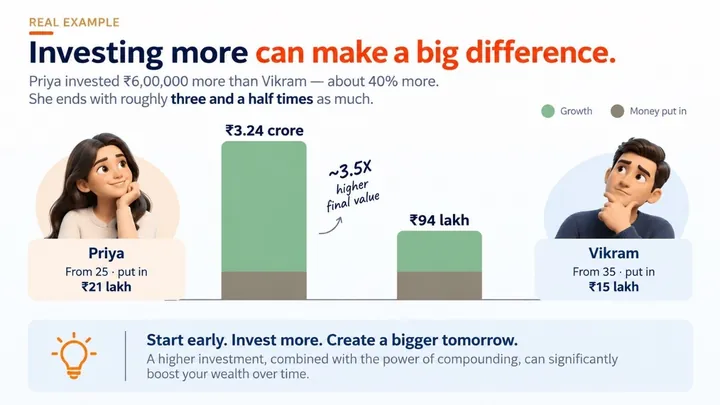
(Illustrative, assuming a constant 12% annual return. Actual market returns vary and are not guaranteed.)
Figure 5: ₹5,000 a month at 12% a year. Illustrative only — actual returns vary and are not guaranteed.
Priya invested ₹6,00,000 more than Vikram — about 40% more. She ends with roughly three and a half times as much.
The ten years Vikram lost were not ten ordinary years. They were the ten years that would have compounded the longest, and therefore the most valuable ten years of his entire investing life.
There is no way to buy them back later.
When should you start?
The honest answer is - on the day you first receive money.
That does not require a salary. A student receiving a stipend has income. A young person receiving pocket money has income. Prize money from a competition is income. The point is not the amount — a ₹500 monthly investment at eighteen will not fund a retirement. The point is that the habit is being built during the years when the habit is cheapest to build and the compounding runway is longest.
Watch Out — the two enemies of compounding
Compounding has exactly two enemies, and neither is market volatility.
Interruption: Every time you withdraw and restart, the clock resets on that money. A person who invests for six years, withdraws, and restarts has not had six years of compounding — they have had two separate short periods.
Cost: A fee of 2% a year does not reduce your final corpus by 2%. Over thirty years it can reduce it by a quarter or more, because the fee compounds against you exactly as returns compound for you. This is why expense ratios get so much attention later in this book, and why you should look at them before you invest anything.
Small amounts, done regularly
Most people cannot invest a lump sum. They can set aside a little every month, and that turns out to be enough — because compounding does not care whether the money arrives all at once or in instalments. It cares how long each rupee stays invested.
Here is the same arithmetic applied to a monthly amount rather than a one-time one. ₹5,000 a month, at 12% a year:
| You invest for | Total you put in | Approximate value |
|---|---|---|
| 10 years | ₹6,00,000 | ₹11,60,000 |
| 20 years | ₹12,00,000 | ₹50,00,000 |
| 30 years | ₹18,00,000 | ₹1,76,00,000 |
| 40 years | ₹24,00,000 | ₹5,94,00,000 |
(Illustrative, assuming a constant 12% annual return. Actual returns vary and are not guaranteed.)
Look at the middle two rows. Going from twenty years to thirty adds ₹6,00,000 of your own money and roughly ₹1.26 crore of value. You did not invest harder. You invested longer.
Two things follow, and they are the whole reason this chapter sits where it does:
Regularity beats size: A modest amount every month, uninterrupted, will usually beat a larger amount invested sporadically whenever there happens to be a surplus. The monthly habit also removes the question of when to invest, which is a question nobody answers well.
The transfer should be automatic: This is the savings-first principle from earlier, applied to investing: money that leaves your account on a fixed date, before you have had a chance to spend it, is money that actually gets invested. Automation beats willpower, because willpower has bad days.
The practical machinery for doing this — how to set up a standing monthly investment, what it is called, and how to step it up as your income grows — is covered in Part 4, once you have the accounts to do it with. For now, the point is only this: compounding does not require wealth. It requires regularity and time.
Recap in one minute
- Compounding means returns earn returns. It is back-loaded: nothing much happens, and then a great deal does.
- Time value of money: a rupee today is worth more than a rupee tomorrow. Future value (FV) projects forward from an amount you have; present value (PV) works backward from a goal you want.
- Rule of 72: years to double ≈ 72 ÷ rate. It works for inflation too.
- Starting ten years earlier can be worth more than investing 40% more money.
- Compounding’s two enemies are interrupting it and paying high costs.
- A modest monthly amount, left alone for decades, outperforms a larger amount invested sporadically.
Check your understanding
At 9% a year, roughly how long does money take to double?
Show answer to question 1
About 8 years (72 ÷ 9).Why is the difference between simple and compound interest almost invisible in year 3 but enormous in year 30?
Show answer to question 2
Because compounding is back-loaded. In early years the “interest on interest” is a tiny base; by year 30 the accumulated interest is many times the original principal, and the return is earned on all of it.Priya and Vikram both invested ₹5,000 a month at the same rate. Explain in one sentence why Priya ended with three and a half times more.
Show answer to question 3
Because her money had ten additional years to compound — and those were the ten years that would compound the longest, making them the most valuable years of her investing life.
Your action step
Find SEBI or NISM online compound interest or monthly investment calculator. Enter a realistic monthly amount you could set aside, 12% as the return, and the number of years until you turn 60. Write the answer on your spending sheet. Then reduce the number of years by five and look at the difference.