Where this fits: You are now an investor with money at stake. This chapter is the one to read twice.
By the end of this chapter you will be able to
- Recognise the structure common to every investment fraud
- Identify the main fraud types operating in India today
- Verify any intermediary in under two minutes using SEBI’s own tools
Every fraud has the same skeleton
The stories change. The costumes change — one year it is a chit fund, the next a crypto token, the next an AI trading bot. The structure underneath does not.
- An abnormal return, presented as safe: “3% per month.” “Guaranteed 28%.” “Assured returns, zero risk.”
- Urgency: “The offer closes tonight.” “Only 50 slots.” “The price doubles tomorrow.”
- Social proof: Screenshots of profits. Testimonials. A group of enthusiastic strangers. A celebrity or influencer, sometimes without their knowledge.
- An opaque method: “Proprietary algorithm.” “Arbitrage strategy.” “Foreign portfolio access.” Something that sounds sophisticated and cannot be examined.
- Early payouts that work: Small withdrawals are honoured, sometimes for months. This is the mechanism that converts the sceptical into believers — and converts believers into recruiters.
- Then friction: Withdrawals slow down. A “processing fee” or “tax clearance” is required before you can access your money. Then the platform disappears.
If you learn one thing from this chapter, learn this: you do not need to identify which specific fraud you are looking at. You need to recognise the skeleton. Points 1 and 2 together are sufficient grounds to walk away, every time, with no exceptions.
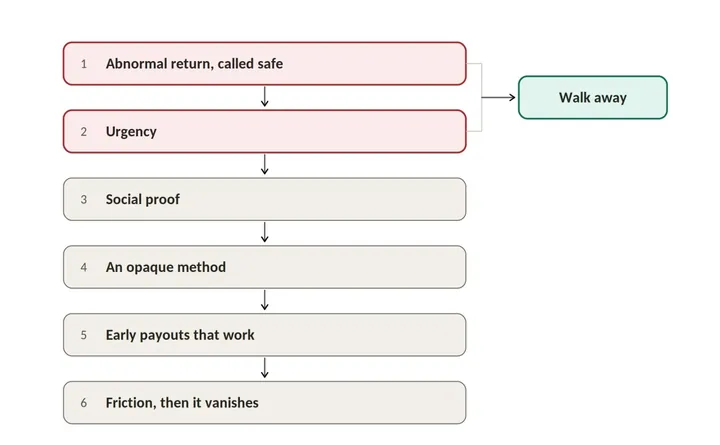
Figure 14 You do not need to identify which fraud you are looking at. Stages 1 and 2 together are sufficient grounds to leave, every time, with no exceptions.
Why point 1 alone is enough
The risk-return relationship is not a guideline; it is how markets work.
Anyone offering a return substantially above what regulated markets produce, while describing it as safe or guaranteed, is telling you something that cannot be true. There are only three possibilities: they do not understand their own product, they are misrepresenting it, or they intend to take your money.
None of the three is a reason to invest.
And note: SEBI does not approve, guarantee or assure returns on any product. Any claim that a return is “SEBI-approved” or “government-guaranteed” is, by itself, proof of dishonesty.
The main fraud types
| Fraud | How it works |
|---|---|
| Ponzi scheme | Promises high returns with little risk; pays early investors from new investors’ money rather than from any real profit. Collapses when new money slows |
| Pyramid and MLM schemes | Returns depend primarily on recruiting others rather than on any underlying product or investment |
| Fake advisers and fake apps | Entities not registered with SEBI providing stock tips or portfolio services, or apps mimicking genuine brokers |
| Phishing | Fake emails, messages or websites designed to capture OTPs, passwords and personal data |
| Smishing | The same, via SMS with malicious links |
| Vishing | The same, by phone call, with the caller impersonating a bank, broker, exchange or regulator |
| Pump and dump | Coordinated promotion inflates a thinly traded stock’s price; the promoters sell into the buying, leaving others with overpriced shares |
| Social media scams | WhatsApp and Telegram groups, or fake accounts, promoting manipulated stocks or non-existent IPO allotments |
| Unregulated chit funds and deposit schemes | Collecting deposits without authorisation, outside any regulator’s supervision |
| Crypto and digital asset frauds | Fake tokens, non-existent exchanges, or platforms promising fixed returns on digital assets |
| Malware | Software that steals credentials or locks your data, often delivered through an “investment tool” download |
Case study: the fake trading app
This has cost Indian investors substantial sums, and the method is worth knowing in detail.
How it runs:
- The target is added to a WhatsApp or Telegram group that appears official — the name and logo of a well-known broker or institution, professional-looking material, and many apparently satisfied members (most of whom are the operators)
- A “research analyst” or “relationship manager” shares tips. Several of them work deliberately, and often chosen after the fact from a wide spread
- The target is asked to download an app, via a link, to “access exclusive institutional allocations.” The app looks like a real trading app
- Money is deposited. The app displays a portfolio and rising profits. None of it exists. No shares were ever bought. The numbers are a display
- Small withdrawals are honoured, converting doubt into confidence. Larger sums are invested. The target often introduces family and friends
- When a substantial withdrawal is attempted, a “tax,” “clearance fee” or “margin requirement” must be paid first. Paying it produces a further requirement
- The app stops working. The group is deleted. The money is gone
Every warning sign was present from the beginning:
- The app was not from an official app store listing verified as a SEBI-registered broker
- The entity was not verifiable on SEBI’s website
- Returns were abnormal and described as certain
- Money was transferred to an account not verifiably belonging to a registered intermediary
- “Exclusive access” and urgency were used throughout
- A demand for payment in order to withdraw your own money is definitive proof of fraud. No legitimate intermediary in India requires this. Not once. Not ever
Case study: pump and dump
Messages circulate in groups: “This stock will double in two days. Buy now.”
Enough people buy that the price genuinely rises — which appears to confirm the claim and draws in more buyers. Thinly traded small-company shares are used precisely because a modest amount of buying moves the price a great deal.
The promoters bought before the messages went out. As the price rises, they sell into the demand they created. Buying dries up, the price collapses, and the last buyers hold shares worth a fraction of what they paid.
What to learn:
- Anonymous tips are not information. Somebody is paying to put that message in front of you, and it is not for your benefit
- Coordinated urgency to buy a specific stock is the signature of manipulation
- Check what the company actually does and what its financials look like. Manipulated stocks frequently have negligible business behind them
Market manipulation is a serious violation. SEBI investigates and acts against it, and its orders are published — but enforcement comes after the loss. Your protection is not participating.
Verify before you pay: the tools
SEBI has built specific tools to let you verify an entity in under two minutes. Use them.
SEBI Check
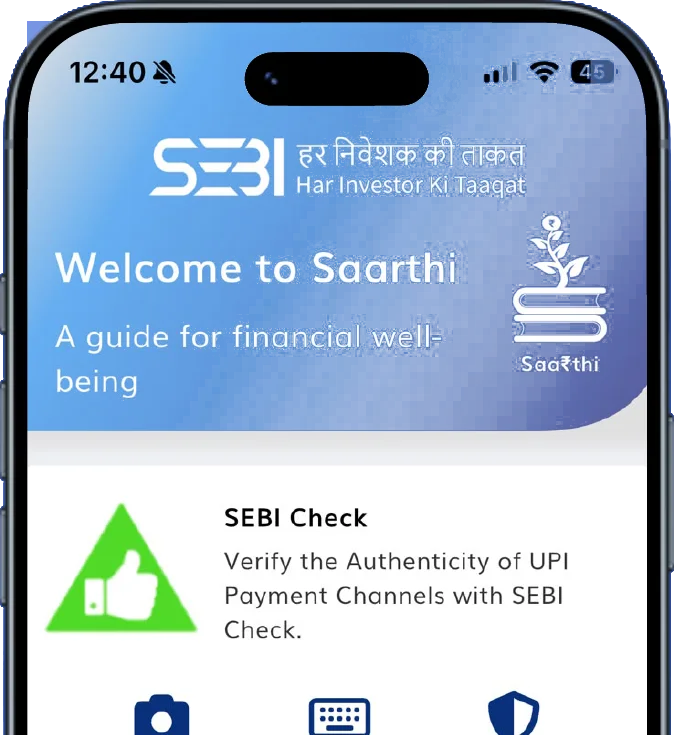
SEBI Check lets you verify the authenticity of an intermediary before transferring funds. By entering a UPI ID or scanning a QR code, you can confirm:
- The validity of the intermediary’s SEBI registration
- The corresponding bank account details of the registered entity
Access it through SEBI’s investor website, the Saa₹thi app, or at:
https://siportal.sebi.gov.in/intermediary/sebi-check
Validated UPI handles
UPI IDs of SEBI-registered investor-facing intermediaries carry an exclusive “@valid” handle issued by NPCI, with category-specific suffixes — for example .brk for brokers and .mf for mutual funds.
A genuine intermediary’s UPI ID therefore has a recognisable, verifiable structure. Legitimate transactions display a thumbs-up icon inside a green triangle, and genuine QR codes carry the thumbs-up logo at the centre.
Before paying any intermediary, check for the @valid handle and the thumbs-up indicator. An intermediary claiming SEBI registration but using an ordinary personal UPI ID is a contradiction that requires explanation.
Verified label on app stores
Following instances of spoofed trading apps, SEBI worked with Google to introduce a “Verified” label on the Google Play Store for trading apps belonging to genuine SEBI-registered brokers.
Download trading apps only from official app store listings carrying this verification. Never from a link sent to you.
SEBI’s intermediary lists: sebi.gov.in publishes lists of registered intermediaries, recognised stock exchanges and Market Infrastructure Institutions. This is the definitive check, and it is free.
SEBI orders and enforcement
Search SEBI’s published orders for the entity’s name. If SEBI has previously acted against them, you will find it.
What SEBI is doing about social media
The tools above are ones you use. There is also one working in the background, and it is worth knowing about because it changes what you should expect to see online.
Most of the fraud described in this chapter now reaches people through social media rather than through a person in an office. The volume is far beyond what any team could review by hand, so SEBI built Sudarshan, an in-house artificial intelligence system that watches publicly available content for securities market fraud. It became operational in November 2025.
What it does:
- Scans publicly available videos, posts, images, messages and advertisements across major social media platforms
- Works across languages and formats — speech and visuals as well as text, which matters in a market where a great deal of the material is in regional languages
- Looks for specific patterns: guaranteed-return claims, fabricated certifications, impersonation of SEBI-registered entities, and investment advice from people who are not registered to give it
- Assigns a risk score and generates a structured alert, so that human reviewers spend their time on the cases most likely to be real
SEBI can then direct platforms to take the content down, and reports that platforms have cooperated. In its first months the system flagged more than twenty thousand instances of potentially fraudulent content, and SEBI has reported the removal of well over a lakh of misleading posts.
What this means for you — and what it does not
It is a useful signal that regulators are no longer waiting for complaints before acting. But automated surveillance runs behind the people it is chasing. A scheme can be live for weeks before it is flagged, operators move between platforms and change their vocabulary, and content in a private WhatsApp or Telegram group is not public content at all.
So do not read the absence of a warning as a clearance. The fact that a post is still up means nothing about whether the person behind it is registered. That remains a question you answer yourself, in two minutes, on sebi.gov.in.
The distinction SEBI draws is worth holding on to: financial education is permitted, and so is commentary. Investment advice is not, unless the person giving it is registered with SEBI. Someone telling you what a mutual fund is may be doing something legitimate. Someone telling you what to buy, for a fee, without a registration number, is not.
Your safety checklist
Before investing anywhere:
- Verify SEBI registration on sebi.gov.in, not on the entity’s own website
- Use SEBI Check to verify the UPI ID and bank account before transferring
- Check for the @valid handle and the thumbs-up indicator
- Search for SEBI orders against the entity
- Confirm the promised return is plausible against regulated market norms
- Insist on written documentation — scheme documents, terms, registration numbers
- Take 48 hours. Genuine opportunities survive it
Never, under any circumstances:
- Share a password, PIN or OTP with anyone. No institution ever needs your OTP. Not to verify you, not to cancel a fraudulent transaction, not for any reason
- Download a trading or investment app from a link
- Pay any fee in order to withdraw your own money
- Approve a UPI mandate you did not initiate — and remember that a PIN authorises money to leave your account, never to arrive
- Transfer money to an individual’s personal account for an investment
- Sign a blank form or blank DIS, or give a broker a general Power of Attorney when a DDPI would do
- Invest on a tip from a group, a stranger, or a celebrity endorsement
- Invest borrowed money
Also:
- Keep your device and apps updated
- Use two-factor authentication everywhere it is available
- Do not use public Wi-Fi for financial transactions
- Enable all SMS and email alerts and actually read them
- Guard your mobile number; investigate any unexplained loss of network immediately
Watch Out — you are the target, not the exception
Fraud victims are frequently educated, financially literate and cautious people. Frauds do not succeed by fooling the foolish. They succeed by applying skilled social engineering under manufactured time pressure, often through a relationship built over weeks.
The defences that work are procedural, not intellectual: verify every entity at the source, never share an OTP, never pay to withdraw, and take 48 hours. Rules protect you when your judgement is under pressure. Confidence in your own judgement does not.
If it has already happened
Speed matters enormously.
- Contact your bank immediately: Report the unauthorised transaction and request that the account be secured. Prompt reporting can affect your liability
- Report to the National Cyber Crime Reporting Portal at cybercrime.gov.in, or call the national cybercrime helpline 1930. Reporting within the first hours materially improves the chance of funds being frozen
- File a police complaint and keep a copy of the FIR
- If a SEBI-registered entity is involved, lodge a complaint on SCORES
- Report the fraudulent entity to SEBI, so that others can be warned
- Preserve everything — screenshots, messages, transaction records, app details, group names, phone numbers, URLs
- Change all passwords and review every linked account
- Tell your family. Shame keeps victims silent, and silence lets the same operation continue. Reporting it is the responsible act, not a humiliating one
Recap in one minute
- Every fraud shares one skeleton: abnormal returns presented as safe, plus urgency. That combination alone is sufficient reason to walk away.
- SEBI never approves, guarantees or assures returns. Any such claim is proof of dishonesty.
- A demand for payment before you can withdraw your own money is definitive proof of fraud.
- Verify with SEBI Check, the @valid UPI handle, the verified app label, and SEBI’s own registration lists — under two minutes.
- If defrauded, act within hours: bank, cybercrime.gov.in or 1930, police FIR, SCORES.
Check your understanding
Name the six elements of the standard fraud structure.
Show answer to question 1
An abnormal return presented as safe; manufactured urgency; social proof; an opaque method; early payouts that work; then friction and disappearance.Why is a request to pay a “processing fee” before withdrawing your profits conclusive?
Show answer to question 2
Because no legitimate intermediary in India ever requires a payment in order to release your own money. It is the point at which the operation converts a fictitious balance into a further real extraction.A caller says they are from SEBI and needs the OTP just sent to your phone to protect your account. What do you do, and why?
Show answer to question 3
End the call and share nothing. SEBI does not call investors asking for OTPs, and no institution ever needs your OTP. Then report it and verify independently through official channels.
Your action step
Do three things today. Open SEBI Check and verify the UPI ID of one intermediary you already use. Check whether your broker’s app carries the verified label. Then tell one older family member the two rules that matter most: never share an OTP, and never pay a fee to withdraw your own money.