Where this fits: The last chapter covered criminals. This chapter covers legitimate entities that have failed you — and exactly what to do about it.
By the end of this chapter you will be able to
- Follow the correct escalation path for a securities market complaint
- Use SCORES and the Smart ODR platform
- State your rights as an investor and the Do’s and Don’ts that protect them
The escalation ladder
Complaints are resolved fastest when raised at the right level, in order. Skipping steps generally slows things down rather than speeding them up.
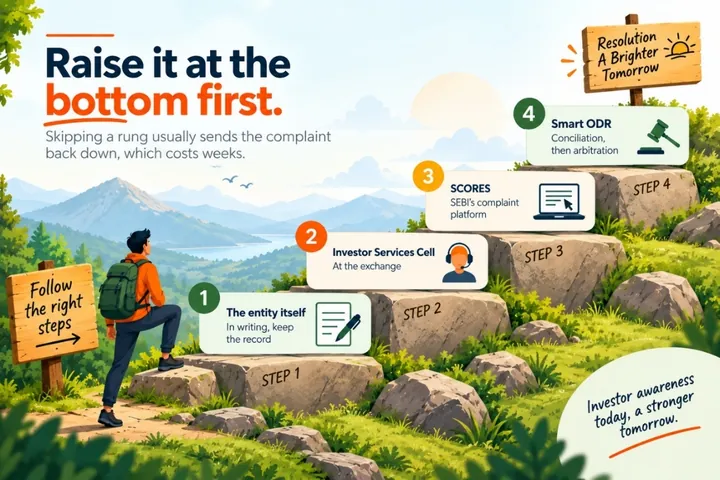
Figure 15 Raise it at the bottom first. Skipping a rung usually sends the complaint back down, which costs weeks.
Step 1 — The entity itself: Raise the complaint in writing with the intermediary or company, addressed to its compliance officer or designated grievance officer. Every registered entity must have one, and the details must be displayed on its website. Keep the acknowledgement.
Step 2 — Investor Services Cell of the exchange: For matters involving a trading member, the exchange’s Investor Services Cell handles queries, complaints and dispute resolution.
Step 3 — SCORES: If unresolved or unsatisfactorily resolved, lodge a complaint on SEBI’s SCORES platform.
Step 4 — Smart ODR: For disputes not resolved through the entity or SCORES, use the Online Dispute Resolution platform for conciliation and, if needed, arbitration.
SCORES
SCORES — the SEBI Complaints Redress System — is an online platform for lodging and tracking complaints against listed companies, SEBI-registered intermediaries and Market Infrastructure Institutions.
It is a facilitative platform: it routes your complaint to the concerned entity, requires a response, tracks it, and escalates if the entity does not act. SEBI does not itself adjudicate your individual commercial dispute through SCORES.
What SCORES covers
Complaints relating to your investments in the securities market against:
- Listed companies — non-receipt of dividend, shares, annual report, refunds, transfer or transmission issues
- SEBI-registered intermediaries — brokers, depository participants, RTAs, investment advisers, research analysts, merchant bankers
- Market Infrastructure Institutions
- Mutual funds and AMCs
What SCORES does not cover
- Commercial or contractual disputes outside SEBI’s purview
- Complaints unrelated to securities market investments
- Complaints against unlisted companies
- Anonymous complaints
- Matters that are sub judice
- Dissatisfaction with investment performance. A share that fell in value is investment risk, not a grievance
Filing a complaint
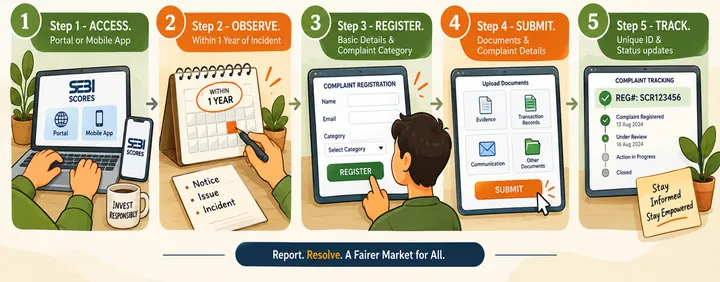
SCORES 2.0
In April 2024 SEBI introduced an upgraded platform, SCORES 2.0, with several improvements:
- Reduced resolution timelines
- Auto-routing of complaints to the concerned entity without manual intervention
- Auto-escalation where the entity does not respond within the prescribed period
- A two-level review system, allowing you to seek review if you are dissatisfied
- Integration with the KYC Registration Agency database, validating complainant identity
Under the current process, the concerned entity is expected to submit an Action Taken Report (ATR) within 21 calendar days. If you are dissatisfied, you may seek a first-level review, and subsequently a second-level review, within the prescribed windows — currently 15 calendar days each. Timelines are revised from time to time; check the current guidance on the portal.
Other features: available 24×7; instant acknowledgement with a unique complaint number; online status tracking with the ability to send reminders; a central database with audit trails; and aggregate complaint data that informs SEBI’s supervisory and policy decisions.
Online Dispute Resolution
The Smart ODR platform provides online conciliation and arbitration for disputes in the Indian securities market. It was introduced under SEBI’s master circular on Online Dispute Resolution.
Why it exists
Traditional dispute resolution is slow, expensive and geographically inconvenient. A retail investor in a small town with a ₹40,000 dispute has, historically, had no proportionate remedy — the cost of pursuing it exceeded the amount at stake. ODR was designed to address exactly that gap.
The three stages
Stage 1 — Direct with the entity. You must first raise the dispute with the market participant and give it a reasonable opportunity to resolve it.
Stage 2 — Conciliation. If unresolved, the matter goes to an independent conciliator through the ODR portal. Conciliation is a facilitated settlement process; the conciliator helps the parties reach agreement.
Stage 3 — Arbitration. If conciliation fails, the matter proceeds to arbitration. An independent arbitrator hears the matter and passes an award, which is binding subject to applicable law.
Key benefits
- Fully digital. File, track and participate online, from anywhere
- Faster than conventional routes, with defined timelines at each stage
- Lower cost, making small disputes economically worth pursuing
- Independent conciliators and arbitrators drawn from empanelled institutions
- Accessible regardless of your location
The platform is at https://smartodr.in/. Exchanges including NSE and BSE facilitate investor grievance redressal through it.
Investor Services Cells
Stock exchanges operate Investor Services Cells that resolve queries and complaints against trading members and facilitate conciliation and arbitration.
If your complaint concerns a broker — non-receipt of funds or securities, unauthorised trades, excess brokerage, non-issuance of contract notes — the exchange’s Investor Services Cell is a direct and effective route alongside SCORES.
SEBI’s investor education resources
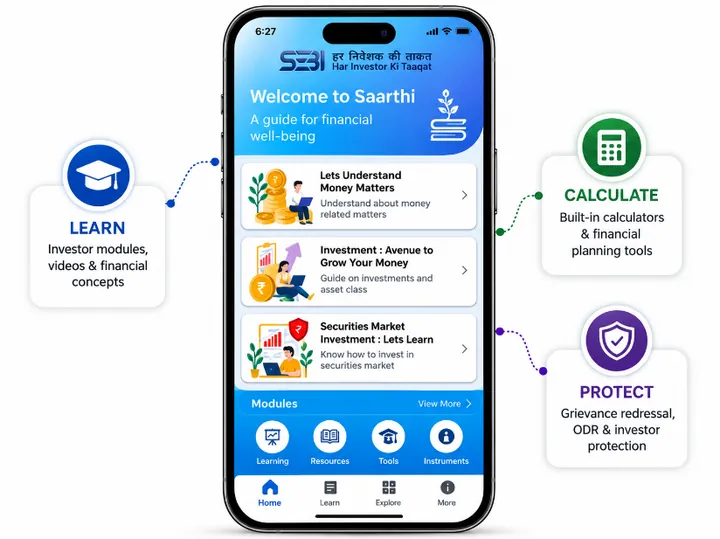
Saa₹thi app. SEBI’s official investor education mobile application, containing a financial health check tool, a “spot a scam” feature, modules on KYC, mutual funds, ETFs, buying and selling shares, grievance redressal and ODR, and videos on personal finance planning.
Investor awareness programmes. SEBI conducts these through several channels: visits to SEBI offices by students and visits by SEBI officials to institutions; Regional Investor Seminars for Awareness (RISA) run with exchanges, depositories, AMFI and commodity exchanges; programmes by SEBI-recognised Investor Associations in tier II and tier III cities; and programmes by SEBI-recognised Securities Market Trainers (SMARTs).
SEBI Investor Certification Examination. Also known as the SEBI Investor Awareness Test, a free online examination run by SEBI in collaboration with the National Institute of Securities Markets (NISM). It covers the basics of savings, investments and the Indian securities market.
| Feature | Detail |
|---|---|
| Cost | Free |
| Languages | English and Hindi |
| Negative marking | None |
| Certificate | Issued on passing |
| Eligibility | No age or education restrictions |
Registration is through the NISM portal at sice.nism.ac.in. If you have worked through this book, you have covered most of the ground. Taking it is a good way to confirm what you have learned.
Dharohar: SEBI’s digital repository of Indian securities market history, launched on 26 January 2025, documenting the market’s evolution over more than 150 years.
Services you are entitled to
From market intermediaries:
- Execution of trades on your instructions
- Issuance of contract notes within the prescribed time
- Intimation of margin payments due
- Facilitation of early pay-in instructions
- Settlement of your funds
- Intimation of securities held in the Client Unpaid Securities Account
- Issuance of a retention statement of funds
- Risk management systems to mitigate operational and market risk
- Processing of client profile changes as instructed by you
- Sharing of relevant exchange circulars
- Redressal of your grievances
Your rights as an investor
You have the right to:
- Ask about background. Information about the work history and background of the person handling your account, and about the firm itself
- Complete risk disclosure. Full information about the risks, obligations and costs of any investment before you invest
- Suitable recommendations consistent with your financial needs and investment objectives
- Copies of everything you signed — all completed account forms and agreements
- Accurate, understandable statements
- Clear terms and conditions for every transaction you undertake
- Timely access to your funds, and information about any restriction or limitation on that access
- Full disclosure of charges — maintenance or service charges, transaction or redemption fees, and penalties
- Grievance redressal — to raise concerns with the firm’s compliance officer and receive prompt attention and fair consideration
Do’s
- Consult a SEBI-registered Investment Adviser for advice where appropriate
- Invest according to your own investment objective and risk appetite
- Insist on a valid contract note or confirmation memo within 24 hours of every transaction
- Track your demat holdings regularly
- Read every document carefully before signing
- Note all charges, fees and brokerage applicable to your accounts, and keep a record
- Keep records of documents signed, account statements, contract notes received and payments made
- Periodically review your financial goals and your portfolio against them
- Always pay through banking channels — never in cash
- Keep your information updated with your broker and DP: address, bank details, email, mobile number. Since numbers can be ported, keep a single mobile number attached to your accounts, because it is the key to every important transaction
- Avail nomination for every investment. Multiple nominations may be permitted in a demat account
- Get your running account settled periodically, at the interval you have opted for
- Examine and review your trading account regularly
- Read the SMS and email alerts from the exchange about trades executed in your account, and the periodic communications about funds and securities balances held with your trading member
Don’ts
- Don’t borrow money to invest
- Don’t deal with unregistered brokers or other unregistered intermediaries
- Don’t pay more than the agreed brokerage or charges
- Don’t execute any document without fully understanding its terms
- Don’t sign any blank form or Delivery Instruction Slip
- Don’t issue a general Power of Attorney to a broker or DP. Give a DDPI, which is limited to four defined purposes, or authorise each sale yourself through eDIS
- In a dispute, don’t delay — file a written complaint with the intermediary, exchange or SEBI within a reasonable time
- Don’t engage in dabba trading. It is illegal, and apparent cost savings come at the price of every protection described in this book
- Don’t act on hot tips. Someone circulating a tip may be trying to offload securities they cannot otherwise sell. Disseminating such tips is itself an illegal activity and should be reported to SEBI
- Never share your password with anyone, and change it frequently
- Don’t fall for Ponzi schemes, unregistered chit funds, or unregistered collective investment or deposit schemes
- Don’t forget to strike off blank spaces in your KYC documents
- Don’t opt for digital contracts if you are not comfortable with computers
Recap in one minute
- Escalate in order: the entity’s compliance officer, then SCORES, then Smart ODR, with the exchange’s Investor Services Cell available for broker matters.
- SCORES routes and tracks your complaint; the entity must file an Action Taken Report within the prescribed period, currently 21 calendar days, with two levels of review available.
- SCORES does not cover investment losses, unlisted companies, anonymous complaints, or disputes outside SEBI’s purview.
- Smart ODR provides low-cost digital conciliation and arbitration, making small disputes worth pursuing.
- Know your rights — risk disclosure, suitable recommendations, accurate statements, full disclosure of charges, and grievance redressal.
Check your understanding
Your broker has not issued contract notes for three months. Set out the escalation path.
Show answer to question 1
Raise it in writing with the broker’s compliance officer and keep the acknowledgement. If unresolved, lodge a complaint on SCORES. If still unresolved, use Smart ODR. The exchange’s Investor Services Cell is also available for matters involving a trading member.You bought a share and it fell 40%. Is this a SCORES complaint? Explain.
Show answer to question 2
No. A fall in the value of an investment is investment risk, not a grievance. SCORES does not cover dissatisfaction with investment performance.Why does Smart ODR matter particularly for a small-value dispute?
Show answer to question 3
Because conventional dispute resolution costs more than a small dispute is worth, so small-value investors historically had no proportionate remedy. ODR is digital, faster and cheaper, making such disputes economically worth pursuing.
Your action step
Register on SCORES today, before you need it. Registration takes a few minutes and is validated against your KYC. Then bookmark smartodr.in and cybercrime.gov.in. Knowing exactly where to go, before something goes wrong, is worth more than reading about it afterwards.