Where this fits: You have invested. This chapter makes sure you know what you actually own and that it is correct.
By the end of this chapter you will be able to
- Read a contract note and a Consolidated Account Statement and know what to check
- Explain the settlement process and where your money and securities are at each stage
- Set up a review routine that informs you without provoking you
Investing does not end at the purchase
Every transaction you make generates a record. Those records are your proof of ownership, your basis for tax computation, and your early warning system if something is wrong.
Most investors never read them. The ones who do catch errors early, when they are easy to fix.
Your documents
Contract note — Issued by your stockbroker after every trade executed on the exchange, within the prescribed time. It is a legally significant document.
It shows:
- The security bought or sold
- Quantity and price
- Trade date, time and order number
- Brokerage
- Securities Transaction Tax (STT)
- Stamp duty
- Exchange transaction charges, SEBI turnover fees and GST
- The net amount payable or receivable
What to check, every single time:
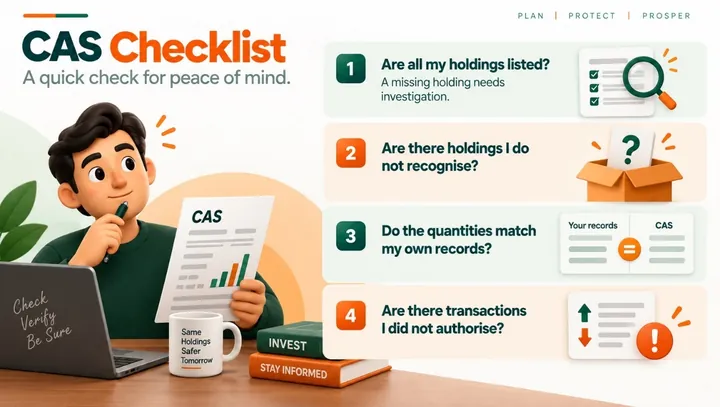
- Did I place this trade? An unfamiliar trade is a serious matter — report it to your broker and the exchange immediately.
- Do the quantity and price match what I intended?
- Is the brokerage what was agreed? Compare against your tariff sheet.
- What did this actually cost in total? The gap between the price you saw and the net amount is your real cost of transacting, and seeing it in rupees is instructive.
You are entitled to a contract note for every trade. If you are not receiving them, that itself is a grievance.
Consolidated Account Statement (CAS)
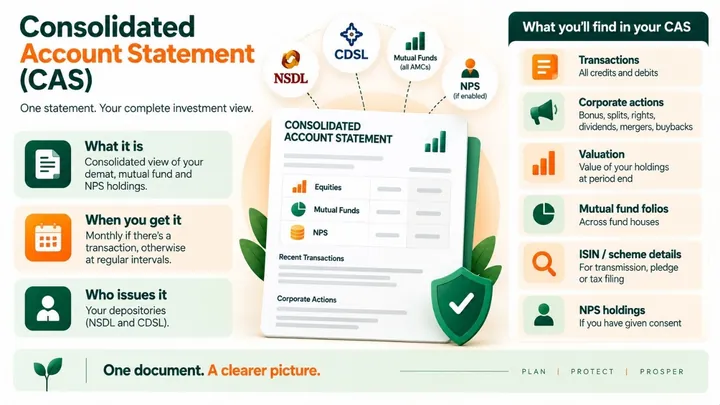
Issued by the depositories, the CAS gives a consolidated view of the securities held in your demat account, and — where linked by PAN — your mutual fund holdings across fund houses.
It is the single most useful document for checking that your records match reality.
It is issued monthly where there has been a transaction, and at longer prescribed intervals where the account has been dormant, so a CAS arrives whether or not you ask for one. What makes it valuable is its scope: it is the only document that pulls holdings from both depositories and from every fund house you have invested with into one place.
Beyond a list of holdings, a CAS typically carries:
- Transactions for the period, so you can trace every credit and debit against your own records.
- Corporate actions affecting your holdings — bonus issues, stock splits, rights entitlements, dividends, mergers and buybacks. This is often how an investor first learns that a holding has changed in number or in name.
- Valuation of your holdings at the period-end price, which gives you a portfolio total without any calculation.
- Mutual fund folios across AMCs, linked by PAN, including schemes you may have forgotten.
- ISIN and scheme identifiers, which are what you will need for a transmission, a pledge or a tax computation.
- NPS holdings, where you have consented. Your NPS Statement of Transaction can be folded into the CAS on a consent basis, given on your Central Recordkeeping Agency’s website. Once enabled, the pension corpus appears alongside your demat and mutual fund holdings — which is as close as most people get to a single view of everything they own.
Report any discrepancy immediately, in writing, to your DP or broker — and escalate through the grievance channels if it is not resolved.
Getting your CAS through DigiLocker
Registered users of DigiLocker can securely access their latest Consolidated Account Statement and Transaction-cum-Holding Statement for their demat accounts through the DigiLocker portal. Documents fetched this way carry the same standing as the originals, and having them in one place is useful when a bank, a lender or a tax adviser asks for proof of holdings.
DigiLocker also offers a nomination facility, and this is the part worth acting on. In the event of the account holder’s demise, the nominated person may be notified and — subject to completing the prescribed authentication and verification — can access the DigiLocker account and view the documents the holder stored or fetched.
That solves a specific and very common problem: the family knows an investment exists but cannot find the paperwork. A CAS sitting in a nominated DigiLocker account is a list of everything held, reachable by the person who will need it. It complements the nomination you register with your DP; it does not replace it.
Statement of funds and securities
Provided by your broker, showing the balance of funds and securities in your trading account. Check that money you have not deployed is where you expect it, and that securities you have sold have left and been paid for.
Mutual fund statement of account
If you hold mutual fund units without a demat account, the AMC or RTA issues a Statement of Account (SOA) showing units held, transactions, NAV and value. MF Central provides a consolidated view across fund houses.
Annual reports and scheme documents
Listed companies publish annual reports; mutual funds publish periodic factsheets and annual reports. Reading the factsheet of a fund you own once or twice a year is a reasonable habit — it tells you what the portfolio actually holds now, which may have drifted from what you bought.
The settlement process, and where your money is
Understanding this removes a great deal of unnecessary anxiety about the day or two when money has left and shares have not arrived.
T+1 settlement: Means that trades executed on day T settle on the next working day.
Pay-in: On the settlement day, sellers deliver securities and buyers deliver funds to the clearing corporation.
Pay-out: The clearing corporation delivers securities to buyers and funds to sellers.
Because the clearing corporation guarantees both legs, neither side depends on the other’s good faith. This is the structural safeguard of the clearing corporation, working.
The UPI block mandate improves this further for eligible investors: your money stays blocked in your own bank account rather than being transferred to the broker in advance, and is debited only when the trade actually executes. Ask your broker whether it is available to you.
Monitoring without damaging yourself
Here is a genuine paradox. Checking your portfolio more often makes you feel more in control and makes your returns worse.
The reason is behavioural, but the arithmetic of it is worth stating here. Over any single day, an equity portfolio is close to a coin toss — roughly as likely to be down as up. Over a year, it is up considerably more often than down. Over a decade, historically, positive outcomes have dominated.
So the more frequently you look, the more losses you see. Not because you are losing more, but because you are sampling at a frequency where noise dominates signal. And because losses hurt roughly twice as much as equivalent gains, frequent checking produces a steady drip of discomfort that eventually provokes an action — usually the wrong one, usually at the worst time.
A sensible routine
| Frequency | What to do |
|---|---|
| On every transaction | Check the contract note or confirmation against what you intended |
| Monthly | Confirm the SIP debits went through. Nothing else |
| Every six months | Review holdings against goals. Check allocation drift. Read your CAS |
| Annually | Full review — rebalance if needed, update goal costs, increase SIPs with income, check nominations |
| On major life events | Marriage, child, job change, inheritance, serious illness — reassess risk capacity |
What a review is, and is not
A review asks: Am I still on track for this goal? Has my allocation drifted from target? Has anything fundamental changed about what I own? Do I need to increase my contribution?
A review does not ask: What has done well recently? What is everyone else buying? Should I switch to the fund at the top of this year’s table?
The first set of questions leads to considered adjustments. The second leads to performance chasing, which is a reliable way to buy high and sell low.
Watch Out — the annual report you should actually read
Once a year, calculate one number: what percentage of your annual income did you invest?
Not your return. Your savings rate. In the early years it matters far more than performance — the difference between investing 10% and 20% of income dwarfs the difference between an 11% and a 13% return, and unlike the return, it is entirely within your control.
Record keeping
Keep, in one place, physically or digitally:
- Contract notes and transaction statements
- Consolidated Account Statements
- Mutual fund statements of account and folio numbers
- Purchase details for every holding — date, quantity, price. You will need these for capital gains computation, and reconstructing them years later is painful
- Insurance policy documents and nominee details
- Account numbers, DP IDs, client IDs, folio numbers
- Login details stored securely — not in a plain text file, and not written on the first page of a diary
- Tell one trusted family member where this file is. What happens when nobody knows is covered later.
Recap in one minute
- Check every contract note against what you actually intended, and check the CAS for holdings you do not recognise.
- T+1 settlement completes one working day after the trade; the clearing corporation guarantees both legs.
- The UPI block mandate keeps your money in your own account until the trade executes.
- Check monthly that SIPs went through; review properly twice a year; rebalance annually.
- Keep purchase records for every holding. You will need them for tax, and reconstruction is painful.
Check your understanding
Name three things you should verify on a contract note.
Show answer to question 1
That you actually placed the trade; that quantity and price match your intention; and that the brokerage matches your agreed tariff. (Also worth checking: the total cost including all statutory charges.)Why does checking your portfolio daily tend to worsen returns even though nothing about the portfolio changes?
Show answer to question 2
Over a single day an equity portfolio is close to a coin toss, so frequent checking shows you many more losses. Combined with loss aversion, this steady discomfort eventually provokes an action, usually the wrong one.Your CAS shows a holding you do not recognise. What do you do?
Show answer to question 3
Report it immediately in writing to your DP or broker, and escalate through the Chapter 27 channels if it is not resolved promptly.
Your action step
Create one folder — physical or digital — labelled with your name and “Investments.” Put into it every statement you can find. List every account, folio and policy on a single sheet at the front. Then tell one family member where it is. This single hour is worth more to your family than any scheme selection you will ever make.