Where this fits: You know what to buy and how to monitor it. This chapter addresses the largest single risk to your returns — you.
By the end of this chapter you will be able to
- Recognise the main biases that push investors in predictable wrong directions
- Distinguish a considered decision from following a crowd
- Restart after a break without repeating whatever caused it
The uncomfortable finding
Most people believe successful investing is about choosing the right stock or fund. Research and long experience suggest something less flattering: investor behaviour usually matters more than investment selection.
Studies of investor returns versus fund returns have repeatedly found a gap — investors in a fund often earn less than the fund itself reports. The fund did not change. The investors bought after good periods and sold after bad ones, so their money was present for the falls and absent for the recoveries.
Nobody does this on purpose. It happens because our minds use shortcuts that served us well for most of human history and serve us poorly in financial markets. A cognitive bias is one of those shortcuts, misfiring. Everyone has them, professionals included. The goal is not to eliminate them — that is not possible — but to recognise them and build systems that limit the damage.
The two that do the most damage
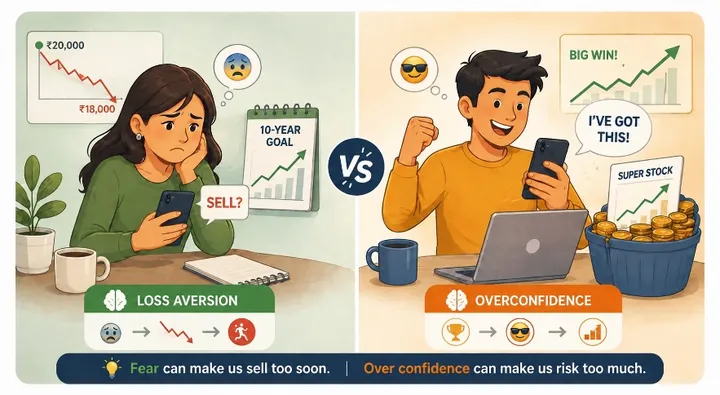
Loss aversion
The pain of losing an amount is felt roughly twice as strongly as the pleasure of gaining the same amount. It causes panic selling in declines, selling winners early to “book the profit” while holding losers hoping they recover, and refusing to exit a poor investment because that would make the loss real.
Example — Riya
Riya invested ₹20,000 for a goal ten years away. A correction reduced its value to ₹18,000. Although she did not need the money for a decade, she checked daily, then redeemed to stop the discomfort. Months later the market had passed her entry point.
Her analysis had not changed. Her plan had not changed. Only her feelings had — and she acted on those instead, converting a temporary paper decline into a permanent realised loss.
Overconfidence
Systematically overestimating our own knowledge and ability to predict. It causes overtrading, heavy concentration in a few positions, and mistaking a rising market for personal skill.
Example — Aman
Aman made a substantial profit on one stock and concluded he had seen something others had missed. Without research he put most of his savings into a second company on the strength of that confidence, and lost a significant amount.
His first success had been a rising market lifting most stocks. He had mistaken a tide for a talent.
Overconfidence is particularly dangerous because it grows during good periods — precisely when risk is accumulating.
The rest, briefly
| Bias | What it is | What it looks like in practice |
|---|---|---|
| Confirmation | Seeking information that agrees with you | Reading the positive analysis on a stock you own and dismissing the negative as pessimism |
| Anchoring | Fixating on the first number you saw | “I’ll sell when it gets back to what I paid.” The market does not know what you paid |
| Recency | Assuming the recent past continues | Buying last year’s top-performing fund; staying in cash for years after a crash |
| Endowment | Valuing something more because you own it | Holding an inherited stock you would never buy today. Ask: if I did not own this, would I buy it at this price? |
| Regret aversion | Avoiding decisions for fear of regret | Not investing in case the market falls tomorrow. Inaction is a decision, and inflation prices it |
| Framing | Reacting to presentation, not substance | “₹1 lakh became ₹3 lakh” in 10 years sounds better than “11.6% a year,” though they may be identical |
| Status quo | Preferring things as they are | Leaving ₹8 lakh in a savings account for six years because moving it requires a decision |
Status quo bias is the quietest of these and possibly the most expensive, because it produces no event you can point to.
The crowd
Herd behaviour deserves separate treatment because it arrives through your phone rather than from inside your head, and because markets make it uniquely dangerous.
When a situation is uncertain and others seem confident, following them is usually sensible. In a market it is not, for one specific reason: the crowd’s action changes the price. If everyone rushes to one exit in a building, the exit does not narrow. If everyone rushes to buy one stock, its price rises — which makes it more attractive to the next person, which pushes it higher still. The signal and the crowd become indistinguishable, and prices detach from anything the business is doing.
Herding is not new; its speed is. Social media carries a claim to millions in hours with no verification. Messaging groups manufacture urgency and consensus among strangers. Friends mention their gains and not their losses. Headlines are written to be clicked, which means written to provoke. Notice how many of these are designed to produce a reaction rather than a decision.
At the top, prices rise, stories of easy gains circulate, and new participants enter — often borrowing, often without research, often into whatever has risen most. Confidence peaks precisely when risk is highest.
At the bottom, headlines turn frightening, selling accelerates, and the falling price validates the fear. Fear peaks precisely when future expected returns are best.
Watch Out — the pattern that destroys wealth
Buying enthusiastically near the top and selling in despair near the bottom is the most reliable wealth-destroying pattern in retail investing, and it is entirely a product of following the crowd.
The remedy is not courage in the moment; courage is unreliable when you are frightened. The remedy is a plan written in advance and mechanisms that execute it without needing your consent.
Momentum investing is not herd behaviour
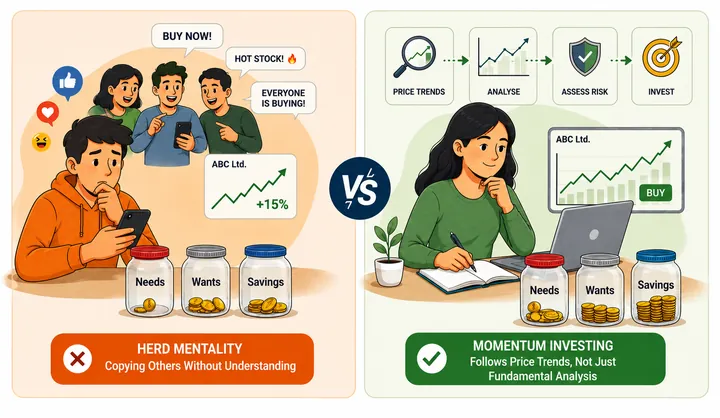
These are frequently confused. The difference is method, not direction.
| Momentum investing | Herd mentality | |
|---|---|---|
| Basis | A defined strategy analysing trends and other factors | Copying what others are doing |
| Rules | Entry and exit criteria decided in advance | None |
| Risk management | Position sizing and exit discipline built in | None |
| Exit plan | Defined before entry | Absent — typically exits in panic |
Two people buy the same rising share. Neha has examined the results, decided in advance where she would exit, and sized the position to her plan. Ravi bought because three people in a group chat were buying. When the price falls 15% next month, Neha’s plan tells her what to do, and Ravi has no idea. Neha is not guaranteed a profit — she may lose. The difference is that she made a decision and can evaluate it, while Ravi outsourced his judgement to strangers with unknown motives.
Five questions before you act
When you feel the pull to buy because something is rising, or sell because everything is falling, answer these in writing:
- Why this specific thing? If the answer contains “because it’s going up,” you have your answer.
- Do I understand how it works? Can you explain it in two sentences?
- Which goal does it serve, and does it fit my allocation?
- Am I relying on facts or on other people? Where did the information come from, and have you verified it at the source?
- What would make me wrong, and what would I do then?
If you cannot answer all five, you are not investing. You are joining.
Starting, stopping, and starting again
Biases and crowds explain why investors go wrong. This last section is about the practical business of beginning — and of resuming, which is far more common than anyone admits.
If you have never started
| What people say | What usually helps |
|---|---|
| “I don’t earn enough” | Start with an amount so small you are guaranteed not to notice it. The purpose of year one is not accumulation; it is proving that the money leaves and nothing bad happens |
| “It’s too complicated” | It genuinely was, once. Complete the KYC this week. That is the barrier; everything after it is easier than you expect |
| “I’ll start when things settle down” | Things do not settle down. Notice that this reasoning has no end point, and that you have already seen what a ten-year delay costs |
| “I’m afraid of losing money” | The most rational of the four. Put the emergency fund and insurance in place first, start in a lower-risk category, and accept that not investing is not the safe option — idle money loses value with certainty |
| “I don’t know who to trust” | Trust the system, not individuals. Deal only with SEBI-registered intermediaries, verified on SEBI’s own website. A low-cost index fund requires faith in nobody’s judgement |
If you keep intending and not acting
You have the knowledge. What is missing is a mechanism, and the gap between intention and action closes by removing decisions rather than by increasing resolve. Set a date, not an intention. Start smaller than feels serious — a trivial amount that runs for five years beats a serious amount that runs for two. Automate within two days of your salary credit. Tell someone. And do one thing this week rather than the whole plan.
If you stopped
This is common and rarely discussed. People stop for reasons that are usually sound at the time.
| Reason | What usually helps |
|---|---|
| Income fell or expenses rose | Reduce rather than cancel. ₹500 continuing beats ₹5,000 stopped. Most platforms allow a pause — use it |
| A loss, and it hurt | Check whether the investment was wrong or the horizon was. Often a good investment was held with a short-term mindset |
| Life event took over | Entirely legitimate. Set a specific restart date rather than an open-ended intention |
| Lost track of the paperwork | MF Central and MITRA can trace forgotten folios. Recover first, then restart |
| Lost confidence in the choice | Review against the goal, not against last year’s performance |
| It simply drifted | The most common and the easiest to fix. Reinstate the mandate |
Three rules for restarting.
Do not wait for a better entry point — waiting for the market to fall before restarting is market timing.
Diagnose before repeating: if the amount was too high, restart lower; if you stopped after a fall, restart in a lower-risk category. Restarting identically produces an identical outcome.
Recover what you already have before starting anything new; you may own more than you remember.
What actually works
Awareness is weak. Knowing about loss aversion does not stop you feeling it at 3pm on a day the market has fallen 6%. Systems, rules and friction are what work.
- Write a one-page plan before you invest: the goal, the horizon, the target allocation, and the conditions under which you would sell. In a crisis, read your own document. The person who wrote it was calmer than any commentator will be.
- Automate: A monthly instruction invests whether or not you feel like it. Automation removes the decision at exactly the moments when your judgement is least reliable.
- Impose a waiting period: No investment decision within 48 hours of reading news or receiving a tip. Almost every damaging decision is made quickly; almost none becomes worse for a two-day delay.
- Check less often: Remove the app from your home screen, turn off price alerts, review on a fixed schedule. You are not less informed; you are less provoked.
- Verify at the source: Company filings, exchange disclosures, scheme documents, regulator websites — not screenshots. Never act on a tip from a friend, an influencer or a message group.
- Diversify: A portfolio where no single holding can devastate you is a portfolio you can hold through a bad year without panicking.
- Audit your sources: Every channel, group and account that sends you investment information: is the person SEBI-registered, do they disclose their own position, and do they profit if you act?
Watch Out — the bias you cannot see
Every reader of this chapter will recognise these biases in other people and doubt they apply to themselves. That reaction is itself among the most robust findings in the field — the belief that we are less biased than average.
The practical response is not more confidence in your own objectivity. It is systems: written plans, automation, waiting periods, and rules made in advance. Design for the person you will be during a crash, not the person reading calmly today.
Recap in one minute
- Behaviour usually affects outcomes more than selection does. Investors often earn less than the funds they hold.
- Loss aversion drives selling at the bottom; overconfidence grows in good periods, exactly when risk is accumulating.
- In a market the crowd moves the price, so following it is circular. Confidence peaks at tops and fear at bottoms — precisely inverted.
- Momentum follows a method with exit rules; herding follows people. If you cannot answer the five questions, you are joining, not investing.
- If you stopped, reduce rather than cancel, restart on a date rather than a level, and diagnose the cause before repeating it.
Check your understanding
Which bias is at work when someone says “I’ll sell as soon as it gets back to what I paid,” and why is the reasoning faulty?
Show answer to question 1
Anchoring. The reasoning is faulty because the market has no knowledge of your purchase price and no obligation to return to it. Whether to hold depends on the investment’s prospects from today, not on what you paid.Why is following the crowd more dangerous in a market than in most other situations?
Show answer to question 2
Because in a market the crowd’s own action moves the price. Everyone buying makes the price rise, which makes it look more attractive to the next buyer. The signal and the crowd become indistinguishable, so “everyone is buying” tells you nothing about value.Someone stopped investing two years ago after a sharp fall and now wants to restart, but is waiting for the market to correct first. What is wrong with that plan, and what should they do instead?
Show answer to question 3
Waiting for a correction is market timing, and nobody does it reliably — the correction may not come for years, and the wait itself is the cost. They should restart on a chosen date rather than a market level, at a smaller amount than before, and in a lower-risk category if the earlier fall is what stopped them.
Your action step
Write your investment policy statement on one page: your goals, horizons, target allocation, monthly amounts, and the specific circumstances in which you would sell. Sign and date it. Keep it with your investment folder and read it before any decision you are tempted to make quickly.