Where this fits: You know what the market is and what it trades. This chapter names everyone involved, explains what an intermediary is, and sets out what each one is responsible for.
By the end of this chapter you will be able to
- Define what a market intermediary is and explain the four functions intermediaries perform
- Name the Market Infrastructure Institutions and say what each guarantees
- Explain why “is this entity SEBI-registered?” is the most important question you will ever ask
Why this matters more than it sounds
When you place an order to buy a share, roughly eight organisations do something on your behalf before the shares appear in your account. You will never meet seven of them. But knowing they exist — and knowing which one to approach when something goes wrong — is the difference between a resolved problem and a lost sum of money.
It also matters for a blunter reason. The single most reliable defence against investment fraud is the question “is this entity registered with SEBI, and in which category?” You cannot ask it usefully unless you know what the categories are.
The map
| Role | Who | What they do |
|---|---|---|
| Regulator | SEBI | Regulates the securities market and protects investors |
| Stock exchanges | NSE, BSE, MSE | Provide the trading platform where securities are bought and sold |
| Commodity exchanges | MCX, NCDEX and others | Provide the platform for commodity derivatives |
| Clearing corporations | Clearing arms of the exchanges | Guarantee that every trade settles — buyer gets securities, seller gets money |
| Depositories | NSDL, CDSL | Hold securities in electronic form |
| Depository participants (DPs) | Banks, brokers, financial institutions | Your point of contact with a depository; open and service your demat account |
| Stockbrokers | SEBI-registered brokers | Execute your buy and sell orders on the exchange |
| Asset Management Companies | Mutual fund houses | Pool investor money and manage it according to scheme objectives |
| Role | Who | What they do |
| Registered Investment Advisers (RIAs) | SEBI-registered advisers | Provide personalised, fee-only investment advice |
| Research Analysts (RAs) | SEBI-registered analysts | Publish research reports and recommendations |
| Registrars and Transfer Agents (RTAs) | CAMS, KFintech and others | Maintain investor records and process transactions for issuers and funds |
| Banks | Scheduled banks | Handle payments, transfers and ASBA services |
| Credit rating agencies | SEBI-registered CRAs | Assess and rate the credit quality of debt instruments |
| Merchant bankers | SEBI-registered | Manage public issues such as IPOs |
| Investors | You, and institutions | Provide the capital |
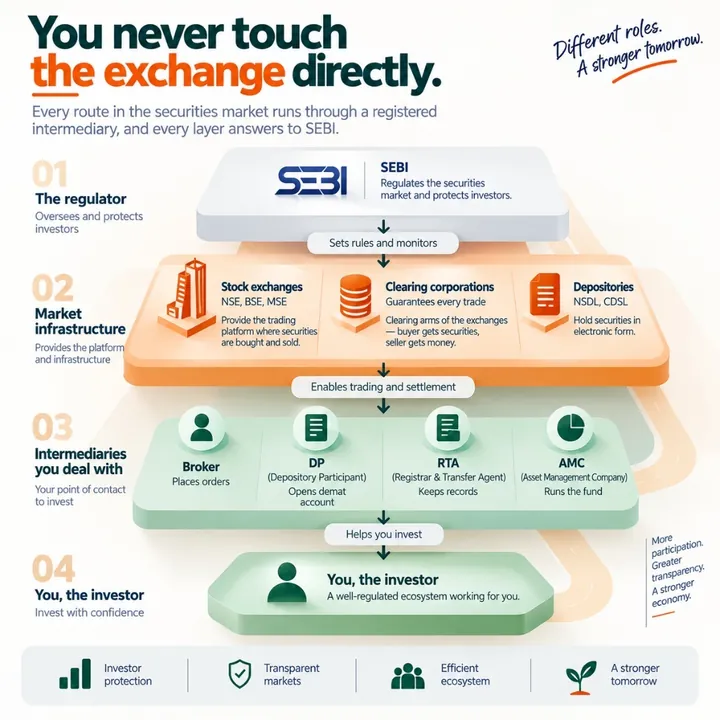
Figure 9 You never touch the exchange directly. Every route in runs through a registered intermediary, and every layer answers to SEBI.
Market Infrastructure Institutions
Three types of institution form the backbone of the market. Collectively they are called Market Infrastructure Institutions (MIIs), and they are regulated especially closely because the entire market depends on them.
Stock exchanges
Exchanges provide a nationwide, computerised, screen-based trading platform on which registered brokers place orders on behalf of investors. Prices are determined by the orders themselves, in the open — that is what makes the market fair and transparent rather than negotiated in private. India’s main nationwide exchanges are the National Stock Exchange of India Limited (NSE), BSE Limited (BSE) and the Metropolitan Stock Exchange of India Limited (MSE).
Clearing corporations
After a trade is agreed on the exchange, someone must ensure it actually completes. The clearing corporation guarantees settlement: every buyer receives the securities they bought, and every seller receives the money for what they sold.
This is a bigger deal than it appears. It means you never need to know or trust the person on the other side of your trade. The clearing corporation stands between you, becoming buyer to every seller and seller to every buyer. Without this, the entire market would depend on the creditworthiness of strangers.
The mechanism has a name: novation. When your trade is accepted for clearing, the single contract between you and the unknown seller is extinguished and replaced by two new ones — you with the clearing corporation, and the clearing corporation with the seller. The original obligation does not merely get guaranteed; it is legally substituted.
Two consequences follow, and both matter to you:
- Counterparty risk disappears - You are never exposed to whether the person on the other side can pay or deliver. Your counterparty is the clearing corporation, which is capitalised, regulated and backed by a settlement guarantee fund.
- Anonymity becomes possible - Because nobody needs to assess anybody, buyers and sellers never learn each other’s identity — which is what allows an exchange to match orders on price and time alone.
Novation is why an Indian equity market trade settles with near-total reliability, and why a default by one member is that member’s problem and the clearing corporation’s problem, rather than yours.
Depositories
Depositories hold securities in dematerialised — electronic — form, replacing the physical paper certificates that once made the market slow, insecure and prone to forgery, theft and “bad delivery.” India has two depositories:
- National Securities Depository Limited (NSDL)
- Central Depository Services (India) Limited (CDSL)
You do not deal with a depository directly. You deal with a Depository Participant (DP) — typically a bank or broker — which acts as the depository’s agent, opens your demat account and services it.
A useful analogy: the depository is like the Reserve Bank in this arrangement, and the DP is like your local bank branch. Your account is with the system; your relationship is with the branch.
Market intermediaries
What is an intermediary
A market intermediary is a SEBI-registered entity that stands between you and the market and performs a function you cannot perform yourself.
The word is worth taking literally. You cannot walk onto a stock exchange and buy a share. You cannot hold a share in your own name in an electronic register. You cannot value a portfolio of fifty companies every evening. Somebody has to do each of those things, and the law requires that somebody to be registered, capitalised, supervised and answerable.
Intermediaries perform four functions between them:
| Function | What it means | Who does it |
|---|---|---|
| Access | Giving you a route into a market you cannot enter directly | Stockbroker, mutual fund distributor, online bond platform |
| Custody and record | Holding your securities safely and recording that they are yours | Depository Participant, Registrar and Transfer Agent |
| Advice and analysis | Telling you what to do, or what a security is worth | Registered Investment Adviser, Research Analyst |
| Management | Investing pooled money on your behalf under a stated mandate | Asset Management Company, portfolio manager |
Three things follow from this, and they matter more than the list itself.
An intermediary handles your money or your securities, but does not own them: Your shares sit in a depository in your name, not your broker’s. Your mutual fund units are recorded against your folio, not the distributor’s. This separation is deliberate and it is the reason a broker failing is survivable.
Every intermediary must be registered with SEBI in a specific category - and the category defines what it is allowed to do. A distributor may not advise for a fee. An adviser may not take custody of your money. When someone offers to do everything for you, they are describing something no single registration permits.
An intermediary is paid, and how it is paid changes what it tells you: A fee taken from you and a commission taken from a product manufacturer create different incentives. Knowing which one applies is the most useful thing you can learn about anyone advising you.
All intermediaries are bound by SEBI’s conduct rules, must have a grievance mechanism, and are subject to inspection. That is what registration buys you.
Stockbroker
Executes your orders on the exchange, issues you a contract note for every trade, and holds your trading account. Brokers charge brokerage plus statutory charges.
Depository participant
Opens and maintains your demat account, processes transfers, and provides holding statements.
Registrar and Transfer Agent (RTA)
Maintains the register of investors on behalf of companies and mutual funds. When you invest in a mutual fund without a demat account, it is the RTA that records your units and issues your statement of account. When you need to update a bank mandate or claim an unclaimed dividend, the RTA is often who you deal with.
Registered Investment Adviser (RIA)
An individual or firm registered with SEBI under the Investment Advisers Regulations, providing personalised advice based on an assessment of your circumstances and risk profile.
The critical feature: an RIA charges you a fee and is prohibited from receiving commissions or distribution income on the products they recommend. That separation is what makes the advice advice rather than salesmanship. If someone advising you is paid by the product manufacturer, their incentives and yours are not aligned — which does not make them dishonest, but does mean you should know it.
Research Analyst (RA)
Registered with SEBI to prepare and publish research reports and recommendations based on fundamental or technical analysis. An RA publishes views to a general audience; an RIA advises a specific client.
Mutual fund distributor
Sells mutual fund schemes and is paid a commission by the AMC, embedded in the expense ratio of the “Regular” plan. Distributors must hold an ARN (AMFI Registration Number). The Directversus-Regular choice this creates is explained later.
Industry bodies
AMFI (Association of Mutual Funds in India) is the industry association of SEBI-registered AMCs. It sets professional standards, issues the ARN to distributors, publishes industry data, and runs investor education (including the “Mutual Funds Sahi Hai” campaign).
ANMI (Association of National Exchanges Members of India) and the BSE Brokers Forum (BBF) represent stockbrokers and trading members, working with regulators and exchanges on operational, technology and compliance matters.
ARIA (Association of Registered Investment Advisers) is the industry body for SEBIregistered investment advisers. It promotes the fee-only advisory model, sets professional and ethical standards for its members, and works on adviser education and public awareness of the difference between advice and distribution.
RAASB (Research Analyst Administration and Supervisory Body) is a body recognised by SEBI to handle the day-to-day administration and supervision of registered Research Analysts — processing registrations, monitoring compliance and administering the supervisory framework, while SEBI retains regulatory authority. A parallel body performs the same role for Investment Advisers. Their practical significance to you is that registration and oversight of the people publishing research and giving advice is continuous rather than one-time.
Industry bodies are not regulators. They set standards for their members and represent them to the regulator; they cannot make binding rules for the market or penalise a firm the way SEBI can. When you verify an entity, verify its SEBI registration, not its membership of an association.
Types of investors
You will encounter these three categories constantly, and especially when a company issues new shares.
Retail Individual Investors (RII) — individual investors, including Hindu Undivided Families and NRIs, applying for relatively small amounts. In public issues, the retail category has an application-size ceiling under the applicable framework; retail investors may use UPI for publicissue applications up to a prescribed limit. These limits are revised from time to time, so check the current issue document.
Non-Institutional Investors (NII), also called High Net-worth Individuals (HNI) — individuals, HUFs, companies, trusts and societies applying above the retail limit. In IPOs this category is commonly sub-divided into small HNI and big HNI bands. They do not require registration but commit large amounts.
Qualified Institutional Buyers (QIB) — large professional institutions with the expertise and capital to evaluate securities: foreign portfolio investors, mutual funds, scheduled commercial banks, insurance companies, pension funds, alternative investment funds and venture capital funds. QIBs often act as anchor investors in public issues, providing stability and professional price discovery.
The proportion of an issue reserved for each category depends on the applicable public-issue framework and the type of issue. Do not assume a fixed percentage applies to every issue — read the issue document.
Watch Out — the one question that prevents most fraud
Before you give money or personal data to any entity in the securities market, ask: is this entity registered with SEBI, in which category, and what is its registration number?
Then verify it yourself — not by asking them, but on SEBI’s own website at sebi.gov.in, which publishes lists of registered intermediaries, recognised exchanges and MIIs.
An entity that is not registered has no obligations to you, is outside the grievance system this book describes, and cannot be compelled to return your money. “SEBI-registered” is not a marketing phrase to skim past. It is the difference between a dispute and a loss.
How India’s market got here
A brief history, because it explains why the safeguards exist.
Before 1988 — the open-outcry era — Trading happened by shouting on a physical floor, with paper share certificates changing hands. It was slow, opaque and unsafe: delays, forged certificates, “bad delivery,” theft, and no protection if the counterparty defaulted.
1988 — SEBI created — The Securities and Exchange Board of India was set up on 12 April 1988 by an administrative order of the Government of India, initially without statutory powers.
1992 — statutory powers and liberalisation — The SEBI Act, 1992 was enacted on 30 January
1992, giving SEBI statutory authority. The Controller of Capital Issues was abolished, introducing free pricing of shares — companies could price their issues by market demand rather than by official permission.
1994–1996 — electronic trading and dematerialisation — Screen-based nationwide trading replaced the trading floor. The Depositories Act, 1996 enabled paper certificates to become electronic holdings, with NSDL established in 1996 and CDSL in 1999.
2000–2003 — derivatives and faster settlement — Index and equity derivatives were introduced; settlement moved to a T+2 rolling cycle in 2003.
2010–2016 — investor-protection infrastructure — ASBA was introduced for public issues, so application money stayed blocked in the applicant’s own bank account rather than leaving it. SCORES, the centralised online grievance portal, was launched.
2020s — digital acceleration — Settlement moved to T+1. IPO listing timelines shortened to T+3 working days. UPI was integrated into ASBA. Verification tools such as validated UPI handles and SEBI Check were introduced, along with SCORES 2.0 and the Smart ODR platform for dispute resolution.
To commemorate over 150 years of Indian securities market history, SEBI launched Dharohar, a digital knowledge repository, on 26 January 2025. It documents the market’s institutional milestones, regulatory developments and technological transformation, and is aimed at investors, students and researchers. It is accessible through SEBI’s official channels.
The direction of every one of these changes is the same: less paper, less delay, less counterparty risk, more verification. Almost every safeguard you will use in Part 4 exists because something went wrong before it.
Recap in one minute
- An intermediary is a SEBI-registered entity that gives you access, holds your securities, advises you or manages your money — and never owns any of it.
- MIIs — exchanges, clearing corporations and depositories — form the market’s backbone. The clearing corporation guarantees settlement, so you never need to trust the stranger on the other side of your trade.
- Depositories (NSDL, CDSL) hold securities electronically; you access them through a Depository Participant.
- An RIA charges you a fee and cannot take product commissions; a distributor is paid by the product manufacturer. Know which you are talking to.
- Always verify SEBI registration on SEBI’s own website before parting with money or data.
Check your understanding
What does a clearing corporation guarantee, and why does that matter to you personally?
Show answer to question 1
It guarantees settlement — every buyer receives their securities and every seller receives their money. It matters because you never need to know or trust the person on the other side of your trade.What is the difference between a depository and a depository participant?
Show answer to question 2
The depository (NSDL or CDSL) maintains the electronic records centrally. The DP is your point of contact — a bank or broker that opens and services your account on the depository’s behalf.Why is the fee-only rule for Registered Investment Advisers important to an investor?
Show answer to question 3
Because an RIA cannot receive commissions from product manufacturers, their recommendations are not influenced by which product pays them more. Their incentives align with yours.
Your action step
Go to sebi.gov.in and find the list of registered intermediaries. Look up one entity you already deal with — your bank, your broker, or a mutual fund house. Confirm its registration and note the number. This is a two-minute habit that you should repeat before every new financial relationship for the rest of your life.