Where this fits: The last chapter named the players. This chapter explains who makes the rules they must follow, who enforces them, and what that is worth to you.
By the end of this chapter you will be able to
- Explain what a financial regulator is and why a market cannot function without one
- Name India’s four main financial regulators and say which one governs which product
- Describe SEBI’s three core functions and, equally important, what SEBI does not do
What a regulator is, and why it matters
A regulator is a statutory authority created by law to make rules for a sector, license the firms that operate in it, supervise their conduct, and punish those who break the rules. It is not a government department and it is not an industry association. It is an independent body with powers of its own, answerable to Parliament rather than to the industry it oversees.
Why does a securities market need one at all? Because of a problem no market solves by itself.
The two sides do not know the same things: A company issuing shares knows far more about its own business than you ever will. A broker knows more about market mechanics than its client. A fund manager knows more about a scheme than the person buying it. Left alone, that gap is an invitation — to overstate, to conceal, to charge what cannot be seen. Economists call it information asymmetry; in practice it is the reason most investment fraud is possible.
A regulator closes the gap in four ways:
| What it does | What it means for you |
|---|---|
| Makes rules | Standard disclosures, so every prospectus and scheme document tells you comparable things |
| Licenses and registers | Only vetted, capitalised, qualified entities may take your money, and you can check |
| Supervises | Inspections, audits and surveillance run continuously, not only after a complaint |
| Enforces | Penalties, bans, disgorgement of illegal gains and criminal referral when rules are broken |
The result is not a market where you cannot lose money. It is a market where you can find out what you are buying, verify who you are buying it from, and complain to someone with teeth if you are cheated. That is a much smaller promise than most people assume, and a much more valuable one than they realise.
The cost of a market without a regulator is not theoretical. India’s own market history — the reason SEBI was given statutory powers in 1992 — was written by episodes in which settlement failed, prices were manipulated and small investors carried the losses.
Four regulators, four domains
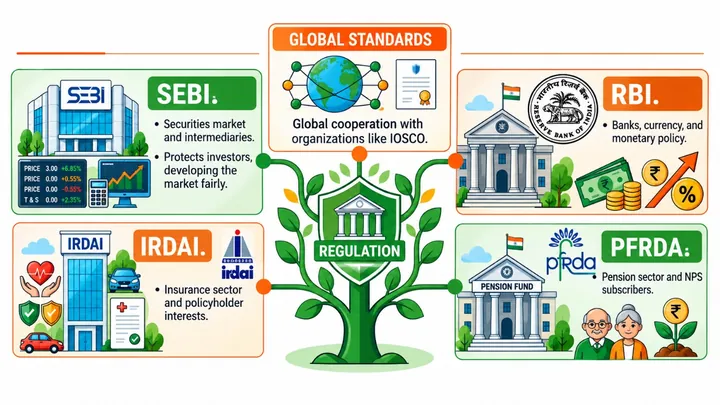
India’s financial system is regulated by four principal authorities. Knowing which one covers which product tells you where to complain, and — just as usefully — tells you when a product is covered by nobody.
| Regulator | Covers | Examples of what it regulates |
|---|---|---|
| SEBI — Securities and Exchange Board of India | The securities market | Shares, mutual funds, brokers, exchanges, depositories, investment advisers, REITs, InvITs |
| RBI — Reserve Bank of India | Banking and the monetary system | Banks, NBFCs, payment systems, currency, interest rate policy, Government Securities |
| IRDAI — Insurance Regulatory and Development Authority of India | Insurance | Life, health, motor and general insurance companies and intermediaries |
| PFRDA — Pension Fund Regulatory and Development Authority | Pensions | The National Pension System, Atal Pension Yojana, pension fund managers |
Watch Out — the regulatory gap is where frauds live
If a scheme does not fall under any of these four, ask why. Unregistered chit funds, “collective investment schemes” that never registered, crypto-token offerings promising returns, and multilevel marketing plans dressed as investments typically sit outside all four.
That is not a technicality. It means there is no supervision, no disclosure requirement, no complaint mechanism and no enforcement. When such a scheme fails — and they fail — you are a creditor in a criminal matter, not an investor with rights.
What SEBI does
The Securities and Exchange Board of India was established in 1988 and given statutory powers by the SEBI Act, 1992. Its mandate has three parts, and every SEBI activity falls under one of them.
1. Protect the interests of investors
- Runs investor awareness programmes across the country, including in rural and semiurban areas, working through Market Infrastructure Institutions, depositories, investor associations and trainers
- Operates SCORES, the online complaint platform, and the Smart ODR portal for online dispute resolution
- Monitors and acts against insider trading, market manipulation and fraudulent practices
- Takes action against unregistered advisers, misleading investment platforms and deceptive schemes
- Requires listed companies to disclose material information publicly, so that all investors have the same facts at the same time
2. Regulate the securities market
- Frames regulations for stock exchanges, brokers, authorised persons, portfolio managers and investment advisers
- Enforces rules on fair trading practices and disclosure norms
- Regulates intermediaries including mutual funds, credit rating agencies, custodians and RTAs
- Prescribes eligibility, conduct and net-worth requirements for market participants
3. Promote the orderly development of the market
- Develops market infrastructure — the shift to T+1 settlement, online trading, faster listing timelines
- Encourages institutional participation and market depth
- Enables new products and formats, including small-ticket investment options intended to widen participation
SEBI’s powers and enforcement
SEBI is not merely an advisory body. Under the SEBI Act it has substantial statutory powers, including powers of a civil court in certain matters.
Inspections and audits: SEBI inspects the books, records and systems of intermediaries and MIIs to check compliance.
Investigations: Where it suspects a violation, SEBI can investigate, summon persons and documents, and examine records.
Directions and interim orders: SEBI can issue directions — including ex parte interim orders — to stop ongoing harm. Common measures include barring an entity from accessing the securities market, restraining it from dealing in securities, and attaching or impounding assets or bank accounts.
Administrative and disciplinary action: These include warnings, monetary penalties through adjudication proceedings, suspension or cancellation of registration, and disgorgement of unlawful gains.
Prosecution: For serious violations, SEBI can initiate criminal prosecution in the appropriate courts.
Public transparency: All enforcement orders and adjudication penalties are published on sebi.gov.in. This is a resource you can use — before dealing with an entity, it is worth searching whether SEBI has passed any order against it.
An investor can appeal certain SEBI decisions to the Securities Appellate Tribunal (SAT), and from there to the Supreme Court on questions of law.
Watch Out — what SEBI does not do
SEBI regulates the market. It does not, and cannot:
- Guarantee or approve returns - No SEBI registration implies any assurance about performance. Anyone claiming “SEBI-approved returns” is lying.
- Compensate you for market losses - If you buy a share and it falls, that is investment risk, not a grievance.
- Vouch for the quality of an investment - SEBI ensures a company discloses; it does not certify that the company is a good buy. The prospectus of every IPO says exactly this.
- Resolve commercial or contractual disputes - outside its purview, or complaints about unlisted companies.
Understanding the boundary saves you from two errors: expecting protection you do not have, and failing to complain when you genuinely do have a remedy.
The other regulators, briefly
RBI — India’s central bank. It issues currency, sets monetary policy, manages inflation through the repo rate and other tools, regulates banks and NBFCs, oversees payment systems including UPI, and manages the government’s borrowing programme. When you use RBI Retail Direct to buy Government Securities, you are in RBI’s domain.
IRDAI — Regulates insurers and insurance intermediaries, protects policyholders’ interests, prescribes disclosure and claim-settlement norms, and publishes claim settlement ratios that are worth checking before you buy any policy.
PFRDA — Regulates the National Pension System and pension fund managers, and safeguards subscribers’ interests.
How the economy moves your investments
You do not need to be an economist. But three forces will affect every rupee you invest, and recognising them prevents you from mistaking a normal cycle for a crisis.
Growth
When the economy grows strongly, company sales and profits generally rise, which supports equity prices. When growth slows, investors typically move towards safer fixed-income securities, and equity valuations come under pressure.
Inflation
High inflation erodes real returns and typically pushes the RBI towards raising rates. Investors often increase allocation to assets seen as inflation hedges, such as gold.
Interest rates
This is the one most retail investors misunderstand, so it is worth stating carefully.
When the RBI raises the repo rate (to control inflation), borrowing becomes costlier across the economy. Newly issued bonds offer higher interest. Existing bonds — which pay the older, lower rate — become less attractive, so their prices fall. Equity valuations often come under pressure too, since future profits are worth less when discounted at higher rates.
When the RBI cuts the repo rate, the reverse happens. Existing bonds paying the older, higher rate become more attractive, so their prices rise. Cheaper borrowing tends to support economic activity and equity valuations.
The counter-intuitive part is worth repeating: bond prices and interest rates move in opposite directions. This is why a debt mutual fund can show a negative return in a month when interest rates rise, even though nothing defaulted and nothing went wrong.
The RBI also uses the Cash Reserve Ratio (CRR) and Statutory Liquidity Ratio (SLR) to influence how much banks can lend, which affects short-term money market rates and eventually deposit and lending rates at your own bank.
What has changed recently
The Indian market has modernised rapidly. The developments below matter to you as an investor, and all appear again later in this book:
- Paperless onboarding through Aadhaar-based e-KYC, DigiLocker and video in-person verification
- T+1 settlement for secondary market equity trades, reducing the period during which either side is exposed
- UPI in ASBA and T+3 IPO listing, shortening the time between application and listing
- New product formats such as REITs and InvITs, giving retail investors access to real estate and infrastructure assets in small denominations
- SCORES 2.0 and Smart ODR, strengthening complaint handling and dispute resolution
- Verification tools including validated UPI handles, SEBI Check and the verified-app label on app stores
Recap in one minute
- SEBI regulates securities, RBI banking and money, IRDAI insurance, PFRDA pensions. Products outside all four have no supervision.
- SEBI’s mandate: protect investors, regulate the market, and develop it.
- SEBI has real enforcement powers — inspection, investigation, directions, penalties, prosecution — and publishes every order.
- SEBI never guarantees returns or compensates market losses. Anyone claiming otherwise is misleading you.
- Bond prices move opposite to interest rates. A falling debt fund in a rate-rising month is normal, not a failure.
Check your understanding
You have a complaint about a mis-sold health insurance policy. Which regulator, and why not SEBI?
Show answer to question 1
IRDAI, because it regulates insurance. SEBI regulates the securities market and has no jurisdiction over an insurance policy.The RBI raises the repo rate by 0.5%. What happens to existing bond prices, and why?
Show answer to question 2
Existing bond prices fall, because newly issued bonds now pay more, making existing lower-coupon bonds less attractive at their old price.A scheme claims to be “approved by SEBI with assured 18% returns.” Identify two things wrong with that claim.
Show answer to question 3
First, SEBI does not approve or guarantee returns on any product. Second, assured returns in the securities market do not exist. Both statements are proof of dishonesty.
Your action step
Open sebi.gov.in and find the orders and enforcement section. Read any one recent order in full. It will show you, more vividly than any warning, exactly what market misconduct looks like in practice and what happens to those who attempt it.