Where this fits: You have a plan and you understand the market. This chapter gets you the keys to the door.
By the end of this chapter you will be able to
- Say which accounts you need for which products
- Complete KYC and understand what happens to your documents
- Protect your accounts from the most common forms of unauthorised access
The three accounts
To buy and sell listed securities on a stock exchange, you generally need three accounts working together.
| Account | What it does | Who provides it |
|---|---|---|
| Savings bank account | Sends money out for purchases; receives money from sales, dividends and interest | Any bank |
| Trading account | The account through which buy and sell orders are placed on the exchange | A SEBI-registered stockbroker |
| Demat account | Holds your securities in electronic form | A Depository Participant, on behalf of NSDL or CDSL |
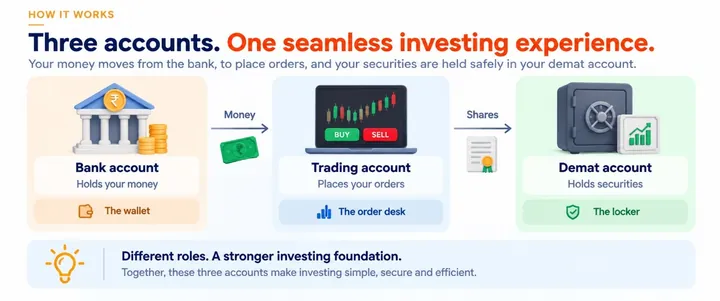
Think of it as a wallet, an order desk and a locker. Money moves from the wallet, the order desk transacts, and the securities land in the locker.
Figure 10 A wallet, an order desk and a locker. You do not need the last two to invest in most mutual funds — only to hold shares, ETFs, or units in demat form.
Two ways to hold mutual fund units: Investors may hold mutual fund units either in
Statement of Account (SOA): form or in a demat account. You can invest directly with an Asset Management Company, or through its website, app, an Investor Service Centre or an RTA, and your units are recorded in a Statement of Account. A demat account enables investors to hold mutual fund units alongside other securities in a single account, and is required for ETFs and for investments through stock exchange platforms. Neither route is superior; they suit different holdings.
You will need a demat account if you want to hold shares or ETFs, hold mutual fund units in demat form, or invest through stock exchange platforms.
What a demat account is
A demat account — short for dematerialised — holds eligible securities electronically: shares, bonds, ETFs, Government Securities, and mutual fund units if you choose to hold them that way.
Before dematerialisation, ownership was proved by paper certificates. Those certificates could be lost, damaged, forged or stolen, transfers took weeks, and signature mismatches caused endless disputes. The demat system removed all of that in one stroke, and it is one of the main reasons the Indian market is now considered safe by global standards.
Two depositories maintain these accounts:
- National Securities Depository Limited (NSDL)
- Central Depository Services (India) Limited (CDSL)
You open your account through a Depository Participant (DP) — a bank, broker or financial institution registered with one of the depositories.
Why a demat account matters?
Beyond being a requirement for shares and ETFs, a demat account holds a wide range of securities in electronic form, delivers corporate benefits to you directly, and keeps a single record of what you own across asset classes. The practical benefits:
- Consolidated holding: Shares, ETFs, bonds, Government Securities and mutual fund units sit in one account rather than scattered across folios and certificates.
- A single statement of holdings: One document shows everything, which makes checking and tax computation far simpler.
- Corporate benefits reach you directly: Bonus issues, splits, rights entitlements and dividends are credited against your holding without paperwork.
- Easier nomination and transmission: A nomination registered once covers everything in the account, and transmission to a nominee follows a single process rather than one per holding.
- Lower risk of loss, forgery or duplicate records: Electronic holdings cannot be misplaced, torn, stolen or forged in the way physical certificates could.
- Simpler portfolio tracking: Values, quantities and transactions in one place, reconcilable against the Consolidated Account Statement described in Chapter 21.
None of this makes a demat account compulsory for a mutual fund investor. It makes it the more convenient choice once you hold more than one kind of security.
Basic Services Demat Account (BSDA)
Most people opening a demat account are quoted an annual maintenance charge (AMC) and assume it is unavoidable. Small investors holding limited securities may be eligible for a Basic Services Demat Account (BSDA), which provides reduced or nil annual maintenance charges subject to applicable conditions.
SEBI has prescribed a Basic Services Demat Account (BSDA) — not a lesser account, but the same demat account with the maintenance charge reduced or waived. The holdings sit in the same depository, under the same statutory protections, with the same access to corporate actions. Only the annual fee is different.
Who is eligible
Three conditions apply together:
- You are an individual, not a company, trust or partnership
- You hold only one demat account across both depositories as the sole or first holder. You may be a second or third holder on other accounts without losing eligibility
- The value of your holdings stays within the prescribed limit on the relevant date
An eligible account is required to be given BSDA treatment. It is not a favour, and you should not have to negotiate for it.
How the charge works
AMC is applied in slabs based on the value of holdings. The structure is what matters, because the figures are revised periodically:
| Value of holdings | Annual maintenance charge |
|---|---|
| Up to ₹4,00,000 | Nil |
| Above ₹4,00,000 and up to ₹10,00,000 | ₹100 a year, plus GST |
| Above ₹10,00,000 | The DP’s ordinary tariff, in full — the account ceases to be a BSDA |
These figures took effect on 1 September 2024, under SEBI’s circular of June 2024, and replaced an earlier structure in which the nil-charge threshold was ₹2,00,000. Debt and non-debt securities are counted together against the limits, and SEBI has since excluded certain holdings — Zero Coupon Zero Principal instruments and delisted securities among them — from the valuation. The figures are revised periodically. Do not act on any figure quoted here or anywhere else without checking the current position — the depository websites and your DP’s tariff sheet both carry it.
What this is worth in practice — A DP charging ₹400 a year plus GST on an ordinary account collects roughly ₹472. On a BSDA holding ₹3,00,000 the same account costs nothing, and on one holding ₹7,00,000 it costs about ₹118. Over twenty-five years of holding, that is the difference between roughly ₹11,800 and nothing at all — paid out of a portfolio that is small enough for the charge to matter.
What is not covered
BSDA reduces the maintenance charge only. These are unaffected:
- Transaction and DP charges when you sell
- Dematerialisation and rematerialisation charges
- Pledge creation and invocation charges
- Statutory levies and GST
A BSDA does not make trading cheaper. It makes holding cheaper, which is what a long-term investor actually does.
If you cross the limit
Nothing is frozen and nothing is lost. The account is simply charged at ordinary rates for the relevant period. If the value falls back within the limit later, the concession can apply again. Crossing the threshold is a sign your portfolio has grown, which is the point of the exercise.
Statements
Electronic statements are the default and are free. Physical statements beyond the prescribed number may be charged. Keep your email address current and you will never need one.
Watch Out — the second account that costs you both
Eligibility depends on holding only one demat account as first holder. Opening a second account to take up a new broker’s offer can end BSDA eligibility on both, and full maintenance charges then apply to each. Before opening another demat account, ask what it will cost you every year for as long as you keep it. Two accounts at ordinary rates for twenty-five years is a meaningful sum to pay for an offer that lasted a month.
What to do
Ask your DP, in writing, two questions: whether your account is currently classified as a BSDA, and what the AMC would be if it were. Keep the reply. If you hold one demat account with modest holdings and are being charged full maintenance, you have grounds to ask for it to be reclassified.
How securities leave your demat account
Securities arrive in your demat account by themselves. Nothing leaves it without an instruction, and knowing what those instructions are called is what stops you signing away more authority than you meant to.
When you buy, the shares are credited automatically on settlement. When you sell, gift, transfer or pledge, something has to authorise the debit. There are three ways to give that authorisation, and they are not equally safe.
Delivery Instruction Slip (DIS)
A Delivery Instruction Slip (DIS) is the written instruction to your DP to debit securities from your account and deliver them somewhere — to the exchange when you sell, to another demat account when you gift or transfer, or to a lender when you pledge.
The physical version comes as a booklet issued by your DP, with serially numbered leaves. Each leaf names the security by its ISIN, the quantity, the destination account and the execution date, and carries the signature of every holder. It is, in every practical sense, a cheque book for your shares, and it should be handled like one:
- Keep the booklet in your own custody - Not with your broker, not with a relationship manager, not with the relative who “handles” your account.
- Never sign a leaf before it is completely filled in - A signed blank DIS is a signed blank cheque for your securities, and it is the single most common way retail holdings are stolen in India.
- Strike out unused space - in every field so that nothing can be added after you sign.
- Record the serial numbers you use and report a lost or missing booklet to your DP in writing immediately.
- On a joint account, every holder signs, every time - A DP that accepts one signature on a jointly held account is not protecting you.
Electronic DIS (eDIS) is the same instruction given digitally, and it does away with the booklet entirely.
When you place a delivery sell order, the platform hands you over to the depository’s own page. You authorise the debit there with a PIN the depository issued directly to you — a TPIN at CDSL, an MPIN at NSDL — together with a one-time password sent to your registered mobile number and email. The debit happens only after both are entered.
Three things make this safer than the paper version:
- The PIN is generated by the depository and sent to you. Your DP cannot see it, change it or store it.
- You authorise named securities and quantities, not a blank authority. The authorisation is also time-limited, and typically lapses at the close of that trading day.
- Every authorisation leaves a record at the depository, not only at the broker — which matters a great deal if there is ever a dispute.
Its one drawback is friction. An active seller repeats the PIN and OTP on every trade, and on a volatile day that is a genuine nuisance. That is the problem the third method solves.
Demat Debit and Pledge Instruction (DDPI)
For years the standing alternative to authorising each sale was a Power of Attorney (PoA) given to the broker. A PoA is a broad legal authority, and it was routinely written broadly. Some brokers used it for purposes the client had never contemplated — meeting the firm’s own margin obligations, funding other clients, pledging holdings without consent. When such a firm failed, its clients discovered their shares had already gone.
SEBI’s response, through circulars issued in 2022, was to replace the instrument rather than police it. The Demat Debit and Pledge Instruction (DDPI) does the same practical job, with the authority narrowed to four specific purposes and nothing else:
- Transferring securities out of your demat account to settle a sale you have executed through that broker
- Pledging or re-pledging securities to a trading member or clearing member to meet your own margin requirement
- Executing mutual fund transactions on stock exchange order-entry platforms
Tendering shares in an open offer through an exchange platform
Anything outside that list is simply not authorised, whatever the broker may wish to do. Unlike a PoA, a DDPI may also be signed electronically, so it can be completed online in a few minutes.
What this means for you:
- It is optional - No broker may make a DDPI a condition of opening an account. Without one you simply use eDIS on each sale, which costs you nothing but a minute.
- If you still have an old PoA, ask your broker in writing to replace it with a DDPI and to confirm that the PoA stands revoked. Keep the confirmation.
- Read what you are signing - A document limited to the four purposes above is fine. A document titled “DDPI” that also authorises the broker to do other things is not a DDPI in substance. Do not sign it.
- Never give a general Power of Attorney to a broker or DP - Since the DDPI exists, there is no legitimate reason for anyone to ask you for one.
The three side by side:
| Power of Attorney | DDPI | eDIS | |
|---|---|---|---|
| What it authorises | Broadly worded, open to interpretation | Four listed purposes only | One transaction, exactly as specified |
| How long it lasts | Until revoked | Until revoked | Usually to the close of that trading day |
| How it is signed | Physically, on stamp paper | Electronically or physically | Not signed — PIN and OTP each time |
| Right choice today | No | Yes, if you trade often | Yes, if you trade rarely |
One limitation worth knowing: a DDPI covers settlement, margin pledging, exchange-platform mutual fund transactions and open offers. It does not cover an off-market transfer such as a gift to a family member. Those still need a DIS, physical or electronic, completed by you — which is covered in Part 6.
KYC: the one-time identity check
Know Your Customer (KYC) is a mandatory verification process before you can invest in the securities market. It confirms your identity and address, and protects the financial system from being used for money laundering and fraud.
What you need
- PAN card — mandatory for most securities market investments
- Aadhaar — linked to your active mobile number
- Identity and address proof
- Recent photograph
- Signature
- Bank proof — a cancelled cheque or a passbook copy
Why it is done once
KYC records are maintained centrally by KYC Registration Agencies (KRAs). Once you are KYC-compliant, other registered intermediaries can access your verified status rather than repeating the whole process. If you have already completed KYC for a mutual fund, opening a demat account elsewhere is generally simpler.
Keep your KYC details current. If your address, mobile number, email or bank details change and you do not update them, you may miss statements, alerts and — in the worst case — payouts.
e-KYC completes the same verification digitally. With your explicit consent, your identity can be verified using Aadhaar-based authentication, often supported by video in-person verification (VIPV), in which a short video call confirms that you are the person applying.
Two rules for e-KYC:
Complete it only on the official website or app of the intermediary - Not through a link forwarded on WhatsApp. Not through a website that resembles the real one.
Understand what you are consenting to e-KYC requires your consent to share identity data. Read what you are agreeing to, particularly on platforms you have not used before.
DigiLocker is a government platform that stores verified documents electronically. With your consent, documents such as Aadhaar, PAN and certificates can be shared securely with authorised institutions. This reduces paperwork and speeds up onboarding, and the institution receives a document verified at source rather than a photocopy you could have altered.
Choosing your intermediary
Before you open anything, verify that the entity is registered with SEBI in the relevant category. Do this on sebi.gov.in, not on the intermediary’s own website — anyone can print a registration number on a webpage.
Beyond registration, compare:
Charges — Account opening fee, annual maintenance charges (AMC), brokerage per trade, demat transaction charges, and charges for services such as physical statements or delayed payment. Ask for the complete tariff sheet in writing.
Platform quality — Whether the app or website is stable, and whether order placement and statement access are straightforward.
Support — How you reach a human being when something goes wrong, and how quickly. This matters far more than it seems on the day you open the account and far less than it seems until the day something goes wrong.
Grievance record — Exchanges publish complaint data about their members. It is worth a look.
Watch Out — the deals that are not deals
“Zero brokerage” and “free account opening” offers deserve a careful read. Revenue has to come from somewhere: it may be recovered through higher charges on other services, through margin funding interest, through payment for order flow arrangements where permitted, or through encouraging high-frequency trading that generates statutory charges.
None of that is necessarily improper. But read the full tariff sheet, not the headline. And be especially wary of any platform whose interface is designed to make you trade more often. Frequent trading is one of the most reliable ways to reduce your own returns.
Protecting your accounts
Your demat account can hold a substantial part of your net worth. Treat its security accordingly.
Two-factor authentication
Two-factor authentication (2FA) requires a second verification step after your password — typically a one-time password (OTP) or a code from an authenticator app. It is mandatory for trading accounts, and it is the single most effective protection against unauthorised access, because a stolen password alone becomes useless.
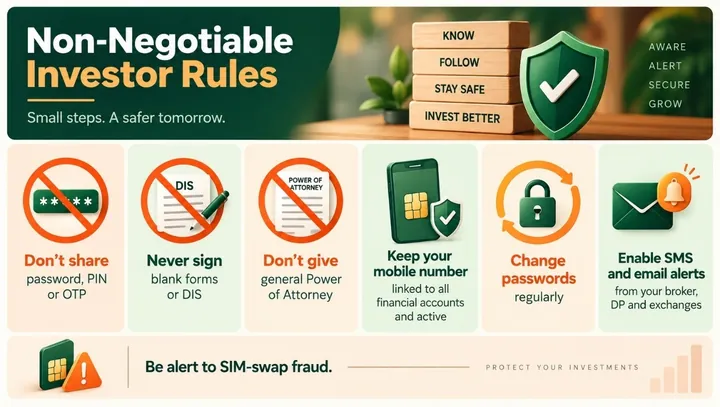
The rules that are not negotiable
- Never share your password, PIN or OTP with anyone — including someone claiming to be from your broker, your bank, the exchange or SEBI. No legitimate institution will ever ask for an OTP. Not once. Not for verification. Not to “cancel a fraudulent transaction.”
- Never sign blank forms or blank Delivery Instruction Slips (DIS) - A signed blank DIS is a signed blank cheque for your securities.
- Do not give a general Power of Attorney to a broker or DP - Use a DDPI, which is limited to four defined purposes, or authorise each sale yourself through eDIS. Both are described above.
- Change passwords periodically and do not reuse them across platforms.
- Keep one mobile number linked to all your financial accounts and guard it. Your mobile number is the key to almost every transaction. Be alert to SIM-swap attempts — if your phone loses network unexpectedly and stays down, contact your operator immediately.
- Enable all SMS and email alerts from your broker, DP and the exchanges. Read them. Exchanges and depositories send periodic statements of your holdings and transactions precisely so that unauthorised activity gets noticed. Investors should immediately contact their Depository Participant if they receive any depository alert for a transaction that they do not recognise.
Nomination
Add a nominee to every account, at the time of opening. Depending on the current framework, multiple nominees may be permitted in a demat account, with specified shares.
This takes two minutes and prevents your family from spending months on a transmission process at the worst possible time. What happens when it is skipped is set out in detail later — it is one of the most consequential subjects in this book, and one of the most neglected.
Other access routes worth knowing
RBI Retail Direct: An online platform allowing individual investors to buy Government Securities, Treasury Bills and State Development Loans directly, without an intermediary.
Online Bond Platform Providers (OBPPs): SEBI-regulated platforms through which retail investors can buy and sell listed debt securities such as corporate bonds and G-Secs. Verify the platform’s SEBI registration before using it.
Recap in one minute
- Bank, trading and demat accounts work together for listed securities — but most mutual funds need only a bank account and KYC.
- KYC is one-time and centrally recorded by KRAs; keep your details updated or you will miss statements and payouts.
- Complete e-KYC only on the intermediary’s official site or app, never through a forwarded link.
- Verify SEBI registration on sebi.gov.in before opening anything, and read the full tariff sheet.
- Never share an OTP, never sign a blank DIS, and never give a broker a general Power of Attorney — use a DDPI or eDIS instead. Add a nominee on day one.
Check your understanding
Ritu wants to start a monthly investment in a mutual fund. Which of the three accounts does she actually need?
Show answer to question 1
Only a savings bank account plus completed KYC. Most mutual funds do not require a trading or demat account; units are held in a Statement of Account.Why is it safer for an intermediary to receive your documents through DigiLocker than as photocopies?
Show answer to question 2
Because DigiLocker documents are verified at source and shared with your consent, so the institution receives an authenticated document rather than a photocopy that could have been altered.Someone calls saying they are from your broker’s risk team and need the OTP just sent to you to stop a fraudulent trade. What do you do?
Show answer to question 3
End the call and do not share the OTP. No institution ever needs your OTP — not to verify you, not to cancel a fraudulent transaction. Then contact your broker on their official published number.
Your action step
If you already have a demat account: log in today and check three things — is a nominee registered, is your mobile number and email current, and are SMS and email alerts switched on. If you do not have one, verify one prospective intermediary on sebi.gov.in and request its full tariff sheet.