Where this fits: You have accounts and KYC. This chapter explains the pooled route into the market, and what to look at before using it.
By the end of this chapter you will be able to
- Explain how a mutual fund works and what NAV means
- Explain what a Total Expense Ratio costs you over a decade
- Choose between a Direct and a Regular plan, and between Growth and IDCW
What a mutual fund is
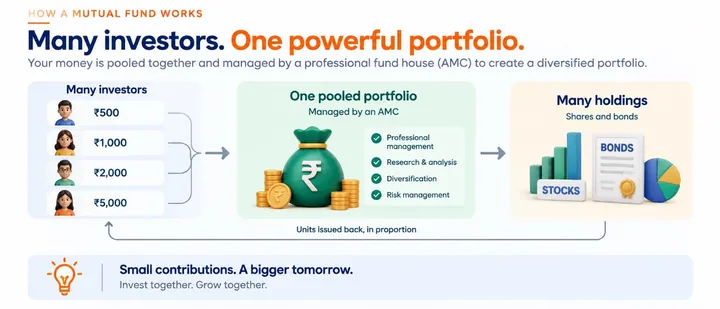
A mutual fund collects money from many investors and invests it, as a single pool, in a portfolio of securities — shares, bonds, money market instruments or a combination. A professional fund manager makes the investment decisions, following the objective stated in the scheme’s documents.
You own units of the scheme, proportionate to what you invested. If the portfolio gains value, so do your units.
The structure solves four problems for a small investor simultaneously:
Diversification for a small amount — ₹1,000 buys you a share of a portfolio holding dozens of companies. Buying those companies individually would take lakhs.
Professional management — A research team analyses companies, sectors and economies. You do not have to.
Convenience — No individual buy and sell decisions, no separate settlement for each holding, one consolidated statement.
Regulation — Mutual funds in India are closely regulated by SEBI, with strict rules on disclosure, valuation, portfolio limits and how investor money is held.
What it does not do is remove risk. A mutual fund investing in equity carries equity risk, in full. Diversification within the fund removes company-specific risk, not market risk. That distinction was drawn earlier and is worth re-reading if it has not stuck.
Figure 11 ₹500 and ₹5,000 buy the same portfolio, in different proportions. What pooling removes is the minimum size needed to diversify — not the risk of the assets themselves.
Net Asset Value
Net Asset Value (NAV) is the per-unit value of a scheme. It is calculated as the total market value of the scheme’s assets, minus its liabilities, divided by the number of units outstanding.
You buy and redeem units at the applicable NAV.
Watch Out — a low NAV is not “cheap”
This is one of the most persistent misunderstandings in Indian retail investing.
Scheme A has an NAV of ₹15. Scheme B has an NAV of ₹450. Many investors conclude that Scheme A is cheaper and offers more room to grow.
It offers nothing of the sort. ₹30,000 buys 2,000 units of A or 66.67 units of B. If both portfolios rise 10%, both holdings become ₹33,000. The NAV tells you nothing about whether a scheme is expensive, attractive, or likely to perform — it mostly reflects how long the scheme has existed and how it has done since launch.
The same fallacy appears with New Fund Offers priced at ₹10, marketed as an opportunity to “get in at the bottom.” There is no bottom. There is only a portfolio, and a new one has no track record to judge.
What it costs you
Three costs matter, and one of them matters enormously.
Total Expense Ratio
The Total Expense Ratio (TER) is the annual charge the AMC levies for managing the scheme, expressed as a percentage of assets. It covers fund management, administration, marketing, distributor commission where applicable, operating costs, and the transaction costs incurred in executing trades — brokerage and statutory levies including GST. SEBI prescribes maximum limits, which vary by scheme type and size.
The TER is not billed to you. It is deducted from the scheme’s assets, so it is already reflected in the NAV. This invisibility is exactly why it is under-examined.
Worked Example — what 1% a year actually costs
₹10,000 invested monthly for 25 years, with the portfolio earning 12% a year before costs. The expense ratio comes off that 12%, so what your money actually compounds at is the figure in the middle column.
| Total expense ratio | Net return after cost | Approximate value after 25 years |
|---|---|---|
| 0.5% (a low-cost index fund) | 11.5% | ₹1.72 crore |
| 1.5% (a typical direct equity fund) | 10.5% | ₹1.45 crore |
| 2.25% (a typical regular equity fund) | 9.75% | ₹1.27 crore |
The difference between the first and third rows is roughly ₹45 lakh — on the same monthly contribution, over the same period, from the same market.
(Illustrative. Actual returns and TERs vary.)
This is not an argument that low cost always wins; an actively managed fund that genuinely outperforms can justify its fee. It is an argument that the fee is a real, compounding, permanent drag that you must consciously decide to pay, rather than never notice.
Exit load
An exit load is a fee charged if you redeem before a specified period — commonly around 1% if you exit within a year, though it varies and many debt and liquid schemes have none.
Its purpose is to discourage very short holding periods that disrupt the portfolio. Check it before you invest, particularly if there is any chance you will need the money sooner than planned.
Stamp duty
A small, uniform stamp duty applies on the purchase or transfer of mutual fund units. It appears on your transaction statement.
Direct plans and Regular plans
Every scheme is offered in two versions of the same portfolio.
| Direct plan | Regular plan | |
|---|---|---|
| How you invest | Directly with the AMC — its website, app, an Investor Service Centre or an RTA | Through a mutual fund distributor, bank, broker or advisor |
| Distributor commission | None | Included in the expense ratio |
| Expense ratio | Lower | Higher |
| Portfolio | Identical | Identical |
| Direct plan | Regular plan | |
| You receive | No advice or hand-holding | Assistance with selection, paperwork and servicing |
The portfolios are the same, run by the same manager, holding the same securities. The only difference is the commission and therefore the TER — which, as the worked example above showed, compounds over decades.
The honest way to think about this: a Regular plan is not a rip-off, it is a bundled service. If your distributor genuinely helps you, keeps you invested during a crash, completes your paperwork and reviews your portfolio annually, that service has real value — arguably more value than the fee.
If you receive none of that and are simply paying a trail commission for a decision you made yourself, you are paying for nothing.
Decide deliberately. And note the third option: use a Registered Investment Adviser who charges you a fee and recommends Direct plans. You pay for advice explicitly rather than through the product, which is generally cheaper over time and removes the conflict of interest described earlier.
Growth plan and IDCW plan
Every scheme also offers two options for what happens to the income the portfolio earns.
Growth plan
Profits and income earned by the scheme are retained and reinvested. No payouts are made. The NAV rises as earnings accumulate.
Suitable for: anyone in the accumulation phase who does not need income from the investment. This is most investors, most of the time. It is compounding working without interruption.
IDCW plan — Income Distribution cum Capital Withdrawal
The scheme may distribute a portion of income earned, or return a portion of your capital, when declared.
Three things to understand clearly:
Distributions are not guaranteed: They depend on the availability of distributable surplus, and they may be reduced or skipped.
The NAV falls by the amount distributed: If a scheme with an NAV of ₹52 declares a ₹2 distribution, the NAV becomes ₹50 (plus any applicable taxes). You have not gained ₹2; you have moved ₹2 from one pocket to another.
The name was changed for a reason: The option was formerly called the “Dividend” plan, and investors reasonably assumed it worked like a company dividend — a payout of profits over and above their capital. It does not. Part of the payout may be a return of your own money. SEBI required the rename to “Income Distribution cum Capital Withdrawal” precisely to make that explicit.
Suitable for: investors who genuinely need periodic cash flow and understand the mechanics. Even then, a Systematic Withdrawal Plan from a Growth option is often a more controlled and more tax-efficient way to generate regular income.
How to invest, step by step
Step 1 — Have your documents ready
Assemble these before you start, not halfway through the form:
- PAN card: Required for most securities market investments. If you do not hold one, a declaration in Form 97 — which replaced Form 60 from 1 April 2026 — may be accepted for certain specified transactions. PAN is now mandatory for a wider range of transactions than before, so check whether the declaration route is still open for what you intend to do.
- Aadhaar, linked to your active mobile number: Aadhaar-based e-KYC routes exist for certain investment limits and channels, subject to the prevailing SEBI and KRA guidelines.
- Bank account details: A cancelled cheque or a passbook copy showing your name, account number and IFSC.
- KYC-compliant identity and address proof.
- A recent photograph, where the channel requires one.
- Your signature in the prescribed form, and an email address you actually read.
- Nominee details, or a signed opt-out. Doing this now takes two minutes; doing it later takes a form.
Step 2 — Decide Direct or Regular
As discussed above. Decide deliberately, and know what you are paying for.
Step 3 — Choose your channel
- The AMC’s own website or mobile app
- An Investor Service Centre (ISC) or the RTA
- An AMFI-registered mutual fund distributor
- A stock exchange platform, through your broker
- The nearest branch of the fund house
Step 4 — Open a demat account as per your requirement
Investors may choose to hold mutual fund units in a demat account, which provides a consolidated electronic holding of mutual fund units and other securities in a single account. A demat account is required for holding ETFs and for investing through stock exchange platforms. Alternatively, mutual fund units may also be held through a Statement of Account (SOA) issued by the AMC or RTA, which is entirely secure and adequate.
You need one if you want to hold units in demat form, invest through exchange platforms, or hold ETFs.
Step 5 — Complete KYC
Physically at a branch or RTA office, or through e-KYC online. One-time, as described earlier.
Step 6 — Select a scheme
This is the decision that takes real thought. The next chapter is entirely about it.
Step 7 — Invest
Choose lump sum or SIP, the amount, and the frequency. A SIP requires a one-time bank mandate authorising the monthly debit.
Step 8 — Track it
- MF Central — a joint platform of the RTAs, giving a consolidated view of your mutual fund holdings across fund houses
- MITRA (Mutual Fund Investment Tracing and Retrieval Assistant) — an industry
facility to help investors trace inactive or forgotten folios, including old investments made under a previous address or contact detail
- The AMC’s own app or website
- Your Consolidated Account Statement
Reviewing twice a year is sufficient. Checking daily is actively harmful, for reasons covered later.
Watch Out — the forgotten folio
Millions of rupees sit in Indian mutual fund folios that investors have lost track of — usually because they changed address, changed phone number, or invested through a distributor they no longer deal with. If you or a family member invested years ago and lost the paperwork, MF Central and MITRA exist precisely for this. It costs nothing to check.
Recap in one minute
- A mutual fund pools money from many investors into a professionally managed, diversified portfolio.
- NAV is the per-unit value. A low NAV does not mean a cheap or better fund.
- TER is deducted invisibly from the NAV and compounds against you over decades. Know what you are paying.
- Direct and Regular hold identical portfolios; Regular includes distributor commission. Pay it only for service you actually receive.
- Growth reinvests and compounds; IDCW pays out and reduces NAV by the same amount, and may return your own capital.
Check your understanding
Fund A has an NAV of ₹18 and Fund B has an NAV of ₹390. Which is cheaper?
Show answer to question 1
Neither. NAV tells you nothing about whether a fund is cheap or attractive. The same amount buys proportionally more or fewer units; a 10% rise produces the same result either way.What is the only difference between a Direct plan and a Regular plan of the same scheme?
Show answer to question 2
The distributor commission, which is included in the Regular plan’s expense ratio. The portfolios are identical.A scheme with NAV ₹64 declares an IDCW of ₹3. What is the NAV afterwards, and how much better off are you?
Show answer to question 3
NAV becomes ₹61 (plus applicable taxes). You are no better off — ₹3 has moved from the NAV to your bank account.
Your action step
Pick any large equity mutual fund. Find its factsheet online and locate three numbers: the Total Expense Ratio of the Direct plan, the TER of the Regular plan, and the exit load. Write down the difference between the two TERs. That annual difference, compounded over your investing life, is what the distribution service is costing you.