Where this fits: You are halfway. You have a budget, a plan, an emergency fund, insurance, accounts, and at least one investment running automatically. Part 5 opens the door to buying securities directly. Before you walk through it — or before you do anything else at all — these five rules need to be permanent.
Part 7 covers fraud and complaints in full, and it is a long way off. This page is the short version, and it is short deliberately. You should not have to reach the end of the book to learn these. If you read nothing else here again, read this page.
Rule 1 — Nobody can guarantee you a return
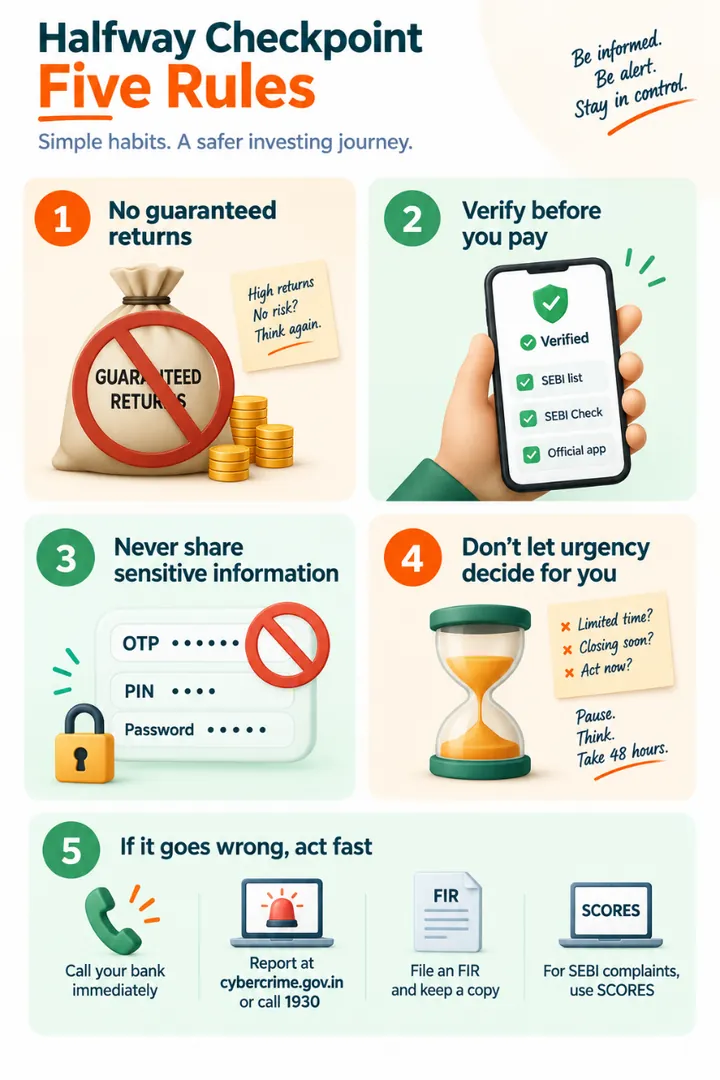
Not a fund manager, not an adviser, not an app, not SEBI. A guaranteed or “assured” return in the securities market is the single most reliable sign of a fraud. Bank deposits and small savings schemes carry fixed rates; market-linked investments never do. Anyone who blurs that line is telling you something about themselves.
Rule 2 — Verify before you pay, every single time
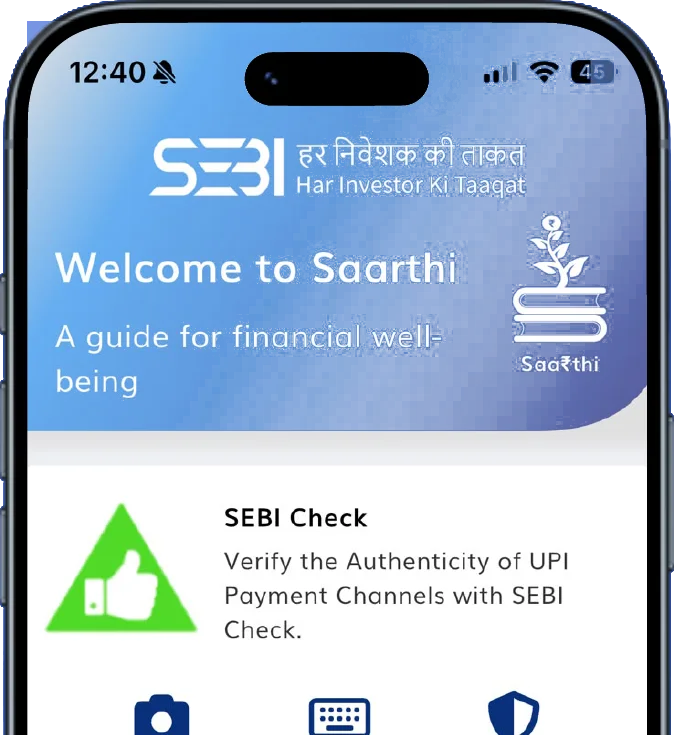
Before money leaves your account, check the entity on the SEBI intermediary lists at sebi.gov.in, and check the collection account on SEBI Check. A registered intermediary’s UPI handle carries the @valid suffix and a thumbs-up indicator in your payment app. An app should come from an official store listing with the verified label. This takes two minutes and it is the highest-value two minutes in this book.
Rule 3 — Never share an OTP, PIN or password, and never sign a blank form
No genuine intermediary, bank or regulator will ever ask for an OTP. Not for a refund, not for verification, not for a “reversal”, not to release your own money. Never sign a blank delivery instruction slip.
Rule 4 — Urgency is the weapon
Every fraud needs you to act before you think. A closing window, a limited allotment, a price about to move, a penalty if you delay. Genuine investments are still there in forty-eight hours. Make the forty-eight-hour rule absolute: no money moves on the day you first hear about something.
Rule 5 — If it goes wrong, act within hours
- Call your bank immediately and freeze the account or block the card
- Report at cybercrime.gov.in or call the helpline 1930 — the first few hours decide whether money can be held
- File an FIR and keep a copy
- For a complaint against a SEBI-registered entity, escalate through SCORES at scores.sebi.gov.in
What comes next
Part 5 — Investing Directly: Shares, Bonds and Government Schemes. Buying shares directly, applying for IPOs, bonds and government securities, and the government-backed schemes — PPF, NSC, SCSS, Sukanya Samriddhi and NPS.
Part 6 — Staying Invested. Reading your statements, the ten biases that cost investors money, herd behaviour at market extremes, restarting after you have stopped, tax, and the nomination and transmission paperwork that decides whether your family can actually reach what you built.
Part 7 — Protecting Yourself. How frauds are constructed, how to verify anyone, and exactly how the complaint and online dispute resolution machinery works.
Everything from here assumes everything before it. There is no prize for hurrying.