Where this fits: You have chosen a scheme. This chapter is about how to put money in, move it around, and take it out — systematically.
By the end of this chapter you will be able to
- Set up a SIP and explain what rupee cost averaging does and does not do
- Use an STP to move money gradually between schemes
- Use an SWP to generate regular income without dismantling your portfolio
Three facilities, one principle
All three are mechanisms for doing something in fixed instalments rather than all at once.
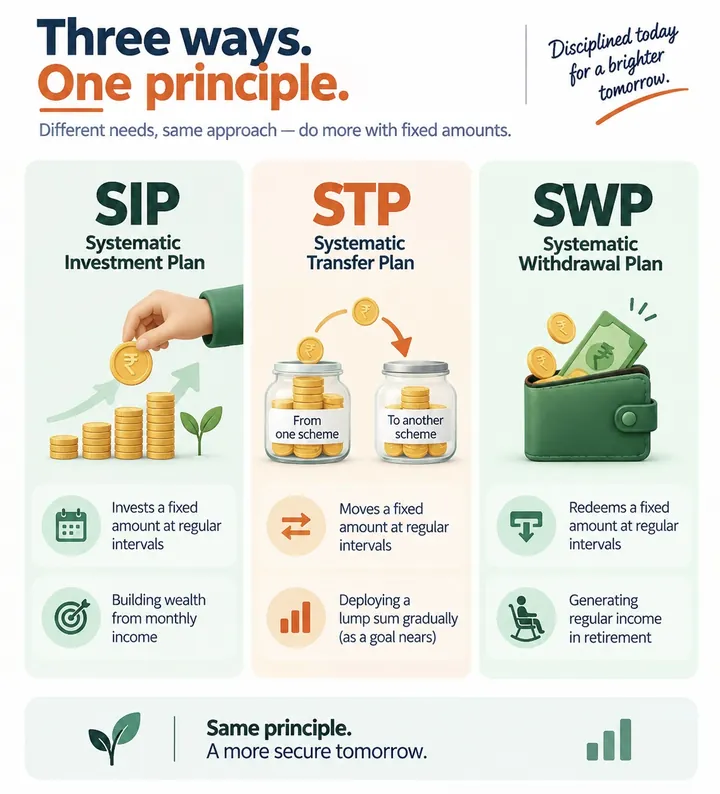
| Facility | What it does | Typically used for |
|---|---|---|
| SIP — Systematic Investment Plan | Invests a fixed amount at fixed intervals | Building wealth from monthly income |
| STP — Systematic Transfer Plan | Moves a fixed amount from one scheme to another at fixed intervals | Deploying a lump sum gradually, or gliding out of equity as a goal nears |
| SWP — Systematic Withdrawal Plan | Redeems a fixed amount at fixed intervals and credits it to your bank | Generating regular income in retirement |
Systematic Investment Plan
A SIP invests a fixed sum at fixed intervals — usually monthly, sometimes weekly or quarterly — into a chosen scheme. Many schemes accept ₹500 a month; some accept less.
Setting one up
- Choose the scheme, amount, frequency and date
- Give a bank mandate — a one-time authorisation for the AMC to debit that amount
- Choose the date to fall within two days of your salary credit, so the money leaves before it can be spent
- Choose the tenure, or select “perpetual” and review it annually
You can pause, modify, increase or stop a SIP at any time. It is a facility, not a contract.
What a SIP actually achieves
It enforces the savings-first principle. The money leaves automatically. Automation beats willpower, and a SIP is that principle turned into a bank instruction.
It averages your purchase cost. Because your rupee amount is fixed, you buy more units when the NAV is low and fewer when it is high. This is rupee cost averaging.
| Worked Example — rupee cost averaging ₹6,000 invested on the same date for four months, into a falling and recovering market. | |||
|---|---|---|---|
| Month | NAV | Units bought | |
| 1 | ₹60 | 100.00 | |
| 2 | ₹50 | 120.00 | |
| 3 | ₹40 | 150.00 | |
| 4 | ₹60 | 100.00 | |
| Total invested: ₹24,000. Total units: 470. Average cost per unit: ₹24,000 ÷ 470 = ₹51.06 — while the simple average of the four NAVs is ₹52.50. More importantly, at the end of month 4 the NAV is exactly back where it started, yet the holding is worth 470 × ₹60 = ₹28,200 against ₹24,000 invested. The fall in months 2 and 3, which felt like bad news at the time, is where the gain came from. |
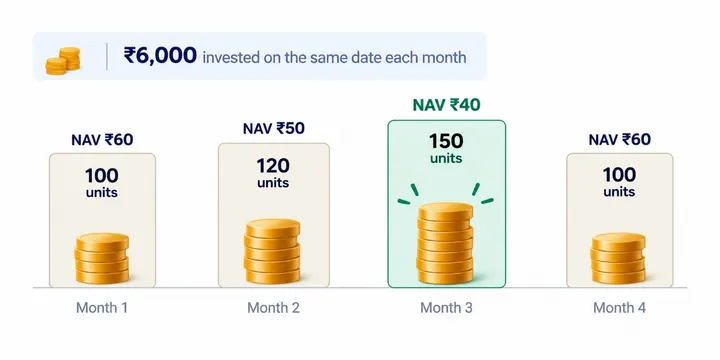
Figure 12 The same ₹6,000 each month. ₹24,000 bought 470 units at an average of ₹51.06, against a simple average NAV of ₹52.50 — the fall in month 3 did the work.
It removes market timing from the decision. You never have to judge whether today is a good day to invest. Over a long period you will have bought at every level.
What a SIP does not do
It does not guarantee a profit. If the market falls throughout your investment period and is still down when you need the money, you will have a loss. Rupee cost averaging improves your average entry price; it does not make markets rise.
It does not always beat a lump sum. In a market that rises steadily throughout, investing everything at the start would have done better. A SIP is not a return-maximising strategy — it is a risk-management and behaviour-management strategy, and it fits how salaried people actually receive money.
It does not work if you cancel it. The entire mechanism depends on continuing to invest during the periods when it feels worst. A SIP stopped in month 2 of the example above would have captured the fall and none of the recovery. The psychology of this is dealt with later, because it is where most SIPs actually die.
Step-up SIP
Most platforms allow a step-up or top-up SIP that increases your instalment automatically each year — by a fixed percentage or a fixed amount.
This is the single highest-value setting most investors never switch on. Your income rises over time. If your investment does not, your savings rate silently falls every year.
| Worked Example — what a 10% annual step-up does ₹10,000 a month for 20 years at 12% a year. | ||
|---|---|---|
| Approximate final value | ||
| Flat ₹10,000 throughout | ₹1.00 crore | |
| With 10% annual step-up | ₹1.90 crore | |
| The step-up nearly doubles the outcome — and each individual annual increase is small enough to be barely noticeable against a rising salary. (Illustrative, assuming a constant 12% return.) |
Systematic Transfer Plan
An STP moves a fixed amount from one scheme to another at fixed intervals, within the same fund house. There are two main uses.
Deploying a lump sum gradually
Suppose you receive ₹12,00,000 — a bonus, a maturity, a sale. Putting it all into equity in one day exposes the entire amount to whatever the market does next month.
Instead: park it in a liquid or ultra-short duration fund, and set up an STP transferring ₹1,00,000 a month into your chosen equity fund for twelve months. The money that has not yet transferred earns something in the debt fund, and your equity entry is spread across twelve different market levels.
Gliding out of equity as a goal approaches This is the glide path, automated.
If your goal is two years away and your money is in equity, a single large fall in the final year could take a substantial part of your corpus at precisely the moment you have no time left to recover.
Set up an STP moving a fixed amount each month from the equity fund into a short duration debt or liquid fund over the final eighteen to twenty-four months. By the goal date, the money is safe. You have captured most of the growth of the long period and removed the endgame risk.
A tax point: an STP is a redemption from one scheme and a purchase in another. Each transfer is therefore a taxable event on the redeemed portion, and exit load may apply. The tax treatment is covered later. This does not make STPs a bad idea; it means you should be aware of it and plan the timing.
Systematic Withdrawal Plan
An SWP redeems a fixed amount from your scheme at fixed intervals and credits it to your bank account.
This is the retirement tool. Instead of holding an IDCW plan and receiving whatever the scheme decides to declare, you hold a Growth plan and instruct the fund to send you a fixed amount every month — ₹30,000, say — regardless of market conditions.
Why it is generally better than IDCW:
- You control the amount. IDCW distributions are irregular and not guaranteed; an SWP pays what you specify.
- You control the timing. Monthly, quarterly, whatever suits your household.
- It is usually more tax-efficient. Each SWP instalment is a redemption, and only the gain portion of it is taxed as capital gains. An IDCW distribution is generally taxed as income in your hands at your slab rate. For most retirees, the first treatment is better. Verify against the current rules before you rely on this.
- The remainder keeps compounding. Only what you withdraw leaves; the rest stays invested.
The one thing to watch: if your withdrawal rate exceeds what the portfolio earns, you are consuming capital, and the corpus will eventually run out. Withdrawing ₹50,000 a month from a ₹50 lakh corpus is a 12% annual withdrawal rate, which is almost certainly unsustainable. Model this before you retire, not after.
Which to use when
| Your situation | Facility |
|---|---|
| Salaried, investing monthly from income | SIP, with annual step-up |
| Received a large lump sum | Park in liquid fund, STP into target scheme over 6–12 months |
| Goal is 18–24 months away | STP from equity into short duration debt |
| Your situation | Facility |
| Retired, need monthly income | SWP from a Growth plan |
| Income has risen | Increase the SIP, or switch on step-up |
Recap in one minute
- A SIP invests a fixed amount at fixed intervals; it enforces discipline, averages your cost and removes market timing.
- Rupee cost averaging lowers your average entry price. It does not guarantee a profit or always beat a lump sum.
- Switch on the annual step-up. Over twenty years it can nearly double the outcome.
- An STP deploys a lump sum gradually, and automates the glide out of equity as a goal approaches.
- An SWP generates controlled, usually tax-efficient regular income from a Growth plan, while the balance keeps compounding.
Check your understanding
In the rupee cost averaging example, why did the investor gain even though the NAV ended exactly where it began?
Show answer to question 1
Because the fixed rupee amount bought more units when the NAV was low in months 2 and 3. Those extra units are worth ₹60 each at the end, so the total holding exceeds the total invested.Manoj receives ₹15 lakh and wants it in equity for a long-term goal. What would you suggest, and why not invest it all on Monday?
Show answer to question 2
Park it in a liquid fund and set up an STP into the equity fund over 6 to 12 months. Investing everything on one day exposes the entire amount to whatever the market does immediately afterwards.Why is an SWP from a Growth plan usually preferable to an IDCW plan for a retiree?
Show answer to question 3
Because an SWP gives control over the amount and timing, is usually more tax-efficient (only the gain portion of each redemption is taxed, rather than the whole distribution being taxed as income), and the balance keeps compounding.
Your action step
If you have a SIP, log in and check whether step-up is enabled. If not, enable it at 10% a year. If you do not yet have a SIP, set one up today for an amount small enough that you will not be tempted to cancel it — the amount matters far less than the start date.