Where this fits: The last chapter ended by claiming that saving alone is not enough. This chapter proves it.
By the end of this chapter you will be able to
- Explain in one sentence what inflation does to money
- Calculate a real return and say whether an investment is actually gaining or losing
- Explain why a goal that costs ₹10 lakh today will not cost ₹10 lakh when you reach it
A question about milk
In 2015, a packet of milk cost around ₹20. Ten years later the same packet costs around ₹60.
The milk did not improve. The packet did not get bigger. What changed is the value of the rupee. In 2015 a ₹100 note bought five packets. Today it buys fewer than two.
That is inflation, and it is the reason this book exists.
What inflation is
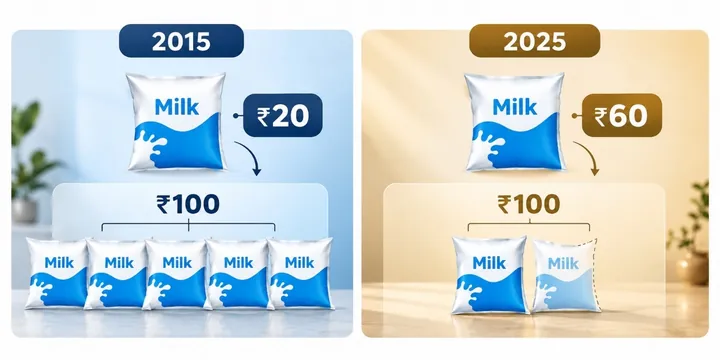
Inflation is the general rise in the prices of goods and services over time. Its practical effect is that money loses purchasing power — the quantity of real things a given amount of money can buy. Notice the direction of the loss. The number on the note does not change. Your bank balance does not fall. Nothing appears on any statement. You simply find, year after year, that the same money does less. This is why inflation is described as a silent thief: there is no moment of theft to notice.
Why prices rise
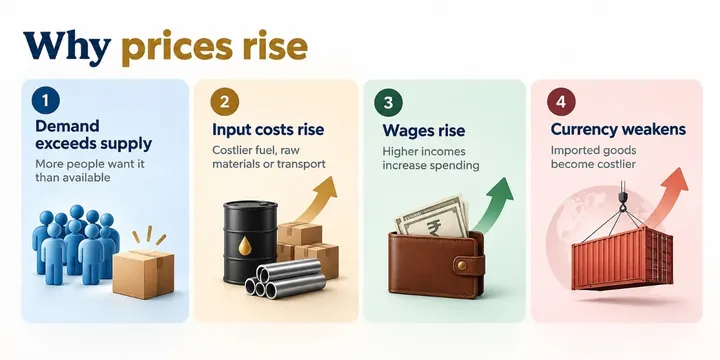
| # | Cause | What happens | |
|---|---|---|---|
| 1 | Demand exceeds supply | When more people want a good than there is supply, sellers raise prices | |
| 2 | Input costs rise | Costlier fuel, raw materials or transport push up the price of the finished good | |
| 3 | Wages rise | Higher incomes increase spending, which raises demand and therefore prices | |
| 4 | Currency weakens | Imported goods — crude oil, electronics, edible oils — become costlier in rupee terms |
In India, the Reserve Bank of India is charged with keeping consumer price inflation within a target band, and it uses interest rates as its main tool. When you read that the RBI has raised or cut the repo rate, this is what it is responding to.
Nominal return and real return
This is the most useful piece of arithmetic in the whole chapter, and it takes one line.
Real return = Nominal return − Inflation rate
The nominal return is the number the bank or the fund advertises. The real return is what you actually gained in purchasing power. Only the second one buys anything.
That is the shortcut, and for a quick judgement it is good enough. The exact formula divides rather than subtracts, because inflation erodes the whole of your ending balance, not just the part you earned:
Real return = [(1 + Nominal return) ÷ (1 + Inflation rate)] − 1
Put both rates in as decimals — 7% is 0.07 — and convert the answer back to a percentage at the end. Taking the fixed deposit above: (1.07 ÷ 1.055) − 1 = 0.0142, or 1.42% a year, against the 1.5% the subtraction gives.
How far apart are they?
| Nominal return | Inflation | Shortcut | Exact formula |
|---|---|---|---|
| 7% | 5.5% | 1.50% | 1.42% |
| 3% | 6% | −3.00% | −2.83% |
| 12% | 6% | 6.00% | 5.66% |
The gap widens as the numbers get larger, and it always flatters the shortcut. At the levels most households deal with it is a fraction of a percentage point, so subtraction is perfectly adequate for answering the only question that usually matters: am I gaining or losing? Use the exact version when the figure is going to be compounded over many years.
Why it matters over a long horizon?
Take 12% nominal against 6% inflation. The shortcut says your purchasing power grows at 6% a year, the exact formula says 5.66%. Over twenty-five years, ₹10,00,000 of buying power becomes about ₹42,90,000 on the first assumption and about ₹39,60,000 on the second — a difference of roughly ₹3,30,000, produced entirely by a third of a percentage point.
Worked Example — two accounts, one loss
Ramesh keeps ₹5,00,000 in a savings account paying 3% a year. Inflation over that year is 6%.
- After one year his balance is ₹5,15,000. The number went up.
- Real return = 3% − 6% = −3%
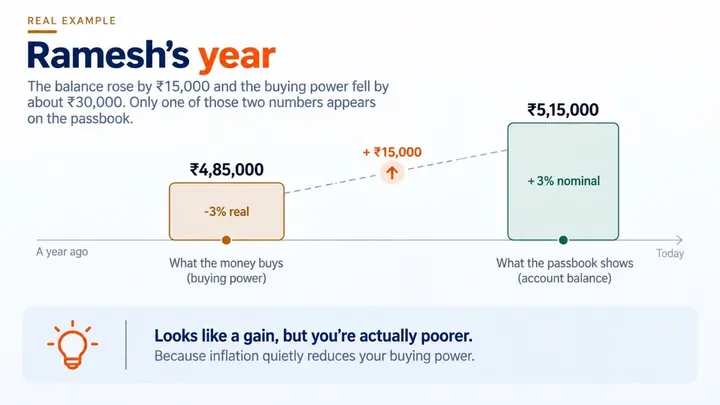
- In purchasing-power terms, his ₹5,00,000 is now worth about ₹4,85,000 in last year’s money.
Figure 3 Ramesh’s year. The balance rose by ₹15,000 and the buying power fell by about ₹30,000. Only one of those two numbers appears on the passbook.
Inflation makes goals move
Here is the consequence that matters most for planning.
If a college course costs ₹10,00,000 today, and education costs rise at 8% a year, then in fifteen years the same course will cost roughly ₹31,70,000. If you save towards a target of ₹10 lakh, you will arrive with less than a third of the fees.
Every long-term goal must be costed in future rupees, not today’s rupees. A retirement plan built on today’s grocery bill will fail. The next chapter gives you the tool for doing it properly.
Notice also that different categories inflate at different rates. Over long periods in India, medical treatment and private education have typically risen faster than the general consumer price index, while the prices of electronics and some manufactured goods have risen slowly or even fallen. When planning a specific goal, think about that goal’s own inflation, not the headline number.
How to protect yourself?
There is only one defence, and it has three parts.
Do not hold long-term money in cash or low-yield accounts: Money you will not need for five years should not be sitting where it earns 3%.
Own assets that can grow faster than prices: Historically, over long periods, ownership assets — equity shares, equity mutual funds, real estate, gold — have had a better chance of outpacing inflation than fixed-return instruments. None of them is guaranteed to do so in any given year, and all of them fluctuate. But over a decade, they are the only realistic candidates.
Start early and stay invested: Time is what converts a modest annual advantage over inflation into a large one. The next chapter shows exactly why.
Watch Out — inflation does not pause because you are worried

Investors often move money out of growth assets into “safety” during frightening periods, intending to return later. Inflation continues throughout. Sitting in cash for three years during a nervous phase is not neutral — it is a guaranteed real loss, taken in exchange for the feeling of safety. The psychology behind this is dealt with in detail later in this book.
Recap in one minute
- Inflation is the general rise in prices; its effect is a fall in the purchasing power of money.
- Nothing on your statement ever shows the loss, which is why it goes unnoticed for decades.
- Real return = nominal return − inflation. Only the real return buys anything.
- Every long-term goal must be costed in future rupees, using that goal’s own inflation rate.
- The only defence is owning assets that have a realistic chance of growing faster than prices, for long enough to matter.
Check your understanding
A fixed deposit pays 7%. Inflation is 5.5%. What is the real return?
Show answer to question 1
1.5%. 7% − 5.5%, using the shortcut. The exact figure is 1.42%: (1.07 ÷ 1.055) − 1.Why can a person’s bank balance rise every year while they become poorer?
Show answer to question 2
Because the balance grows at a slower rate than prices rise. The number of rupees increases; the goods those rupees can buy decreases.If school fees inflate at 9% a year, roughly what will a ₹2,00,000 annual fee cost in eight years? (Hint: at 9% a year, money roughly doubles in eight years.)
Show answer to question 3
At 9%, costs double in about 8 years (72 ÷ 9). So roughly ₹4,00,000.
Your action step
Find one household bill from about five years ago — an electricity bill, a school fee receipt, an insurance premium notice. Compare it with today’s. Write down the percentage increase. That number is your personal inflation rate for that item, and it is more relevant to you than any published figure.